Guides
Part of How to plan industrial heritage travel before you book anything
Industrial Heritage Trip Planning: Questions to Settle Before You Book a Stop
Six questions to settle before booking an industrial heritage stop, plus a source test and a worked example that fixes three weak itinerary lines for Lowell's cotton mills.
What to take away
- Settle six things before you bookwhat the stop shows, what your source covers, who publishes current access, how tickets and seasons work, what safety rules apply, and what replaces the stop if it fails.
- A listing or history page proves a place matters. Only the operator's current visitor page shows what you can do there.
- Check the date on the page. The same park can have one page updated in October 2026 and another with empty hours and fees sections.
- Word an itinerary line so it names the building, the activity and the check date. "Mill tour" is not a plan.
- When access is unclear, mark the stop unresolved and keep a fallback. Do not fill the gap with a guess.
Six questions to settle before you book
- What does the stop showa live process, a demonstration, a preserved structure or a collection?
- What does your source covera region, a collection, a listing or one site's visitor program?
- Who publishes current hours and access, and when was that page last updated?
- Is entry free, ticketed, timed or seasonal, and where are tickets sold?
- What safety and access rules apply, and does the operator say who supplies protective gear?
- If the date, the tour or the access fails, what replaces it?
Keep two lists. One holds the history you will cite. The other holds the live facts you will act on. A history source cannot tell you whether a building opens on a Tuesday. If you want a shorter prompt list for a first trip, see our industrial heritage questions guide.
Test whether a source supports the claim
Run each source through the same five tests before it carries a line in your plan.
| Test | What a clear answer settles | What stays open |
|---|---|---|
| Scope: what does it describe? | The size of claim it can carry, from one building to a region | Whether a named stop takes visitors |
| Type: listing, history or visitor program? | Whether it proves significance or access | Rules at other sites |
| Currency: when was it updated? | The tense you may use | Closures since that date |
| Named place: does it name your exact stop? | Whether a site-specific claim is safe | How the stop fits the wider story |
| Gaps: what does it leave out? | The next source you need | Nothing, until you find it |
Federal designations are the classic scope trap. The National Park Service states that National Register listing does not require public access. It also says National Historic Landmark designation does not necessarily make a property open, and that visitors should contact the landmark directly. Our guide to National Register lists of American industrial sites explains how to read those lists as research, not as opening hours.
For a mill village or company town that no park manages, the National Register questions go to the state. The NPS publishes a list of State Historic Preservation Offices, which survey and nominate historic places and can explain how the process works in their state. They are a source for history and designation. They are not a ticket office.
Worked example: three weak lines about a textile mill
Lowell National Historical Park in Massachusetts is a useful test because it has a weave-room exhibit, ticketed and free parts, and several pages with different update dates. The three lines below are typical first drafts. Each is fixed from the park's own pages.
Weak line 1: "Lowell. See the working mills. Open daily."
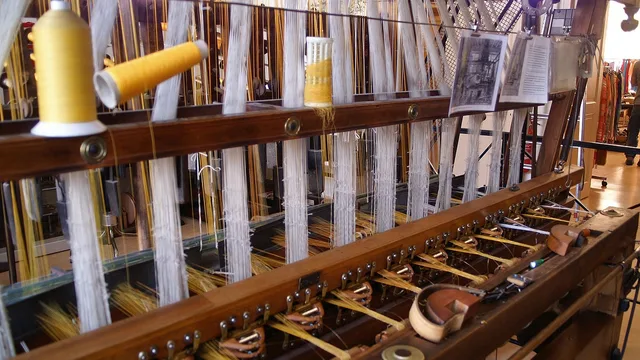
The problem is the word "working" and the word "daily". The Boott Cotton Mills Museum page describes a weave room with over eighty historic power looms from the 1920s, still weaving cotton cloth, with ranger and weaver demonstrations. It lists hours of 9am to 4pm daily to November 28, 2026, and demonstrations of about 15 minutes at set times that the park says to check daily. These are historic looms in a museum, not current commercial production.
Fixed line: "Boott Cotton Mills Museum, weave room demonstration, checked [date] against the park page; times to confirm on the day."
Weak line 2: "Canal boat tour, walk up, about $12."
The park's fees page lists adult canal boat tickets at $12.00, sold through recreation.gov or by phone, with online sales closing the day before. Day-of tickets are first-come, first-served at the Visitor Center. The hours page for the autumn period does not include boat tour information, and it lists the Visitor Center as open only on Saturday and Sunday. So "walk up" may not work on a weekday, and the season is a separate question.
Fixed line: "Canal boat tour. Price from fees page. Confirm season and sales route with the park before choosing a date."
Weak line 3: "Suffolk Mill turbine exhibit, drop in any time."
The hours page says the Suffolk Mill Turbine Exhibit is open only during the ranger-guided Suffolk Mill Tour, Wednesday to Sunday at 2pm. A drop-in plan fails.
Fixed line: "Suffolk Mill Tour, Wednesday to Sunday 2pm per the park hours page. Tour needs a ticket; confirm at booking."
Notice what the fixes share. Each line now names the activity, points to the page that supports it, and says what to confirm. Our Lowell cotton mill tour guide and the New England textile mill overview give the wider picture.
Check how current the page is
Pages from the same operator can differ in age. The Lowell hours page was updated on October 18, 2026 and covers October 18 to November 28, 2026. Another Lowell page, the basic information page, carries a September 2025 update date, and its Operating Hours and Fees headings are only links to other pages. It also notes that snowstorms are common in winter and tells visitors to check the park site for updated hours.
Saugus Iron Works National Historic Site shows the same pattern. Its general visit page carries a February 2022 update date and gives no hours. Its basic information page lists a season, grounds open at all hours, and the museum, industrial site buildings and set program times from Wednesday to Sunday.
The rule: use the most specific, most recently updated page for each live fact, and write down the date you read it. If the page is silent, use the phone number or email it gives. The park lists (978) 970-5000 for Lowell tour reservations and (781) 233-0050 for Saugus.
Put it in order
Editorial suggestion for the sequence:
- Write the question the trip should answer.
- Pick one anchor and run the six questions on it.
- Test each source for scope, type, currency, named place and gaps.
- Write the itinerary line with activity, source and check date.
- Add a fallback that answers the same question and test its source the same way.
- Recheck within a week of travel. Our planning steps guide covers the order of the wider trip.
Editorial suggestion: keep one line per stop in your notes with three fields only: the claim, the page that supports it, and the date you read it.