Costs
What a US factory tour costs: free plants, paid museums and added fees
Factory tours USA costs: free plant visits still add parking and booking fees, while the Henry Ford, Lowell and Hershey charge set ticket prices.
What to take away
- Factory tours USA split into two price worldsfree working plants where you pay only parking and booking fees, and paid industrial museums with set tickets.
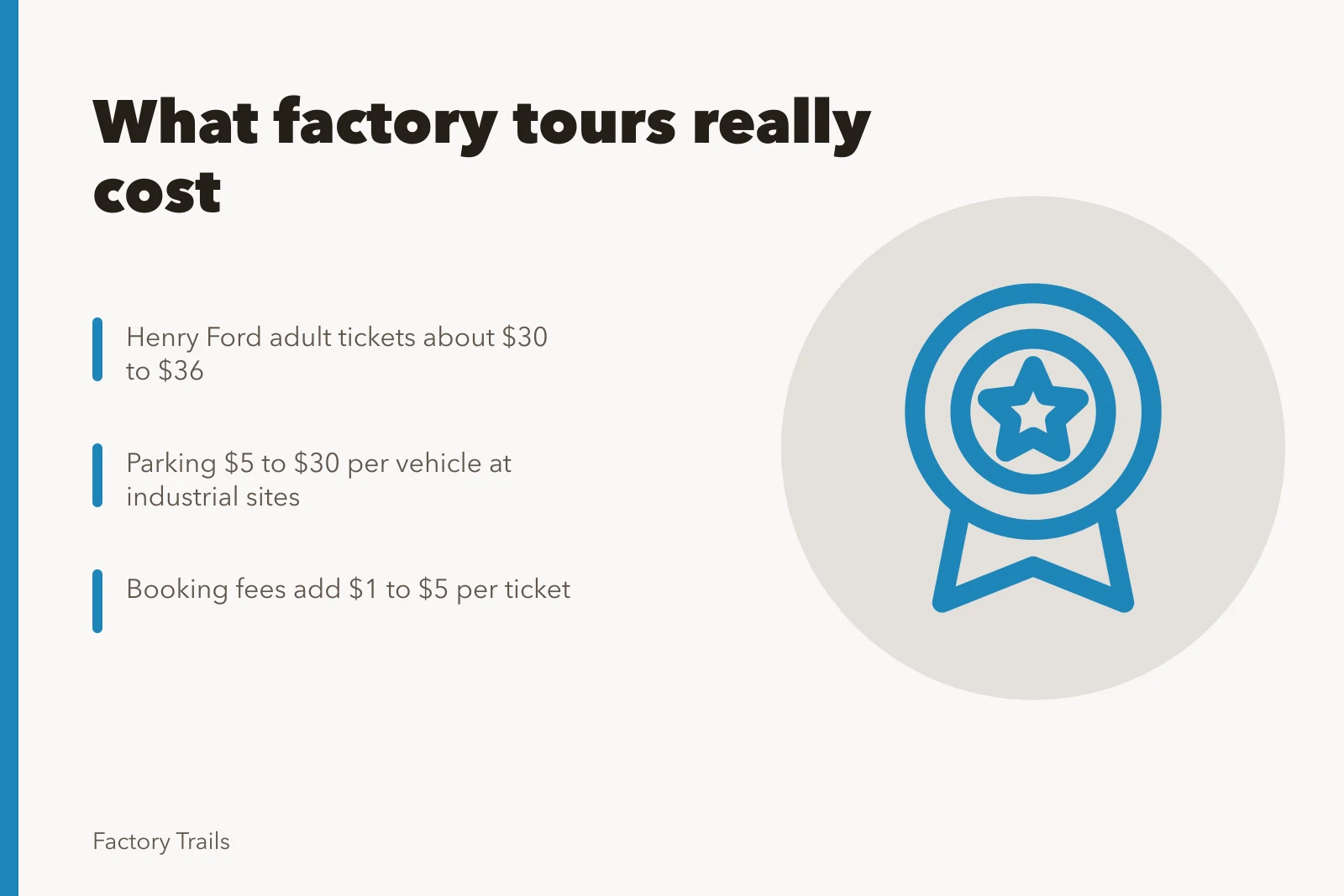
- The Henry Ford charges roughly $30 to $36 for adults, Lowell National Historical Park tours are free or low cost, and Hershey's Chocolate World admission is free with paid add-ons.
- Parking runs $5 to $30 per vehicle at major industrial sites, and online booking fees often add $1 to $5 per ticket.
- Shutdown season, retooling weeks and winter closures cut or suspend factory tours USA schedules, so off-peak rates can drop or disappear entirely.
- A realistic per-person factory tour budget line is $0 to $45 in tickets, plus $2 to $8 in parking and fees when shared.
- Confirm dates, age limits and reservation rules before you book anything, because plant tours close for maintenance without much notice.
What a free US plant tour actually costs once parking and booking fees land
A free factory tour is rarely zero dollars. The ticket line reads $0, then parking, reservation fees and sometimes a timed-entry surcharge appear at checkout.
Hidden Costs of Free Tours
- Self-parking$5-$15
- Urban parking$20-$30
- Booking fee$1-$5
- Family booking total$10
- Budget per vehicle$5-$20
Start with the parking structure. At large plants and industrial museums, self-parking is commonly $5 to $15 per vehicle. Urban sites in Chicago, Detroit, Pittsburgh and Los Angeles push toward $20 to $30.
Booking fees are the second hidden line. Many plants use third-party reservation systems that charge $1 to $5 per ticket, or a flat convenience fee per order. A family of four can add $10 before the tour starts.
Some free tours require a refundable deposit or a no-show fee. If you miss your slot, that deposit can be kept, which turns a free tour into a paid one after the fact.
Government-run heritage sites follow a different pattern. The National Park Service manages several industrial sites, and its fees vary by park rather than by plant. USAGov's government overview explains which federal agencies run national heritage sites and monuments, which helps you predict whether a site charges entry.
For a structured pre-trip checklist, see our guide to cost planning for U.S. visitors. It walks through what to confirm before booking.
Budget rule: treat a free plant tour as a $5 to $20 outing per vehicle, not a $0 outing. That covers parking, a booking fee and a snack.
Ticket prices at the Henry Ford, Lowell and Hershey's Chocolate World
These three sites show the range of factory tours USA pricing. One is a major paid museum complex, one is a federal heritage park, and one is a free admission attraction with paid extras.
Three Factory Tour Price Models
Henry Ford
- Adult ticket
- $30-$36
- Add-on
- Rouge $10-$15
- Parking
- Free
- Family of four
- $80-$120
Lowell NHP
- Adult ticket
- Free grounds
- Add-on
- Boott Mills under $10
- Parking
- Not stated
- Family of four
- Low cost
Hershey's
- Adult ticket
- $0
- Add-on
- Paid extras
- Parking
- Free
- Family of four
- Extras only
Henry Ford ticket prices in dollars
The Henry Ford in Dearborn, Michigan, is the benchmark paid industrial museum. Adult tickets generally run about $30 to $36, depending on the season and whether you buy online. Youth and senior rates are lower, and children under a certain age often enter free.
A separate ticket is usually needed for the Ford Rouge Factory Tour, which is the working-plant experience. That add-on commonly costs around $10 to $15 per person on top of museum admission. Buying the combo online is usually cheaper than buying at the gate.
Expect to spend $80 to $120 for a family of four if you do both the museum and the Rouge tour. Parking at the complex is typically free, which offsets the ticket cost.
Lowell National Historical Park fees
Lowell National Historical Park in Massachusetts is the federal model. Entry to the park grounds is free. The visitor center, the canals and the mill district walking areas cost nothing.
Trolley rides and some ranger-led programs are free or low cost. The Boott Cotton Mills Museum charges a modest admission, generally under $10 for adults, with lower youth rates. That fee covers the working looms exhibit.
Because Lowell is a National Park Service site, fees can change with federal rules and notices. The Federal Register's money category tracks rules and notices with cost implications for plant tour fees and similar charges.
Hershey's Chocolate World admission
Hershey's Chocolate World in Hershey, Pennsylvania, is free to enter. The signature Chocolate Tour ride is also free, which makes it one of the cheapest factory-themed stops in the country.
Paid add-ons are where the money goes. The create-your-own chocolate bar experience typically runs about $20 to $30 per person. The 4D movie, trolley works tour and chocolate tasting packages each carry separate fees, often $10 to $20.
A family can visit Hershey's Chocolate World for $0 in admission and spend $60 to $100 on add-ons. Parking at the site is generally free.
| Site | Base admission | Key add-on | Typical adult total |
|---|---|---|---|
| The Henry Ford, Dearborn, MI | $30 to $36 | Rouge Factory Tour, $10 to $15 | $40 to $51 |
| Lowell National Historical Park, MA | Free grounds | Boott Mills Museum, under $10 | $0 to $10 |
| Hershey's Chocolate World, PA | Free | Create-your-own bar, $20 to $30 | $0 to $30 |
Added fees: parking, reservation charges and timed-entry surcharges
Added fees decide whether a cheap tour stays cheap. Three lines matter most: parking, reservation charges and timed-entry surcharges.
Added Fees to Budget For
- Rural parking$0
- Suburban parking$5-$15
- Downtown parking$15-$30
- Reservation fee$2-$5
- Timed-entry surcharge$2-$10
- Audio guide$5-$10
- Guided upgrade$10-$25
Parking fees at industrial sites generally fall into three tiers. Rural plants often park free. Suburban museums charge $5 to $15. Downtown sites charge $15 to $30 or more.
Reservation charges come from ticketing platforms. A $2 to $5 per-ticket fee is common, and some systems add a flat order fee. Always check the final checkout screen, not the listed price.
Timed-entry surcharges apply at busy plants and museums. Peak weekend slots can cost $2 to $10 more than weekday slots. Some sites charge extra for holiday weekends and school breaks.
Other add-ons to watch: audio guides at $5 to $10, guided upgrades at $10 to $25, and locker or bag fees at secured plants. Working plants with security screening may charge for storage.
If a plant is regulated for safety, tour rules can affect cost too. The federal agency index lists the departments and agencies behind factory tour rules and fees, including safety and environmental bodies.
Keep a simple rule: add 15 to 25 percent to the advertised ticket price to cover fees. That buffer handles parking, booking and one small extra.
Shutdown-season rates and why off-peak factory tours USA pricing drops
Shutdown season is the quiet period when plants retool, repair lines or cut production. Tours pause or shrink, and pricing reacts.
Shutdown Season Tour Availability
- Summer shutdown weeksAutomotive plant tours stop
- Model changeoversPublic tours pause
- Winter weekdaysMuseum prices drop 10-20%
- Off-peakFederal sites no discount, fewer crowds
Automotive plants in Michigan, Ohio and Alabama commonly stop public tours during model changeovers and summer shutdown weeks. When tours resume, some sites offer lower off-peak rates or bundled discounts.
Museums follow demand instead. Winter weekdays at the Henry Ford and similar sites often carry lower online prices than summer weekends. Off-peak discounts of 10 to 20 percent are common.
Federal sites behave differently. Lowell and other National Park Service industrial sites generally do not discount, because entry is already free or low cost. Instead, off-peak means fewer crowds and easier reservations.
Shutdown season also removes options. A plant that closes tours for two weeks in July or December simply cannot be booked, no matter the price. Check schedules before you plan a route.
Off-peak travel has a second saving: hotels and flights drop in the same weeks. That is where the real factory tours USA savings sit, not in the ticket line. For a method to record these swings, see our notes on cost notes that hold up.
Comparing paid industrial museums with free working plant visits
Paid museums and free plant tours deliver different things. Knowing which you want prevents wasted money.
Free Plant vs Paid Museum
Free Plant Tour
- What you see
- Live production
- Cost per hour
- Favors free plants
- Accessibility
- Stairs, standing
- Reliability
- Can cancel
- Photography
- No photos
Paid Industrial Museum
- What you see
- Preserved exhibits
- Cost per hour
- Higher ticket
- Accessibility
- Elevators, seating
- Reliability
- Rarely cancels
- Photography
- Allowed
A free working plant tour shows a live process. You see actual equipment, real workers and current production. The trade-offs are strict rules, no photography, limited dates and often no walk-ins.
A paid industrial museum shows context. The Henry Ford, the Smithsonian's National Museum of American History and similar institutions preserve machines, archives and exhibits. You can linger, photograph and bring children.
Cost per hour favors free plants. A $0 ticket for a 60 to 90 minute tour beats a $35 museum ticket for a half day, unless you use the whole day.
Accessibility favors museums. Free plant tours often require stairs, closed shoes, age minimums and standing for long periods. Museums offer elevators, seating and restrooms.
Reliability favors museums. Plants cancel tours for production needs, safety audits or maintenance. Museums rarely cancel.
A practical split: book one paid museum as your anchor, then add free plant tours nearby. In Michigan, pair the Henry Ford with a free plant tour. In Pennsylvania, pair Hershey's Chocolate World with a free regional plant. In Massachusetts, pair Lowell with a free mill or brewery tour.
For the common trip errors that raise these costs, see costs, transport, stays and tickets.
Building a per-person factory tour budget line for a US trip
A budget line is a single number per person per day for tours. Build it once, then reuse it for every stop.
Family Tour Budget Example
- $172Henry Ford museum + Rouge
- $50Hershey's extras
- $30Lowell Boott Mills + parking
- $23Per person per day
Worked example: a four-person family, two adults and two children, doing three tours in one week.
Building a per-person factory tour budget line
- Pick the anchorThe Henry Ford museum plus Rouge Factory Tour. Adults at $36 plus $15 equals $51 each. Children at reduced rates, roughly $25 plus $10, equals $35 each. Family total: $172.
- Add the free stopHershey's Chocolate World. Admission $0. Two create-your-own bars at $25 equals $50. Parking $0. Family total: $50.
- Add the federal stopLowell National Historical Park. Grounds free. Boott Mills Museum at $6 per adult and $4 per child equals $20. Parking $10. Family total: $30.
- Add booking feesthree orders at $3 each equals $9. Add a $15 buffer for timed-entry surcharges and snacks.
- Divide by four people and three tour days$276 divided by 12 person-days equals about $23 per person per day.
That $23 figure is your budget line. Adjust it for shutdown season, when museum prices may drop 10 to 20 percent, and for peak weekends, when they may rise.
Use this checklist before you commit money.
- Confirm the plant is running tours on your dates, not shut down for retooling.
- Check age minimums and closed-shoe rules for each working plant.
- Price parking at each site, downtown sites cost far more.
- Read the checkout screen for booking and timed-entry fees.
- Buy online in advance when it is cheaper than the gate.
- Keep one backup museum in case a plant tour cancels.
- Note whether the site is federal, state or private, because fee rules differ.
For a wider planning frame, including capacity limits at popular plants, see our cost map and capacity notes.
Federal trip basics, from passports to park passes, sit on the USAGov travel page. Use it to plan the surrounding trip, then layer tour costs on top.