Rules
How OSHA rules shape visitor access on working factory floors
Factory tours USA access follows 29 CFR 1910 subpart D, 1910.132 PPE rules, state plan wording and the induction briefings plants give visitors.
What to take away
- OSHA rules reach the people standing on a working floor, so a plant that opens a tour manages visitor exposure like any other hazard.
- Your route is a walking-working surfaces question first, under 29 CFR 1910 subpart D, which is why so many tours run behind glass.
- Under 1910.132 the employer picks the PPE and normally pays for it.
- Michigan runs a full State Plan through MIOSHA. Pennsylvania's covers public employees only, so private plants there answer to federal OSHA.
- Expect a short induction, a signed acknowledgement and an escort who owns every boundary.
OSHA's reach over visitors on a factory floor
The OSH Act protects employees, not tourists. On a working floor the two blur: a visitor beside a stamping press meets the same noise and struck-by exposure as the operator six feet away.
Employers read the agency's guidance the same way, and that reading becomes inductions, escorts and marked walk lines. No OSHA standard states that factory tours are permitted.
Walking-working surfaces decide your tour route
29 CFR 1910 subpart D covers floors, fixed stairs, ladders, dockboards, floor openings and the guardrails around open pits. A route across a mezzanine above a stamping line is a subpart D question before it is a marketing decision.
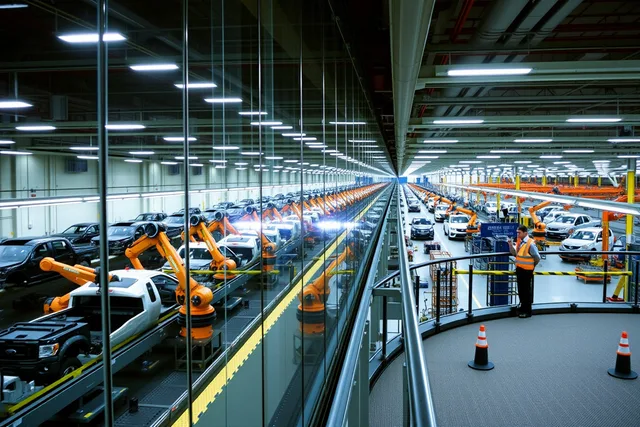
Handrails at a consistent height, toe boards and a painted walk line are the visible parts. A glass gallery is a viewing corridor instead, so the plant controls what you touch and where you stand.
[figure 1]
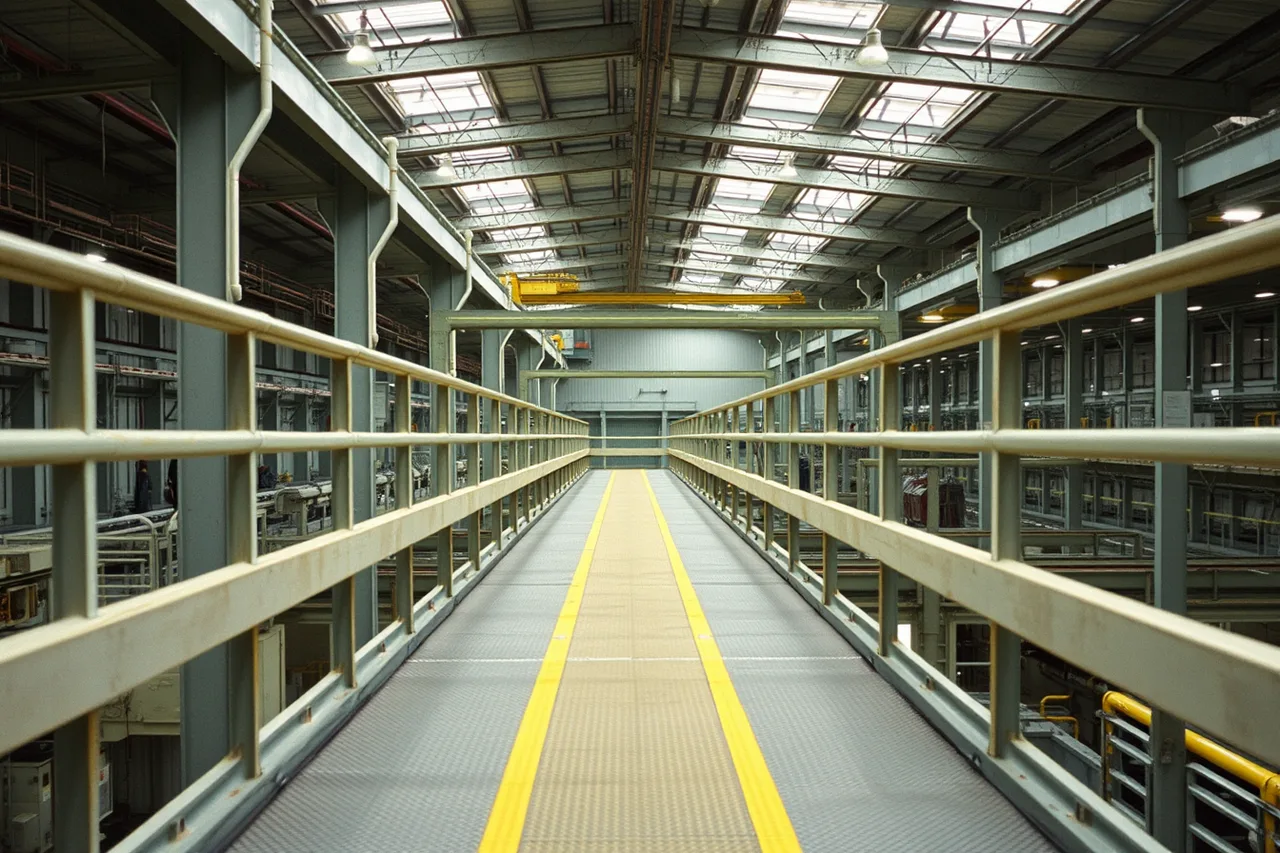
In an assembly plant the aisle marked for you runs beside the truck lane, never in it. Food plants with wet floors often keep visitors on dry elevated walkways.
New paths need inspection before use, so rerouting a tour takes time. Anyone weighing a route for a wheelchair or a cane gets a fuller answer in how route, noise and stairs decide accessibility.
PPE under 1910.132 and who pays
1910.132 opens with a hazard assessment. The employer identifies the hazards on the route, then selects the protection.
Safety glasses come first on most tours, often over-glasses for prescription frames. Hearing protection follows in stamping, forging and bottling areas. Hard hats appear near overhead loads.
Footwear is what visitors get wrong most often. Many plants require closed-toe, flat, rubber-soled shoes and turn away sandals at the desk.
Under 1910.132, employers must provide and pay for most required PPE, with narrow exceptions such as non-specialty safety footwear. Lifting your safety glasses in a grinding area is exactly what an escort stops.
Visitor cost and fees are covered in how to budget factory tour safety across U.S. plants.
Example: a Michigan assembly plant visitor kit
A visitor books a public tour at a Michigan assembly complex. The desk issues safety glasses, ear plugs, a high-visibility vest and a lanyard.
Inside, the escort keeps the group on a marked walkway beside the forklift lane and stops at a viewing platform above the final line. Nobody steps onto the production floor. The kit returns to the same desk, because it is accountable property.
What the Letters of Interpretation do and do not settle
Letters of Interpretation are the agency's written answers to how a standard applies in one situation.
The letters tour planners meet most often concern employer payment for PPE under 1910.132. They set out what a plant must buy and what it may ask a visitor to supply. Others address whether a person on site counts as a covered employee.
No letter says factory tours are allowed. The archive is searchable by standard number, a fair first stop for anyone questioning a visitor policy: Letters of Interpretation.
Michigan, Pennsylvania and who enforces what
Approved State Plans must match the federal program, but their scope decides which citation lands on your induction sheet.
Michigan runs a full plan covering private and public employers, administered by the Michigan Occupational Safety and Health Administration, MIOSHA, under Public Act 154 of 1974.
Pennsylvania's plan is narrower. It covers state and local government employees only and is run by the Pennsylvania Department of Labor and Industry. A private factory there is inspected by federal OSHA.
| Item | Michigan (full plan) | Pennsylvania (public employees only) | Federal OSHA states |
|---|---|---|---|
| Private factory inspection | MIOSHA | Federal OSHA | Federal OSHA |
| Citation on the induction sheet | State rules approved by OSHA | 29 CFR 1910 | 29 CFR 1910 |
| Poster on the wall | State version | Federal version | Federal version |
| Complaint route | MIOSHA | Federal OSHA | Federal OSHA |
So a Pennsylvania induction cites federal standards, while a Michigan sheet may cite state rules and a state complaint line. State Plans lists which programs cover private employers.
Waiver wording differs too, and state factory tour waivers compared across Pennsylvania and Michigan sets out what each form asks you to sign.
Building an induction that holds up
An induction is the record that proves the plant told you the rules. A defensible version is short and signed, and it names the route, the gear, the escort and the prohibited actions.
- State the route and its boundaries, including where visitors may not go.
- List required PPE and the rule for removing it.
- Name the escort and the ratio, commonly a typical range of 10 to 20 visitors per escort on public tours.
- Cover alarms, exits and the outdoor meeting point.
- List prohibited actions such as photography and stepping off the walk line.
- Record the briefing with a signature and a date.
What to confirm before you book is gathered in the factory tour safety checklist for U.S. visitors.