Rules
Part of Confirmed access, not a brochure, is what an industrial tour operator sells
Vehicles and timing: what an industrial tour operator actually controls
Accessible options for industrial tour operators travelers: an operator controls its own vehicle and timing and cannot promise the surface at a private plant.
What to take away
- Separate what the operator controls from what the sites control. Ask each question of the right party.
- Operators can adjust timing, vehicles, group size and information. Plants cannot always adjust their floors.
- Service animals raise specific questions at industrial sites, and the answer is frequently no on the floor.
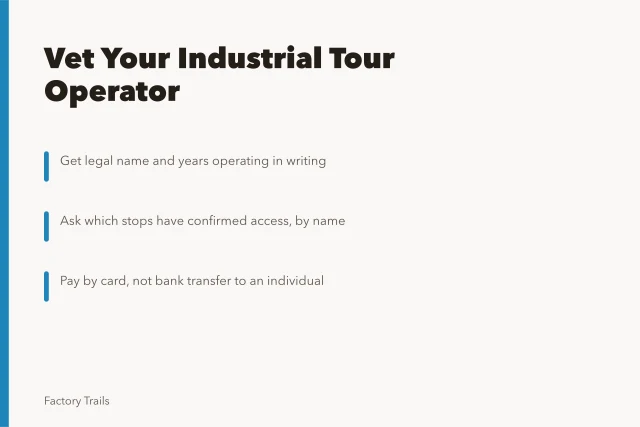
- Get the per-stop detail in writing before paying a deposit.
A multi-stop industrial tour crosses several owners in a day: the operator's vehicle, a museum, a private plant, a restaurant. Nobody controls all of them, which is why a single question about accessibility gets a vague answer.
Split it and the answers become specific.
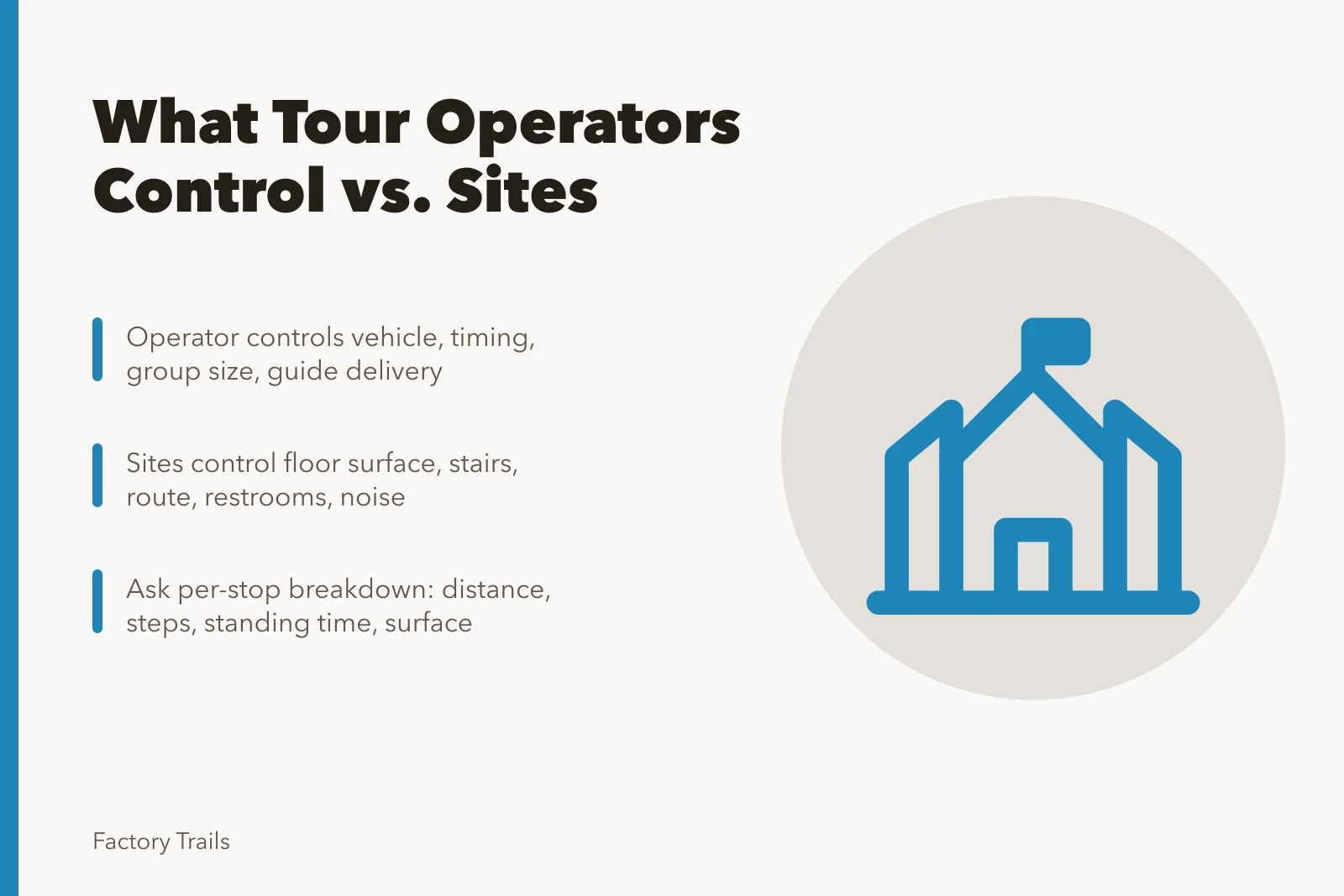
What the operator controls
What the operator controls
- Vehicle type and lift equipment
- Timing and pace of the day
- Group size
- Guide's delivery
- Written information in advance
All of those are adjustable, and a good operator will discuss them: a lift-equipped vehicle or a different pick-up point, a slower schedule, a smaller group, a printed route summary, a seat at the front.
The general framework for services offered to the public is set out in the Department of Justice's material on Title III of the ADA, which covers businesses open to the public and the obligation to make reasonable modifications. Knowing roughly what that covers helps you ask for the right thing rather than argue about whether it applies.
What the sites control
The floor surface, the stairs, the route, the restrooms, the noise and the temperature.
An operator can tell you what each site involves and cannot change any of it. That is the honest position, and an operator who pretends otherwise is the one to avoid.
Ask per stop
- Distance walked
- Number of steps
- Standing time
- Floor surface
- Seating available
- Restroom access
- Shorter route option
Service animals
This is the question that most often produces an unwelcome surprise on an industrial trip.
The Department of Justice's requirements for service animals set out where they must be permitted in places of public accommodation. Working production areas raise genuine complications: moving vehicles, hot surfaces, chemical exposure, hygiene requirements in food plants, and noise that affects the animal.
Ask well in advance, ask per stop rather than per tour, and ask what the arrangement is where the answer is no. A responsible operator will have thought about it.
Sensory load on a multi-stop day
Industrial tours pack a lot into a day: noise, heat, vibration, smells, unfamiliar rules and long stretches on your feet.
Ask about the quietest stop, whether there is a break between plants, whether you can sit out one stop and rejoin, and where the vehicle will be parked if somebody needs to leave early.
Get it in writing before the deposit
Per-stop details, the vehicle, the group size, and whatever has been agreed. A written summary prevents the day being renegotiated at the first curb.
Ask also what happens if a substitution is made: a replacement stop may be less accessible than the one it replaces.
When to book something else
Where the full itinerary genuinely does not work, ask the operator to build a shorter private version. Many will, at a modest premium, and it is frequently a better day for everyone.
The operator qualities behind all this are set out in the operator watchlist, and the site-level version of these questions is covered in accessible options at working plants.