Reviews
Part of Why do two years of argument sit behind every industrial interpretation panel?
Site interpretation choices compared: guides, panels, films and working machines
Guide, panel, film, app or working machine. Each does one thing better than the rest, and most sites pick the one they can afford rather than the one that fits.
What to take away
- A working machine beats every other method and costs the most to sustain.
- A good guide is the most flexible medium and the hardest to keep consistent.
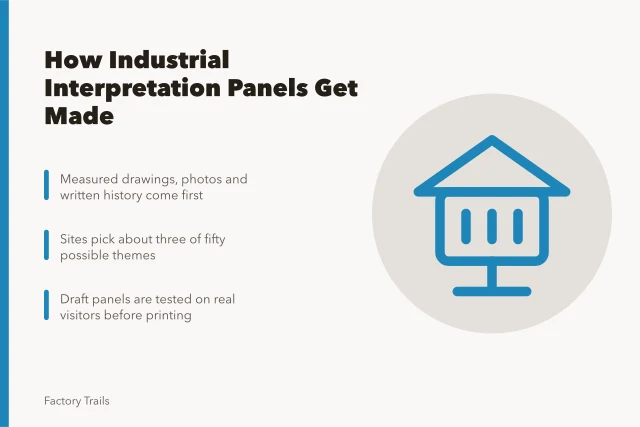
- Panels are cheap, weatherproof and the least effective. They are also unavoidable outdoors.
- Apps solve real problems and fail at exactly the sites with no mobile signal.
Every interpretive method does one job well. Sites that choose deliberately produce good visits; sites that use whatever they could fund produce uneven ones.
Here is what each is actually good at.
The guide
Best at: answering the question you actually have, adjusting to the group, and conveying enthusiasm.
Worst at: consistency. Two guides give two different tours, and the difference between a retired operator and a new volunteer is enormous.
Costs: staff time, forever. This is why guided tours run at fixed hours rather than continuously.
The working machine
Best at: everything. Noise, smell, speed and scale communicate in seconds what a panel cannot in a paragraph.
Worst at: availability. Machines need operators, maintenance, parts and insurance, so they run on a schedule that suits the site rather than you.
Costs: the most, and it is the reason a demonstration schedule is the most important thing on a site's website. A demonstration schedule is only as good as the plan behind it, and realistic factory tours planning starts with the days the line runs.
The wayside panel
Best at: being there. Available all hours, in all weather, needing nothing.
Worst at: depth and revision. Panels carry a few hundred words and get replaced roughly never.
Costs: modest to install, and the low running cost is exactly why outdoor sites are full of them.
Film and audio
Best at: showing what is gone: the plant running, the workforce, the process end to end.
Worst at: ageing well. A film made twenty years ago looks it, and rerecording costs as much as the original.
The app or digital guide
Best at: layering. Optional depth for those who want it, translations, and images of vanished structures shown in place.
Worst at: connectivity and maintenance. The Park Service's own digital program covers how public digital services are planned and maintained, and maintenance is the whole problem: an app is not a purchase but a subscription to keeping it working.
Ask whether it works offline. At a rural industrial site, frequently it does not.
Structured learning programs
Best at: turning a site into something people can use, particularly schools.
The Park Service's Teaching with Historic Places program is the established example, providing classroom material built around real sites, and industrial properties feature heavily because they connect technology, labor and economics in one place.
Worst at: serving casual visitors, who are not the audience.
Living history and demonstration
Best at: skills. Watching somebody mold, forge, weave or set type is the only way to understand how hard it was.
Worst at: accuracy, when done casually. Costumed demonstration without research is theater.
Which combination works
| Site type | Best combination |
|---|---|
| Large complex plant | Guide plus one working machine |
| Outdoor works or ruins | Panels plus an app with offline maps |
| Small collection | Volunteer demonstrators |
| Technical collection | Guide plus film of the process in use |
| Multi-site corridor | App plus panels, with guides at the anchor site |
Sites that specialize in a single technology frequently do this best, because they can afford to keep one thing running properly rather than five things statically.
What to ask before booking
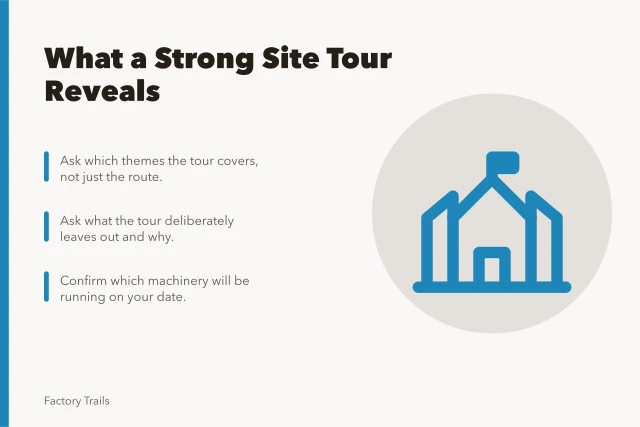
Which methods are in use on my date, and which are running. That question tells you what the visit will actually be.
How these decisions are made is covered in how interpretation works from plan to finish, and what to notice on the ground applies whichever methods a site has chosen.