Guides
A working factory visits planning workflow before you publish the route
Plan working factory visits in 2027 with a practical U.S. workflow for purpose, route review, host roles, access details, guest messages, and follow-up.
Planning a working factory visit means designing a guest experience around an operating site, not turning the site into a museum for the day. A useful plan establishes what visitors can learn, who can approve the route, what information guests need, and what happens when the normal plan cannot be used. It should leave operational, safety, and emergency authority with the people who hold it at the facility.
What to take away
- Start with a visitor purpose and an approval path before advertising a route.
- Plan the visit in stagesscope, route, guest information, host preparation, and review.
- Treat access, timing, and operating conditions as current facts that require confirmation.
- Keep a short decision record so the next host is not working from memory.
What a planning workflow does
A planning workflow makes ordinary decisions visible before a group reaches the gate. It does not replace the plant's safety program, maintenance plan, security process, or emergency procedures. It gives the visitor-program owner a way to coordinate with those systems without assuming authority over them.
The most dependable model is a small cycle. Define the purpose, build the plan, test the plan with the responsible site roles, run the session, then record what should change. OSHA's leading-indicators guidance describes a Plan, Do, Check, Act approach for improving safety and health programs. A visitor program can borrow the discipline of that cycle without presenting itself as a safety-management system.
The National Park Service interpretive-planning program describes planning that begins with intended outcomes and audiences. Apply that order to a factory visit. Define the guest purpose first, then choose an approved route or alternative that can support it. This prevents a route from becoming the whole promise when it is only one way to tell the story.
Stage 1: define the visitor promise
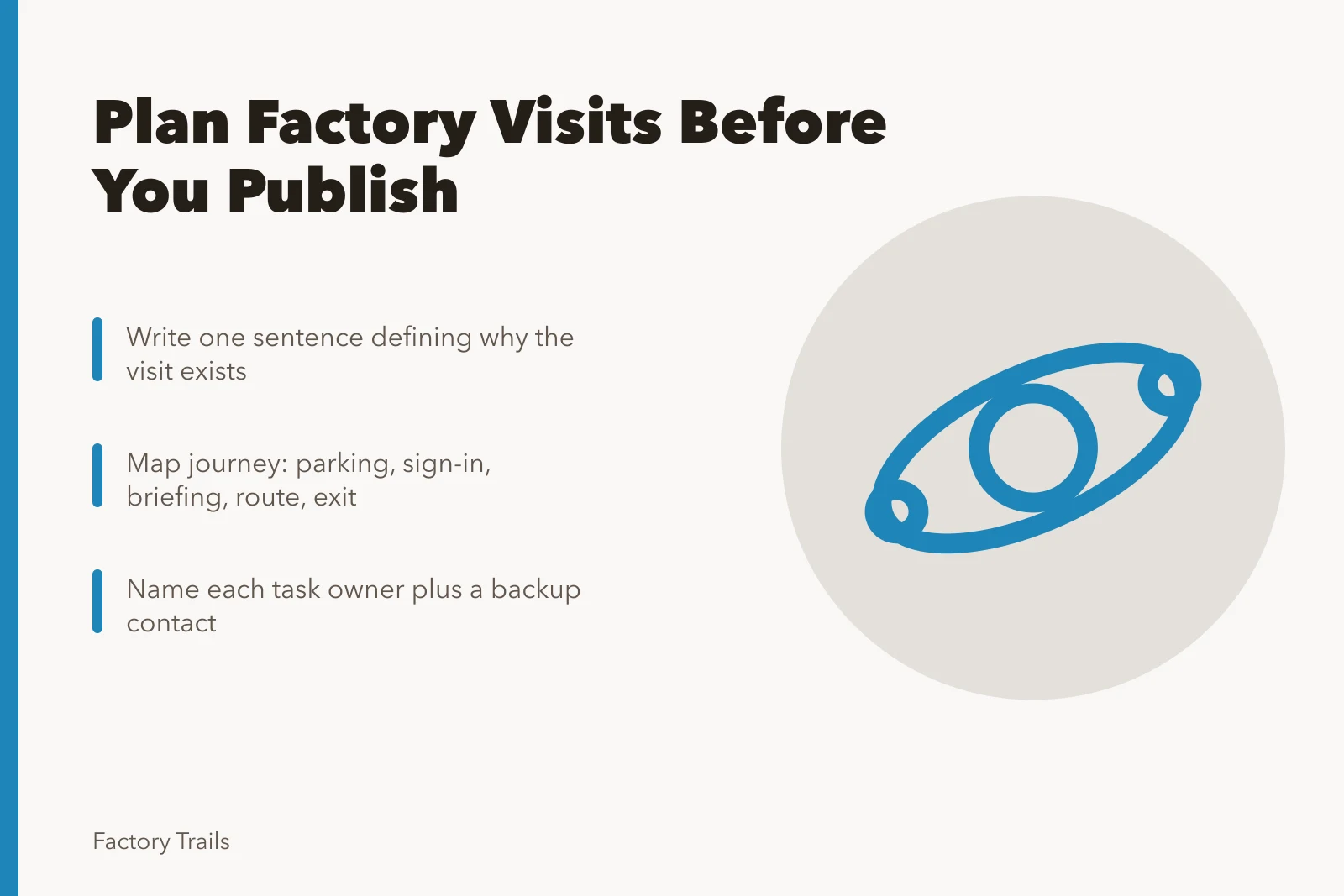
Write one sentence that says why the visit exists. It may introduce a local manufacturing story, show a non-sensitive part of a production process, explain career paths, or connect a historic building with present-day work. Avoid promising a specific machine, room, or process unless the facility has approved that promise for the planned period.
Visitor Promise Scope Fields
- Learning purposewhat visitors understand
- Audiencewho is expected
- Boundarysubjects and spaces excluded
- Session lengthusable arrival to departure
- Approval ownerconfirms visitor-facing plan
Then name the audience. A school group, a prospective customer group, a trade association, and local residents may need different language, timing, and questions. The core story can remain the same, but the session should have one primary audience so the host knows what to emphasize.
Use a short scope note with these fields:
| Planning field | Decision to make |
|---|---|
| Learning purpose | What should a visitor understand by the end? |
| Audience | Who is expected, and what does the group organizer control? |
| Boundary | Which subjects, spaces, and images are outside the visit? |
| Session length | What is the usable time from arrival to departure? |
| Approval owner | Who confirms the visitor-facing plan? |
The boundary matters as much as the attraction. A clear boundary prevents hosts from filling quiet moments with an unapproved explanation, a private operating detail, or a promise they cannot keep.
Stage 2: map the visitor journey
Do not begin with the tour stop. Begin where the visitor first needs help. Walk through directions, parking or drop-off, the entry point, sign-in, waiting area, briefing, route, questions, exit, and departure. At every transition, identify one owner and one guest instruction.
Visitor Journey From Arrival
- Directions and parking or drop-off
- Entry point and sign-in
- Waiting area and briefing
- Approved route and questions
- Exit and departure
This is a visitor journey, not a plant diagram. It should use plain labels such as "wait here for the host" or "group leader checks in first." It should not reproduce controlled maps, equipment layouts, access codes, or internal security details.
For each step, ask three questions:
- What does a visitor need to know or do here?
- Who can confirm the instruction is current?
- What changes if this part of the normal journey is unavailable?
The answer to the third question becomes the fallback plan. A fallback might be a different gathering point, a shorter approved route, a demonstration space, or a rescheduled session. It is not a host inventing a route through an active area after a group arrives.
Stage 3: assign people, not vague departments
"Operations" is not a useful contact when a bus is waiting. Give each planning task a named person or role and a backup contact. The program owner handles bookings and public messages. The facility contact verifies whether the route and timing are available. A safety, security, or emergency role handles the decisions that are outside visitor-program authority. A host leads the approved experience.
Named Roles and Handoffs
Role
- Program owner
- Bookings, public messages
- Facility contact
- Route and timing availability
- Safety or security role
- Decisions outside program authority
- Host
- Leads approved experience
Owns
- Program owner
- Facility contact
- Safety or security role
- Host
Keep the handoff brief. A host needs the group name, expected count, arrival window, approved route version, current restrictions, the fallback choice, and an escalation contact. The host does not need a copied bundle of confidential technical procedures.
Stage 4: assess the route before publishing it
The route is a current agreement, not a permanent feature of the website. Review it with the responsible facility role before the season, after a significant operational change, and close to a scheduled session when the site has variable conditions.
Route Review Before Publishing
- Expected entrance usable by group
- Normal viewing point available
- Photography rules unchanged
- Approved alternative ready
- Access features confirmed by responsible role
Record visitor-facing conditions rather than technical findings. Examples include whether the group can use the expected entrance, whether the normal viewing point is available, whether photography rules have changed, and whether an approved alternative is ready. If the answer is uncertain, the public message should not make it sound certain.
Route planning also needs an access review. Ask what a guest experiences from arrival through departure, where a person may need more information, and whether an approved alternate can communicate the core story. Do not make broad accessibility claims without review by the facility's responsible role. Describe confirmed features, offer a contact for individual questions, and update wording when the route changes.
Stage 5: design the guest messages
One plan can fail because the website, confirmation email, and host briefing say different things. Establish a single factual source for these essentials:
Single Source Guest Messages
- Date, arrival time, expected duration
- Exact arrival point and late contact
- Approved footwear and identification rules
- Photography and device rules
- Group-size limits and organizer duties
- Way to ask access questions
- date, arrival time, and total expected duration;
- exact arrival point and late-arrival contact;
- footwear, identification, or other guest requirements that the facility has approved;
- photography and device rules;
- group-size limits and organizer responsibilities;
- a way to ask access or logistics questions before arrival.
Use a version date on the confirmation message. When conditions change, the program owner can compare the booking record with the newest approved message instead of relying on recollection. Keep the tone practical. "The route may be adjusted for operating conditions" is more honest than guaranteeing every advertised stop.
The Department of Justice effective-communication guidance explains that appropriate communication depends on the nature, length, complexity, and context involved. This is not a route-access determination. It is a reason to check whether guests receive the essential information in a form that fits the visit and have a clear way to ask questions before arrival.
Stage 6: run a pre-session test
Before a new program launches, simulate the first ten minutes. Have a person follow the directions, arrive at the stated point, locate the check-in process, and read the visitor instructions without help. This small test often reveals confusing parking language, a missing contact number, or a mismatch between the public arrival time and the host's readiness.
Pre-Session Test Steps
- Follow directions to stated arrival point
- Locate check-in process unaided
- Read visitor instructions without help
- Confirm host can find approved route version
- Confirm facility contact reachable
Then test the information handoff. Can the host find the approved route version? Can the facility contact be reached? Does the host know how to communicate a route change without improvising? If the answer is no, fix the information path before promoting the session.
Stage 7: conduct a short current-condition check
The day-of check should be short and factual. It is not an inspection or a substitute for the facility's own procedures. The host asks the designated contact whether the planned route is available, whether any visitor-facing instruction needs to change, and whether the planned fallback remains available.
Day-Of Current-Condition Check
- Entry and check-innamed site contact
- Routenormal or approved alternative
- Host coveragehost and backup identified
- Current messageversion sent to organizer
- Follow-up itemowner and due date
Use a simple table rather than a long email chain:
| Item | Confirmed by | Visitor effect |
|---|---|---|
| Entry and check-in | Named site contact | Normal or changed arrival instruction |
| Route | Named site contact | Normal route or approved alternative |
| Host coverage | Program owner | Host and backup identified |
| Current message | Program owner | Version sent to organizer |
| Follow-up item | Assigned owner | Next action and due date |
If an operating condition makes the visit unsuitable, the program owner should use the chosen cancellation or rescheduling path. A calm, direct message protects the guest experience and respects the facility's decision.
Stage 8: close the loop after each session
Capture only information that helps the next session: actual group count, route used, visitor-facing change, question that needs a confirmed answer, and owner for the follow-up. Do not record personal details or sensitive operational information unless there is a defined, authorized reason to do so.
Review patterns monthly or at a reasonable interval for the program. Repeated late arrivals may call for clearer directions. Repeated questions may show that the briefing needs a better explanation. Repeated route changes may mean the public description is too specific. The point is to improve the visitor plan, not to create paperwork for its own sake.
The National Archives records-management profile describes responsibilities for managing records and information. Keep a compact session record with the current guest message, route result, change owner, and next review date. It preserves the decisions that matter without creating a parallel file of confidential facility information.
A 30-day launch sequence
Time / Practical output
- 30 days before
- Purpose, audience, boundaries, and named approvers
- 21 days before
- Draft journey, route review request, and access questions
- 14 days before
- Approved guest messages and host session brief
- 7 days before
- Test arrival instructions and fallback communication
- Session day
- Current-condition confirmation and host handoff
- Within two days
- Brief decision record and assigned follow-up
This sequence is deliberately modest. The facility's operating calendar may require a longer review period, and a site with irregular access may need a session-specific route approval every time.
30-Day Launch Sequence
- 30 days beforePurpose, audience, boundaries, approvers
- 21 days beforeDraft journey and route review request
- 14 days beforeApproved guest messages and host brief
- 7 days beforeTest arrival instructions and fallback
- Session dayCurrent-condition confirmation and handoff
- Within two daysDecision record and assigned follow-up
Common planning mistakes
The most common mistake is treating an attractive itinerary as the plan. An itinerary says where the group goes. A plan says who approves it, how guests arrive, what messages are current, what happens when conditions change, and where questions go afterward.
Another mistake is letting promotional language outrun confirmation. If a visit description says visitors will see a particular process, every group expects it. Use specific descriptions only when the facility can reliably support them, and maintain a respectful alternative when it cannot.
Finally, do not confuse a guest briefing with worker instruction. Visitors should receive concise, approved directions for their experience. Facility roles retain responsibility for workplace training and safety decisions.
Common questions
How far ahead should a factory visit be planned?
Set the timeline based on the site's operating pattern and approval needs. A new or complex program needs enough time to test the guest journey, confirm the route, and prepare host information. Repeat sessions still need a current-condition check.
Who should approve a visitor route?
The responsible facility role should confirm the route and any alternative. The visitor-program owner can coordinate the request and update public information, but should not independently open or change access to an operating area.
What should happen when the normal route is closed?
Use the pre-approved alternative, shorten the session, reschedule, or cancel according to the program's decision path. Tell the organizer what changed and avoid making up a substitute route on the spot.
Does this workflow satisfy regulatory requirements?
No. It is a visitor-program planning method. Each facility must follow the laws, policies, labor arrangements, safety requirements, and access obligations that apply to its own operations.