Industry
Confirmed access, not a brochure, is what an industrial tour operator sells
2027 watchlist for industrial tour operators: before paying an operator, find out who you are actually contracting with, what access they have confirmed.
What to take away
- Find out what kind of business you are dealing with. A one-person operation and a chartered company fail differently.
- Confirmed access is the product an operator sells. A brochure listing plants without permission is a wish list.
- Ask what happens when a plant cancels on them. Every operator faces it; the good ones have an answer.
- Pay in a way that gives you recourse, and know where a complaint goes if it comes to that.
Industrial tour operators range from a retired engineer with a minibus to a coach company running fixed departures. Both can be excellent. They carry very different risk, and the difference is knowable before you pay.
Who are you contracting with
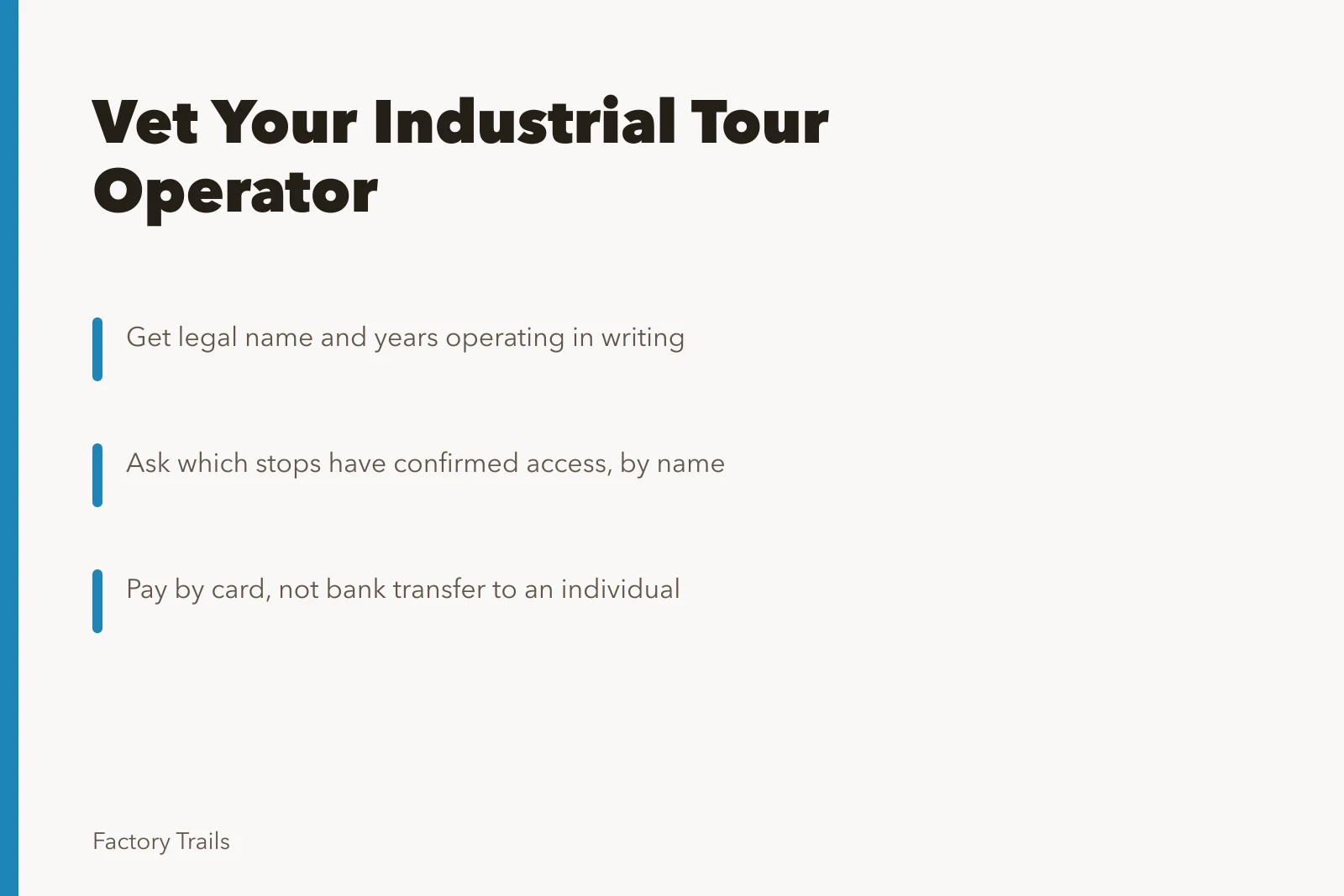
Ask the plain question: what is the legal name of the business and how long has it been operating?
Business Structures Compared
Sole proprietor
- Who is responsible
- Individual
- Nature of promise
- Personal
- Disqualifying?
- No
Partnership
- Who is responsible
- Partners
- Nature of promise
- Shared
- Disqualifying?
- No
Incorporated company
- Who is responsible
- Company
- Nature of promise
- Corporate
- Disqualifying?
- No
Structure matters more than it sounds, because it determines who is responsible if something goes wrong. The Small Business Administration's explanation of business structures sets out the differences between sole proprietors, partnerships and incorporated companies, which is the difference between an individual's promise and a company's obligation.
Neither is disqualifying. A sole operator with twenty years of relationships is frequently the better tour. You simply want to know which you have.
What proof of access looks like
The thing an operator actually sells is permission: arrangements with plants that will not admit individuals.
Confirmed Access Questions
- Which stops have confirmed access for your date?
- Which stops are only hoped for?
- When was each stop last visited?
- Does the plant know the group size?
Two kinds of operator do this well. One is the retired plant engineer who runs a minibus once a month to plants that admit nobody else. The other is a coach company with fixed departure dates and a contracts manager who knows each plant's visitor rules.
A few sites sell tickets to anyone, such as the Ford Rouge Factory Tour in Dearborn, Michigan. The plants that make an industrial tour worth booking usually do not, which is why the operator's relationships are the asset.
Ask which stops have confirmed access for your date, in writing, and which are hoped for. Ask when each was last visited. Ask whether the plant knows the group size.
An operator with real relationships answers immediately and by name. One that answers vaguely is publishing an aspiration.
What happens when a plant cancels
Every operator loses stops to production. What separates them is whether they have a substitute ready.
Ask directly: if a plant cancels the morning of the tour, what do we do instead, and is any part refunded? A good answer names a specific alternative in the same town.
Paying with recourse
Pay by a method that provides a route back if the service is not delivered, which in practice means a card rather than a bank transfer to an individual.
Deposits are typically 20 to 50 percent of the trip price, with the balance due 30 to 60 days before departure. A two-day small-group itinerary with arranged access usually prices in the high hundreds per person.
For a several-hundred-dollar multi-day tour booked months ahead with a small operator, the dispute protection that comes with a card is worth more than the small fee some charge for accepting one.
If it goes wrong
Most disputes resolve directly, and it helps to know the route if one does not. USA.gov, the federal consumer information service, maintains guidance on where consumer complaints go, including the state consumer protection offices that handle a travel service sold inside a state. In most states that office sits in the attorney general's department.
Raise it with the operator first, in writing, with dates and specifics. Most small operators fix things when asked clearly.
The 2027 season
Small operators typically publish next season's prices, deposit terms and cancellation windows in the fall before it starts. For 2027 departures, expect that terms sheet between September and November 2026, and expect it to hold until the season closes.
Two dates on it matter most: the last day for a full deposit refund, and the operator's liability insurance renewal date. Ask for both in writing before you pay anything.
The pre-booking checklist
| Check | Good answer |
|---|---|
| Business name and age | Given immediately, verifiable |
| Access confirmed | Named plants, written confirmation |
| Group size | Under twelve for plant floors |
| Guide | Named, with industry background |
| Cancelation policy | Written, specific, symmetrical |
| Substitute plan | A named alternative per stop |
| Payment | Card accepted |
| Insurance | Carried, and they say so plainly |
The signals that something is wrong
Itineraries that name famous plants with no permission in writing. Pressure to pay by transfer. Vagueness about who the guide will be. No written cancelation terms. A schedule with four plants in a day, which nobody can deliver.
The same judgment applied to individual plants is set out in comparing working factory visits, and the mistakes an operator is being paid to prevent are a fair benchmark for what you are actually buying.
Common questions
Is a big operator safer than a small one?
Should I expect a deposit?
Do operators carry insurance for visitors?
How far ahead do these book?
In this guide
- Volunteer programs: where most industrial tour guides start outThe people who guide industrial tours often start as volunteers. These named programs at museums, railways and industrial sites are where to meet and hire them.
- Vehicles and timing: what an industrial tour operator actually controlsAccessible options for industrial tour operators travelers: an operator controls its own vehicle and timing and cannot promise the surface at a private plant.
- Industrial tour operators earn their keep on one day: the one you cannot arrange aloneTwo-day itinerary built around industrial tour operators: buy the operator for the day you cannot arrange yourself, and do the rest alone. Two days, one guided.
- Industrial tour operators reward homework: check safety records and shift patterns firstIndustrial tour operators: look up the site's own safety record before you go, and understand its shift pattern. Both are public, and both change what you notice.
- Departure points near an industrial tour operator matter more than plant locationsBook where the tour starts, not where the plants are. A guided day picks you up at one point and returns you there tired, twelve hours later.