Reviews
Part of Industrial heritage travel fundamentals: how to plan a visit that holds up
Industrial heritage travel questions to ask before you compare sources
Industrial heritage travel questions for 2027 help U.S. readers compare regional history, individual site records, current visitor information, and source limits.
What to take away
- Test each source with five questionsarea, date, purpose, named place, and gaps.
- A regional history page explains why an industry mattered. It does not confirm that a site is open today.
- Match the size of the claim to the size of the source, one claim per source.
- Record the URL, the date you checked, and the exact claim it supports.
- When access is unclear, mark the stop unresolved instead of filling the gap with a photo or map pin.
Five questions to test one source
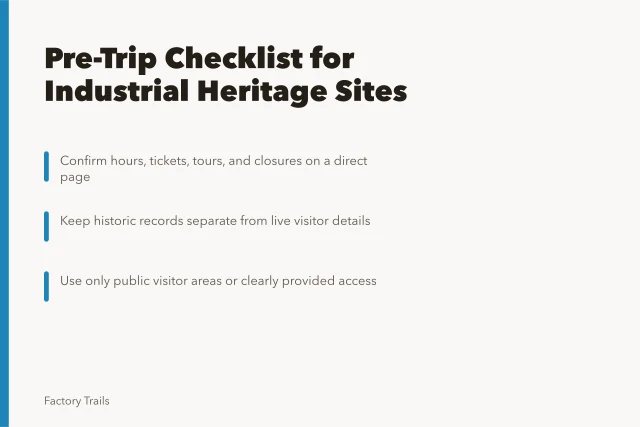
Run each record through the same tests before you combine it with another one. A minute per source is enough. Our industrial heritage travel checklist covers packing and booking; these questions cover the evidence behind each itinerary line.
| Question | What a yes answer settles | What stays open |
|---|---|---|
| What area does it describe? | The reach of the story, from one building to a whole valley | Whether a single site in that area takes visitors |
| Is the record historical or current? | The tense you may use | Present hours, prices and closures |
| What was it made for? | Whether it is a catalog entry, a regional overview or a visitor page | Rules that apply at a different kind of site |
| Does it name the exact stop? | Whether a site-specific claim is safe | How that stop fits the regional story |
| What does it leave unanswered? | The next record you need | Nothing, until you find it |
Source Comparison Questions
- What geographic area does the source describe?
- Is the record historical or current?
- What is the source's purpose?
- Does the source name the exact stop?
- What does the source leave unanswered?
Match the scope of the source to the claim
A claim is only as strong as the record behind it. Sort each source by scope, then decide what it can carry.
| Source scope | Claim it can support | Claim that needs another record |
|---|---|---|
| Regional heritage area | Why an industry shaped a corridor | That a named building offers tours today |
| Museum or archive collection | What an object or photograph shows | That the pictured place is still accessible |
| Site visitor page | Rules for one address | How the site fits the wider story |
| Program or event page | A dated tour, exhibit or opening | Whether other sites share those terms |
Sorting by scope is the habit behind our guide to running a route check before departure, where every stop is confirmed against its own record rather than the region around it.
Example: three itinerary lines, fixed
Line one reads "Oil Region National Heritage Area. Drake Well. Tour confirmed." The NPS page on the Oil Region National Heritage Area describes petroleum history, artifacts, communities and heritage attractions across the area. That page carries the regional story, not the ticket. Hours, admission and access rules need the site's own visitor page.
Line two reads "Hershey factory tour." Hershey's Chocolate World is a visitor center, and the working factory is not open for public tours. Name the visitor center and drop the factory.
Brands with several plants publish one page per location. The Royal Canadian Mint lists a Winnipeg production tour and an Ottawa boutique mint separately. When a brand has more than one address, open its visit or tours directory and check that the city on the page matches the city in your itinerary.
Line three reads "Britannia Mine, underground tour, Saturday." Booking terms and season come from the mine's own calendar. Our notes on booking a Britannia Mine Museum underground tour in BC show how the tour and its conditions come from one page.
Record what each source supports
A citation inside an itinerary is a working note, not a bibliography entry. Four fields are enough.
- The direct URL of the page, not a search results page.
- The date you checked it.
- Its scoperegion, collection, site or program.
- The single claim it carries.
The National Archives guidance on basic records-management concepts ties a record to its origin and purpose. The National Park Service Museum Handbook applies the same precision to collection images, so a caption names the subject, the place and the date. Keep one log for every reference you use.
When access information is missing
Regional pages often cover sites that have closed, changed hands or become private offices. Mark the stop unresolved and keep only what the historical record proves.
Do not fill the gap with a map pin, an out-of-date directory entry or a photograph. Uncertainty written down is useful. A guess printed for a traveler is not.
Re-check close to the departure date. Guidance here is dated to 2027 because seasons, schedules and ticket rules are republished every year; a check made for last season cannot carry a 2027 itinerary.
If the gap covers a whole area, look for a regional list with confirmed sites. Our Alabama industrial heritage sites guide shows how one quiet stop can be swapped for nearby sites that still take visitors.