Guides
Part of Industrial heritage travel fundamentals: how to plan a visit that holds up
Industrial heritage travel warning signs to check before you publish
Industrial heritage travel warning signs for 2027 help U.S. readers spot stale access claims, weak directions, promotional wording, and source-scope mistakes.
What to take away
- A claim about access, hours or rules needs a dated page from the organization that runs the site.
- A historic photograph, a visitor review or a map pin proves the past, not the present.
- Wording such as "abandoned", "just explore", "best" or "safe" needs a source or a rewrite.
- Sponsored listings carry a visible disclosure and stay inside what a current record supports.
- A four-column source log, with source, date checked, claim supported and limit, keeps later edits honest.
Warning signs to check before publishing
Run a finished draft against this table. Each row names a failure mode and the fix that removes it. The questions to ask before you compare sources cover the same ground from the reader's side.
| Warning sign | Why it fails | What to do instead |
|---|---|---|
| No current source for access or hours | Rules change while old pages stay online | Cite a dated page from the operator, or cut the claim |
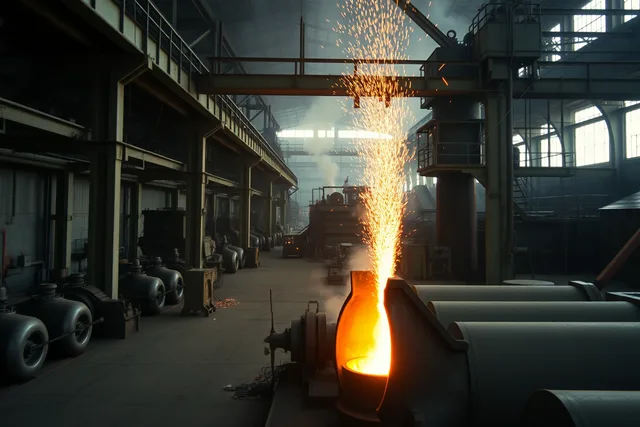
| A photo used as a route or entry description | The structure may have changed since the image was made | Caption it as a historical record and keep travel advice separate |
| A place called "abandoned" or "open" with no record | Both are management facts, not impressions | Verify with the owner or agency, or drop the status word |
| "Just explore" or "find your own way in" | It invites trespass and ignores posted boundaries | Send readers to public visitor areas and official pages |
| "Best", "must-see", "safest" | Promotional wording that no source can carry | Describe the verifiable offering and disclose paid placement |
Warning signs to fix
- No current direct visitor source
- Photo used as route description
- Abandoned or open without source
- Guide says just explore
- Tour or business labeled best
Example: Steamtown's signed 2026 compendium
Steamtown National Historic Site's signed 2026 compendium lists activities banned in the park, including climbing on rail equipment, fences, bridges and historic structures. Read the Steamtown compendium. That document governs the site today.
An article that repeats a 2019 blog post instead of this page is publishing a guess. Steamtown's rule does not travel to other parks, but the habit does. Name the current authority for the place you describe.
Check the claim against the source
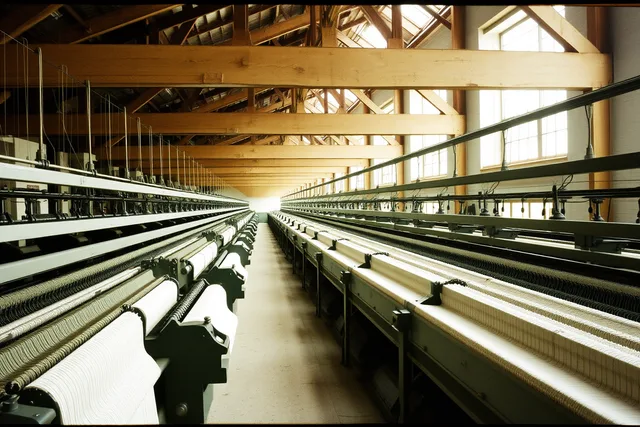
Ask whether the linked page proves the exact sentence beside it. A source that calls a building historic never says the building is open. A photograph of a mill floor is not a route description. Nor does a program listed on one date run all year. When a current page contradicts an older statement, correct the statement.
| Claim you want to write | Evidence needed | Wording when evidence is missing |
|---|---|---|
| "Visitors can enter" | A current page from the operator | "Confirm current access before you travel." |
| "This route is public" | A designated route or visitor map | "Use marked public access only." |
| "The business is open" | Current operator information | Leave the operational claim out |
| "The view is safe" | Official conditions information | Make no safety claim |
Live conditions matter as much as rules. The National Park Service tells travellers to recheck conditions before a trip, because a site's status can change while its history does not.
When no current source exists
Replace the claim with the evidence you hold. If an archive identifies an old furnace, say the archive identifies it.
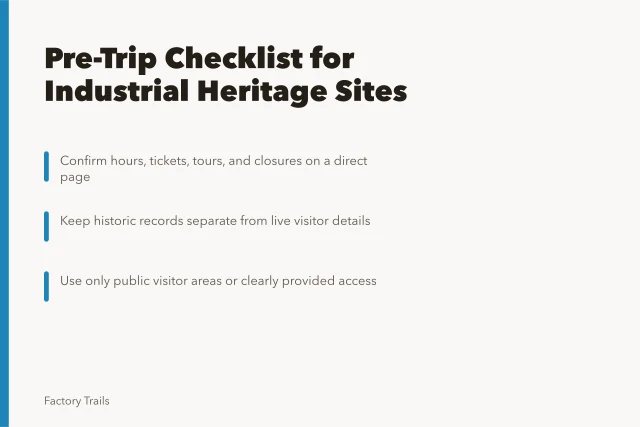
If no current record covers entry, parking or photography, keep the piece to historical context and online collections. Tell the reader to confirm access, and use the pre-trip checklist for industrial sites to show how those confirmations fit a visit plan.
Business content follows the same test. A nearby museum, guide or restaurant can appear for a source-backed statement. Do not call it open, recommended, affordable or available without a current direct record. Sponsored material needs a clear label. The working factory visit mistakes list covers the operational side of the same problem.
Example: Chocolate World is not a factory tour
Hershey's Chocolate World in Pennsylvania is a visitor center, and the working factory is not open for public tours. The Wikipedia entry on Chocolate World draws that line.
For Canadian readers, the Royal Canadian Mint shows the same split. Its official visit page separates the Winnipeg production tour from the Ottawa boutique. One question settles both cases: does the source describe a tour of production, or a visit to a retail and exhibit space?
Keep the source log to one line per claim
One line per claim is enough. Write the source, the date you checked it, the claim it supports, and the limit it does not cover. A sample line, not a real record:
Claim: mill tours run Tuesday to Saturday. Source: operator tour page. Date checked: date of your check. Limit: holiday closures are not listed.
Hold future edits to that format. The National Archives records-management basics make the same point: a record with a date and a stated limit is easier to correct than a note with neither.
Timed entry sites need the operator page in the log too. Bookings such as the Britannia Mine Museum underground tour change by season, so a reprinted timetable is not a source.
Common questions
Does a historic record or an archive scan prove a place can be visited?
No. Use a dated page from the operator for access, hours and rules.
Can I cite a personal review as a source?
Only as an attributed personal account. It cannot carry an access, safety or opening claim on its own.
What do I do with an access claim I cannot verify?
Cut it, or replace it with the line "confirm current access before you travel."
How do I stop a later edit from restoring a weak claim?
Keep the source log line attached to the claim, including the limit the source does not cover.