Guides
Part of Industrial heritage travel fundamentals: how to plan a visit that holds up
How to keep industrial heritage travel records that hold up over time
Keep industrial heritage travel records that survive a decade: dated visitor sources, archive citations, image credits, and clear review triggers for every claim.
Industrial heritage travel notes go stale in a predictable order. Hours change first, then admission, then the docent who ran the furnace-floor walk. The historical record underneath barely moves.
A file that separates those two clocks is the one you can still trust in 2037.
What to take away
- Give every factual sentence one source, one date checked, and one named review trigger.
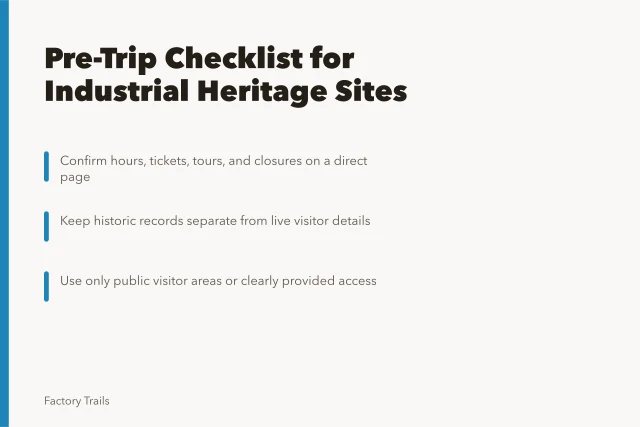
- Keep historical citations and live visitor details in separate fields, never merged.
- When a visitor page disappears, delete the time-sensitive claim and keep the history.
- Never revise an archive caption to sound current; that erases the record you cited.
- Re-check a claim before you republish the page, not after a reader corrects it.
Why records rot at different speeds
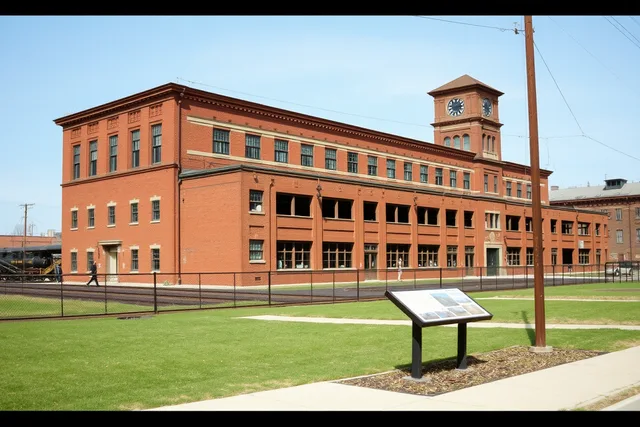
A Historic American Engineering Record drawing of a rolling mill describes the building as surveyed. It stays accurate for a century.
The same mill's tour schedule can change twice in a season. One record, two lifespans, and a single undated note cannot serve both.
The Library of Congress publishes HABS, HAER and HALS documentation through its historic-sites collection. Browse the Library of Congress historic-sites collection for surveyed drawings and photographs. That documentation establishes what stood there and when it was recorded. It says nothing about whether the gate is open on a Tuesday.
Four record types, four review triggers
Split a trip note the moment it tries to carry history, access, price and image rights at once. Each line keeps its source, its claim, its date, and its limit.
| Record line | What it holds | Review trigger |
|---|---|---|
| Historical claim | A former mill, rail feature or process | New research or a corrected survey |
| Visitor claim | Hours, program, seasonal closure | Departure date or a site notice |
| Image credit | The exact catalog or rights record | Any change to the figure or caption |
| Listing detail | A disclosed, verifiable offering | The provider changes the offering |
The National Archives sets out records-management fundamentals that apply to a trip file as much as to an agency: arrange material so a stranger can find the source and see why the claim is there.
The update-without-erasing rule
When hours change, edit the visitor line and leave the historical line alone. When a site's visitor page vanishes, cut the claims that depended on it.
Keep the page on verified history until a replacement source appears. A preserved headframe with no current tour information is still a useful page. A page promising daily access is not.
Never touch an archive caption to make it read as present tense. The date in that caption is the evidence.
Where source roles blur
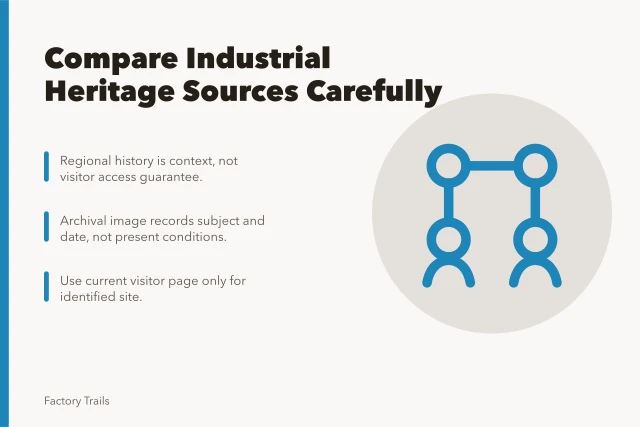
An archive describes a structure at a stated time. A museum page describes a collection or program. A site's own visitor page carries published access details.
Merging them is how a 1978 photograph becomes a 2027 access promise. The National Park Service visitor-conditions guidance shows why live details need a dated re-check: conditions move, and the record has to show when you last looked.
The NPS Museum Handbook covers collection documentation practice. An image record proves what a photograph shows and who holds it. It never confirms entry, staffing or that a plant still runs.
For paid listings and local partnerships, keep the business page, the verification date, the stated offering and the disclosure. A source log is not a rating, an endorsement or an availability promise.
Worked example: a claim that outlived its source
Suppose a 2024 note reads: "Britannia Mine Museum runs the underground train every 30 minutes; see the 2019 site map."
Three problems sit in one sentence. The interval came from a page that may no longer exist. The map is seven years old. The claim is written as permanent.
Rewrite it as two lines. The historical line cites the mine's own records for when the tunnel was driven. The visitor line carries the interval, the date you read it, and the trigger "re-check before each departure."
If the site later drops the train, you delete one line. The other survives.
Common questions
Should a trip file keep archive links after the trip ends?
Yes. They preserve the context that explains why the place matters, and they let the next editor trace where a sentence came from.
Does a source date matter for a museum listing?
It does. The date separates current visitor information from historical context and tells the next editor when the claim needs re-checking.
Can an image credit stand in for a visitor source?
No. An image credit identifies a media record and its rights holder. Visitor details need a current source that the site itself publishes.
What happens when the responsible visitor page disappears?
Remove the time-sensitive claims, keep the verified historical material, and note the gap. Publish the live details again only when a replacement source exists.