Guides
Working factory visits: 8 mistake prevention fixes for 2027
Eight mistake prevention fixes for working factory visits in 2027, with real tools, concrete checks, and clear steps for hosts, organizers, and guests.
Most factory-visit problems start before the guests arrive. A booking message makes a promise nobody rechecked. A host receives an old schedule. An organizer gets a street address instead of the approved meeting point. These details shape whether the group arrives informed and whether the host can begin with confidence.
This is a coordination guide, not a safety or security guide.
A factory keeps authority over its facilities and conditions. The program team should make the guest-facing plan current, truthful, and easy to use.
What to take away
- 1Fix : Avoid promises that have not been confirmed for the actual visit date.
- 3Fix : Keep the organizer, guests, host, and check-in contact on one current message.
- 5Fix : Treat an unanswered access, route, or condition question as an escalation, not an invitation to guess.
- 8Fix : Record the visitor-facing result of a change without copying controlled site information.
Fix 1: Confirm the visit format before booking
An invitation should not promise a room, machine, route, length, or experience because a prior tour had it. Start with a narrow purpose. Ask the facility contact what visitor format is currently approved. If part of the experience is conditional, say so in the guest message.
Visit Confirmation Form Fields
- Group name
- Date
- Count
- Arrival point
- Host
Use a short confirmation form. Google Forms is free with a Google account and sends responses to Google Sheets. A five-field form can collect group name, date, count, arrival point, and host. That suits a coordinator who needs one approved record.
Fix 2: Replace the public address with the approved meeting point
A mailing address may lead to a closed gate, an office entrance, or a shipping area. The confirmation should name the exact approved meeting point, local arrival time, and day-of contact. If the site has a confirmed check-in process, give guests the visitor-approved version.
What3words is a free app that turns a location into three words. Each square covers about three meters. It can help when a gate or door has no useful street number. Test the message as a first-time guest would.
Booking message example. Before: Meet at the main address, 400 Industrial Way. After: Meet at Gate 3, 400 Industrial Way. Arrive by 9:45 a.m. Call the day-of contact if the gate is closed.
Fix 3: Keep one source of guest truth
The organizer's email, calendar invite, host brief, and check-in note should not tell four stories. Assign one person to maintain the current visitor message. When a material detail changes, update every affected channel and record the date. Do not assume a correction sent to the organizer reaches guests or the host.
Notion offers a free personal plan and paid team plans by user. A visitor page can show status labels like draft, approved, sent, and retired. That suits a small program team. A compact change log should list what guests need, who confirmed it, which messages changed, and whether the host acknowledged the new brief.
Fix 4: Give the host a current one-page brief
Hosts can welcome a group and explain an approved program. They should not decide whether a route is available, invent an alternative, or resolve a policy question at the door. Give the host a current one-page brief with the group count, schedule, approved format, alternative, and escalation contact.
The National Park Service's trip-planning guidance encourages visitors to check current conditions and use information available at the site. A factory program can apply that coordination principle without copying park procedures. A current host brief should replace assumptions from an earlier session.
Fix 4: Host brief
| Host brief item | Why it prevents a mistake |
|---|---|
| Group count and organizer | Avoids a wrong handoff |
| Current arrival instruction | Keeps the group at the approved point |
| Approved format | Prevents an old promise from becoming a demand |
| Alternative | Gives the host an honest next step |
| Escalation contact | Keeps decisions with the authorized role |
Fix 5: Treat access requests as early, documented work
An organizer may ask about communication, mobility, seating, timing, or another access need. Do not answer from memory, a photo, or another group's experience. Record the request accurately. Send it to the facility role that can confirm the arrangement. Return only the approved answer. Early coordination gives everyone time to make a practical plan.
For entities covered by the ADA, effective communication depends on the nature, length, complexity, and context of the communication and the person's usual method. The Department of Justice effective communication guidance explains that standard. The ADA applies to United States entities. Canadian hosts should check their own provincial or federal accessibility requirements.
Fix 6: Separate a visitor-program problem from a facility judgment
An unclear calendar invite, a stale phone number, a missing host name, and a vague parking instruction are visitor-program failures. They deserve a prompt correction. They do not authorize the coordinator to make a facility judgment. Name the problem accurately. Route the underlying question to the responsible facility contact.
This boundary matters when guests ask why something changed. The program may explain that the visit format has been updated. It should not explain a technical condition or give an unofficial account of an operational decision.
Fix 7: Prepare an approved alternative before arrival
When the normal visit cannot proceed, it is tempting to promise a different route, a staff member's favorite room, or a new demonstration. Do not. Ask whether an alternative is available and how it should be described. An approved presentation, observation point, hosted discussion, reschedule, or cancellation may all be valid outcomes.
The visitor message should say exactly what guests will receive.
Honest alternatives protect trust. A group can adapt to a changed format. It cannot adapt well to discovering at the entrance that the advertised experience never had approval.
Fix 8: Record the lesson and retire old copies
A late arrival, wrong entrance, missed host, confusing requirement, or changed visit is useful evidence. Record the visitor effect, message version, source of correction, and action taken. Avoid a blame narrative. The goal is to make the next confirmation better, not to create an unofficial incident file.
The National Archives universal electronic records requirements offer a federal framework for electronic records. A visitor program can borrow the habit: mark the current message, retain the approval that changed it, and keep a clear version history for material that affects guests.
The National Archives web-records guidance describes managing web information through its life cycle. That matters when an old booking page, shared document, or automated message stays online after approved instructions change. Update or retire the public copy when the host brief changes.
Review recurring issues at the end of a season. If several groups used an old direction, find every channel that still carried it. If hosts repeatedly had to answer the same organizer question, add the confirmed detail to the booking template.
A simple recovery sequence
When the team catches a mistake, avoid a broad email thread that creates more versions. First, state the visitor-facing problem in one sentence. Second, ask the responsible facility contact to confirm the corrected detail. Third, identify every audience with the earlier instruction. Fourth, send one dated correction and give the host the same version.
Fifth, note the template or handoff step that needs repair.
This sequence works because it separates correction from explanation. Guests need the new time, meeting point, or visit format. The facility may need to keep the underlying operational reason private. A coordinator can handle the first need well without crossing into the second.
Use the same recovery process for a near-miss. If the group found the correct host only because an employee happened to be nearby, that is not proof that the plan worked. Add the failure point to the review list and test the revised instruction as though nobody on the receiving end has visited before.
Common questions
What is the most common factory-visit planning mistake?
Using an earlier visit as proof that the current date, route, host, and arrival plan are still approved.
Should a visitor coordinator tell guests why a route changed?
Only when the responsible facility contact provides approved visitor-facing wording. A clear update is usually enough.
How can a team prevent conflicting messages?
Update every affected channel after a change, and give the host the dated final version.
What should a program record after a problem?
Record the guest-facing effect, the confirmed correction, the channels updated, and the next action. Keep controlled facility detail in its proper system.
In this guide
- Working factory visits: a mistake prevention checklist before you publishFactory visit mistake checklist for 2027 helps U.S. coordinators prevent stale booking details, conflicting guest messages, weak host briefs, and missing approvals.
- Working factory visits: 7 mistake prevention questions to ask before 2027Seven mistake prevention questions for 2027 working factory visits, each tied to the error it stops and the signed audit record that proves the answer.
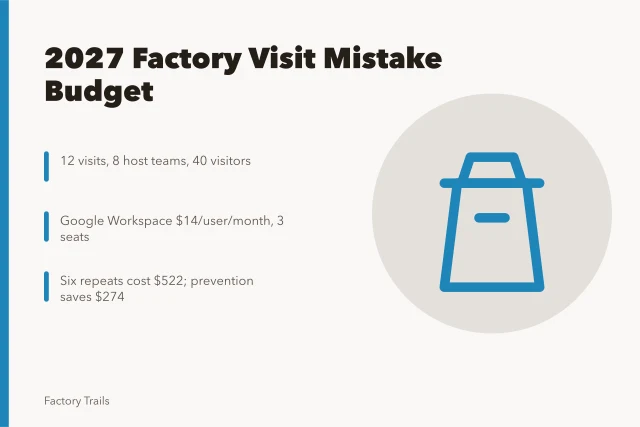
- Factory visits: a 2027 budgeting guide for mistake prevention with cost linesBudget factory visit mistake prevention for 2027 with real cost lines: software seats, host time, translation, reprints, and a worked example.
- Working factory visits: how owners should keep mistake records in 2027Factory visit mistake records guide for 2027 helps U.S. teams document visitor-facing errors, approved corrections, message versions, and follow-up actions.