Guides
Part of Working factory visits: 8 mistake prevention fixes for 2027
Working factory visits: a mistake prevention checklist before you publish
Factory visit mistake checklist for 2027 helps U.S. coordinators prevent stale booking details, conflicting guest messages, weak host briefs, and missing approvals.
What to take away
- Seven checks stand between a booking file and a publishable factory visit confirmation.
- Run the check at least five business days before the visit, so a correction can still reach guests.
- Every approval note carries an approver name, an approval date and a document version.
- If the host brief and the guest message disagree, pause distribution and agree on one current version.
- Send access and accommodation requests into the facility process instead of answering from memory.
These checks cover coordination only. They do not approve a route, a safety plan or a site condition.
What you own is whether the message a guest reads matches what the host will do on the day. Most of these failures repeat across sites, and our review of the eight mistake prevention fixes for 2027 shows which ones keep returning.
Seven checks to run before publishing
These seven items catch stale details, conflicting messages, weak host briefs and missing approvals. Work in order and write down each answer.
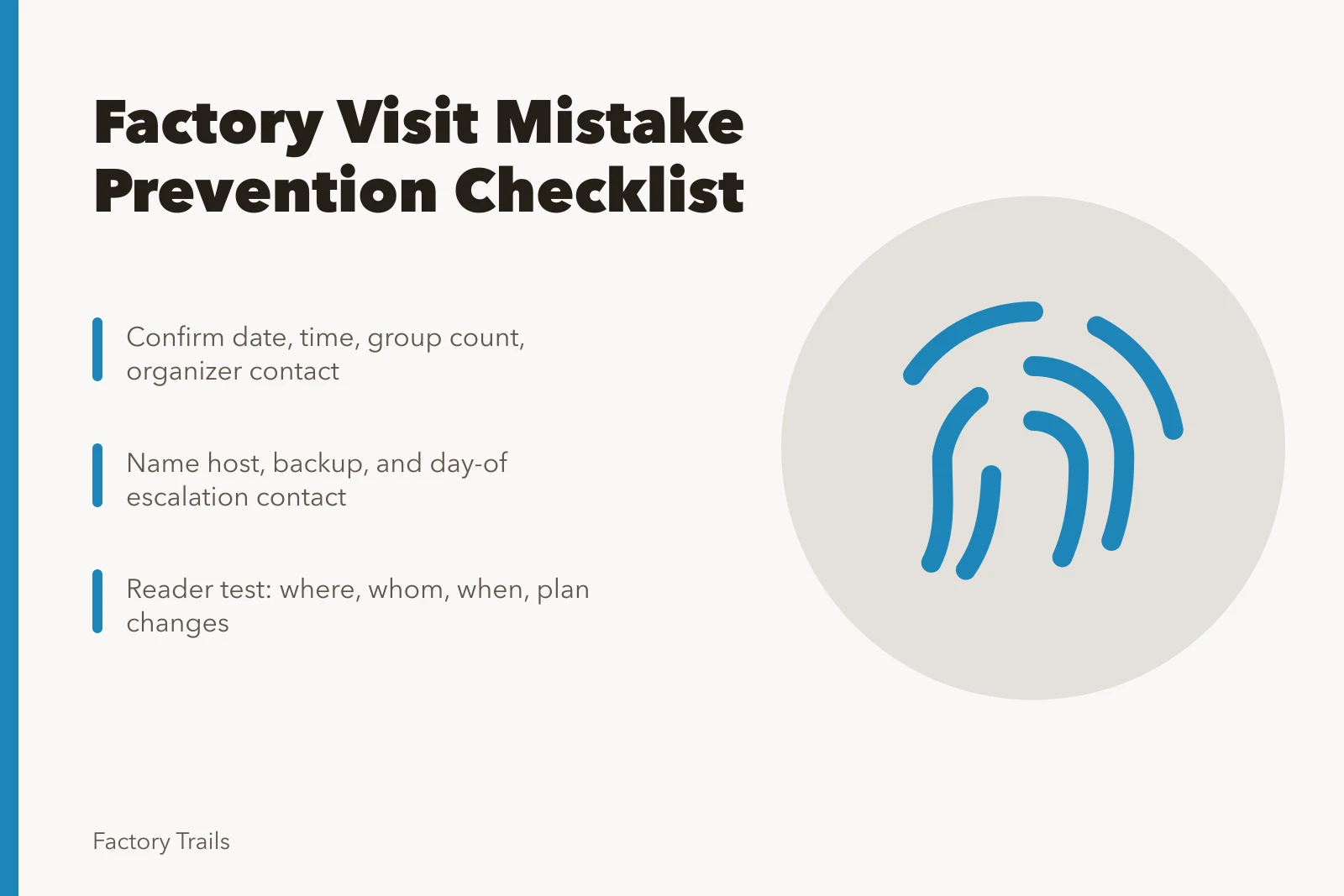
- Confirm the date, time, group count and organizer contact against the current booking record.
- Verify the approved meeting point and the arrival wording a guest will read.
- Name the host, the backup host and the day-of escalation contact.
- Compare the guest message with the host brief, line by line.
- List every access or accommodation request and mark it open or answered.
- Confirm the visit format has not changed since booking.
- State the approved alternative plan, or state that none exists.
Pre-publish factory visit checks
- Confirm date, time, group count, organizer contact
- Verify approved meeting point and arrival instruction
- Name host, backup, escalation contact
- Compare guest message with host brief
- Check access request needs confirmed response
- Ask whether visit format changed
- Identify approved alternative or state none
Missing piece / Action before publishing
- Current approval
- Ask the facility contact who owns the guest message
- Matching host brief
- Hold the release and correct the brief first
- Specific arrival wording
- Replace the street address with approved instructions
- Answer to a guest request
- Mark it open and route it into the facility process
The National Park Service trip-planning guide tells visitors to check conditions before a trip. A coordinator should hold the same line with dates, meeting points and arrival notes.
Where an item sits outside your remit, the guide to choosing a factory visit provider sets out what to look for in whoever carries it.
If the host supplies safety glasses or hearing protection at the door, the message should say what is handed out and what a guest brings. General PPE requirements put the duty to supply equipment on the employer, so ask the host instead of guessing.
A request for an interpreter, a written agenda or a step-free route goes to the facility process. Department of Justice guidance on effective communication notes that the right aid depends on the length, nature and context of the exchange.
Approval fields to record
An approval that names nobody is not an approval. Add a sign-off block to the version about to be sent, and keep it with the booking file.
Field / What goes in it
- Approver name
- The person who approved this version
- Approval date
- The date that approval was given
- Document version
- v1, v2, v3, with the change noted
- Change reason
- One line on what moved and why
- Source
- Booking record, host brief or a facility notice
Keep the current message, the prior version and the reason for the change. A dated note answers a later question without reviving an old error.
Timing rule: when to run the check
Set the deadline backwards from the visit date. A working default is to publish only after the check passes, and to start the work at least five business days before arrival.
Five business days is the floor for a single site. Use ten for multi-day programs, coach groups or any group with an open accommodation request.
Lead time also depends on scope, and the factory tour budgeting checklist sets out the scope items that shift both timing and cost. If the host brief changes late, rerun the comparison within 24 hours of arrival.
Example: a meeting point conflict, resolved
A confirmation named the visitor entrance. The host brief, written after a dock repair, named the shipping office. Both documents looked current.
- The coordinator held the send.
- The facility contact confirmed the shipping office for that week.
- The guest message was rewritten in the approved wording.
- The version moved to v3, with the approver name and date recorded.
- The host received the same wording and confirmed receipt.
The fix took one message and one call. Publishing either version unchecked would have sent a group to the wrong gate.
The reader test, run once
Ask someone who has never seen the site to read the final message. They should be able to say where to go, whom to meet, when the visit starts and what to do if plans change. Keep the result with the booking record.
Rerun the test only after a day-of change. If a host, meeting point or format changes, the replacement message goes through the same test. Guests should read one instruction, not a chain of corrections.
Groups that run visits across several plants often hand coordination to someone else. The guide to choosing industrial tour providers covers how briefs and access requests differ between working plants and heritage mills.