Guides
How to choose a working factory visits provider for 2027
Choosing a factory visits provider for 2027 means fixing the scope, scoring supplier evidence, and keeping plant decisions with the plant team.
A provider can carry the scheduling, the interpretation, the accessible formats and the visitor-facing print for a 2027 factory visit program. It cannot decide who walks a live plant floor.
What to take away
- Fix the scope before you compare providers; a vague brief produces quotes you cannot line up against each other.
- Score evidence that matches the stated work, not the longest client list.
- Keep access, route, restriction and emergency decisions with the plant's own authorized roles.
- Agree the change process, the approval owner and the response time before work starts.
- Closeout recordsfinal scope, accepted versions, approved changes and costs as approved.
Set the boundary in the scope
Start from the visitor outcome, not the vendor category. A scope that names the deliverable, the audience, the date and the approver can be priced. A scope that names a feeling cannot.
Provider scope boundaries
Provider may do
- Booking support
- Collect details, send messages
- Host materials
- Draft brief from approved facts
- Access request
- Capture request, coordinate response
- Photography and media
- Produce approved visitor assets
- Day-of support
- Manage agreed handoff
Provider may not do
- Booking support
- Approve entry or route
- Host materials
- Write technical or emergency instructions
- Access request
- Promise accommodation before confirmation
- Photography and media
- Record controlled areas or information
- Day-of support
- Override a plant decision
Then draw the line the provider will live inside. It may collect questions, draft messages from approved facts, and organize logistics. It may not open an area, change a route, describe a controlled condition, or speak for the plant in an emergency.
Provider may do
- Booking support
- Collect group details, send approved messages
- Host materials
- Draft a brief from approved facts
- Access request
- Capture the request, coordinate the response
- Photography and media
- Produce approved visitor assets
- Day-of support
- Manage the agreed handoff
Provider may not do
- Booking support
- Approve an entry or a visitor route
- Host materials
- Write technical or emergency instructions
- Access request
- Promise an accommodation before confirmation
- Photography and media
- Record controlled areas or information
- Day-of support
- Override a plant decision
Score evidence against the work
Ask for evidence tied to the assignment. A coordinator should show group schedules, changed instructions and host handoffs. An interpreter or accessible-format provider should show the communication arrangement you actually need. A producer should show work samples, a review process and a delivery plan that fits your dates.
Evidence to request
- Coordinatorgroup schedules and host handoffs
- Interpretercommunication arrangement you need
- Producerwork samples and review process
- Producerdelivery plan fitting your dates
- Short account of a late approved update
- References without forcing client disclosure
"We work with industrial clients" tells you nothing. A short account of how the provider handled a late approved update, a multilayer approval, or a group that arrived early tells you plenty. References help; do not make a past client disclose what they would rather not.
The Federal Acquisition Regulation's responsible-contractor guidance requires an affirmative determination of responsibility in public contracting and warns that lowest price alone can be false economy, though a private visitor program is not a federal procurement.
Interview for the handoff
The provider worth hiring makes ownership visible without being asked. Put these questions to every shortlisted candidate and write the answers down.
Handoff interview questions
- How do you receive approved site information?
- Who accepts a deliverable and signs changes?
- What if a guest question goes past your role?
- Who is day-of lead and when is handoff?
- What if the plant changes format that morning?
- How do you confirm that any information you give guests has been approved by the plant?
- Who signs off each deliverable before it reaches visitors, and what does that sign-off cover?
- If a guest question falls outside the approved script, who do you escalate to, and within what time?
- Who leads the handoff on the day, and how do you confirm the plant contact is reachable?
- How do you handle a format or language change after materials are approved?
A clear answer sounds like routing the question to the named plant contact and waiting for approved wording. Treat "we will handle it" as an answer that has not been given.
Make proposals comparable
Send every candidate the same written brief. It must cover these items:
Proposal scoring criteria
Criterion
- Scope understanding
- Reflects visitor outcome
- Relevant capability
- Comparable work or credible method
- Roles and handoffs
- Decisions and escalation named
- Cost clarity
- Assumptions, exclusions, change terms
- Availability
- Confirmed dates and review cycle
What to examine
- Scope understanding
- 1 to 5
- Relevant capability
- 1 to 5
- Roles and handoffs
- 1 to 5
- Cost clarity
- 1 to 5
- Availability
- 1 to 5
Score
- Scope understanding
- Relevant capability
- Roles and handoffs
- Cost clarity
- Availability
- audience
- dates
- deliverables
- approval process
- known constraints
- communication channels
- decisions that stay with the plant
Ask each to state:
- assumptions and exclusions
- staffing and lead time
- revision rounds and costs
- anything they need from the site
A detailed proposal and a vague one are not comparable, however close the totals look. The lower number may have left out coordination, preparation, travel, revision, accessible formats or a required role. Ask each provider to explain its price against the requested scope.
| Criterion | What to examine | Score |
|---|---|---|
| Scope understanding | Does the proposal reflect the visitor outcome you wrote? | 1 to 5 |
| Relevant capability | Comparable work, or a credible method? | 1 to 5 |
| Roles and handoffs | Are decisions and escalation points named? | 1 to 5 |
| Cost clarity | Assumptions, exclusions and change terms visible? | 1 to 5 |
| Availability | Confirmed dates and review cycle met? | 1 to 5 |
Weight the columns before you score, and write one line of reason beside each mark. A small team can stop at relevant experience, process, availability, cost clarity and references. Complex work needs more review, not more columns.
A worked example makes the scores concrete. Provider A scores 5 on scope understanding, 4 on capability, 4 on roles, 3 on cost clarity and 5 on availability, for 21 points.
Provider B scores 3, 5, 2, 5 and 4, for 19 points. Provider A wins even if Provider B quoted less, because B cannot name an escalation owner.
Cost is the gap most briefs leave open. Providers usually price in one of four ways: a fixed fee for a defined deliverable, a day rate for on-site work, an hourly rate for coordination, or a per-visit fee for recurring programs.
Published rates for industrial tourism work are not standard, so ask for a line-item quote tied to the brief. The total depends on group size, site access rules, travel, language, accessible formats, review rounds and insurance. Ask what each proposal excludes.
Choose fit over the longest résumé
The right provider depends on the assignment. A local coordinator with a tight scheduling process can beat a large production company on a recurring community visit. A specialist in accessible communication is not optional when the program needs one. A creative studio suits a visitor exhibit and not guest logistics.
Fit is not a feeling. It is whether the provider's method matches the work in the brief, and whether the named people are available on your dates.
Put approvals and changes in the plan
The provider should know which outputs need approval before guests see them. Build that review time into the schedule, and route comments through one person. Contradictory notes from four desks cost more than the review saves.
Change note process
- Change proposed
- Priced
- Approved
- Communicated
- Written note of scope and price
Factory visits change. The count grows, a language request arrives, the usual format is unavailable, or the session moves.
Do not ask the provider to absorb a material change without a conversation, and do not accept extra work without a written note of scope and price. A short change note naming the new work, the reason, the owner, the timing effect and the approval keeps a routine adjustment out of a dispute.
Handle guest information and plant boundaries
Give the provider only the guest information the assignment needs. Say where it may be stored, who may open it, and when it is returned or deleted under your policy. The National Institute for Occupational Safety and Health privacy guidance sets out why identifiable information needs that care.
The same restraint applies to operational detail. A richer visitor script is not a reason to hand over controlled information. The provider gets a clean brief; the plant keeps what it keeps.
Close out the work
After the visit, compare what happened with the written scope. Did the schedule hold? Did guests get the right materials? Did the handoff work? Did the change process work? Record facts, not impressions.
Log these items:
- Final scope as approved
- Delivered items and accepted versions
- Changes, with costs as approved
- Open issues and who owns them
- One performance note tied to the scope
That log is what lets next season's team tell an approved decision from an old preference.
Treat the scope as a decision record
The scope should name the result, the limits, the review points and the plant contact who makes final calls. The General Services Administration's performance work statement guide shows how outcomes, measures and responsibilities can be stated in one work document, though the federal setting differs.
The National Archives records-planning guidance frames clear responsibility as part of records management: someone is named as keeper of the file.
Budget lines for guides, transport and insurance sit in a separate piece; the provider budget guide breaks those out.
Common questions
Should one provider cover every task?
No. A coordinator, a language service, a creative producer and a transport organizer are different trades. Match each to the defined need, and keep one person accountable for the whole visitor experience.
Can a provider approve a route?
No. Route and access decisions belong to the plant's authorized role. The provider can coordinate the request and communicate the approved result.
How do we compare proposals fairly?
Use one written brief, list assumptions and exclusions side by side, and score capability, handoffs, availability and cost clarity as well as price.
What happens when the scope changes?
Write the new work, the timing effect, the cost effect, the approval owner and the guest message before anyone treats it as part of the job.
In this guide
- Working factory visits: a provider selection scope checklist for 2027Factory visit provider checklist for 2027 helps teams define visitor-program scope, compare capabilities, set approvals, and protect facility decision boundaries.
- How to compare working factory visits providers before you signFactory visit provider questions for 2027 help U.S. teams test scope understanding, relevant experience, cost assumptions, host handoffs, and change management.
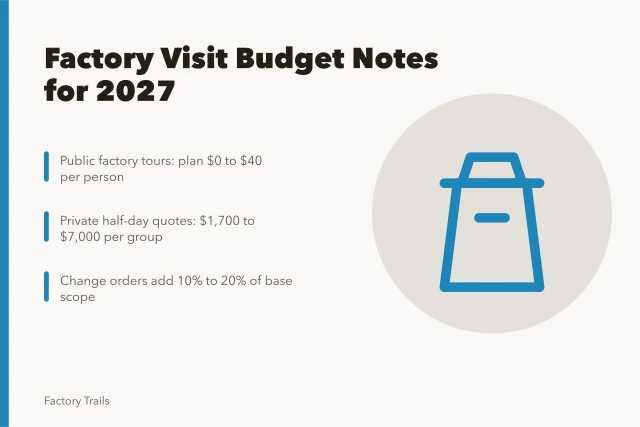
- Working factory visits provider selection: budget notes before you compare 2027 quotes2027 factory visit budget notes: public plant tour prices, private group ranges, change-order rules, and five real providers to compare before you request quotes.
- Factory visits provider records: what owners must keep for 2027Factory visit provider records guide for 2027 helps teams retain scope, selection notes, approvals, provider changes, final deliverables, and completion reviews.