Reviews
Part of How to choose a working factory visits provider for 2027
How to compare working factory visits providers before you sign
Factory visit provider questions for 2027 help U.S. teams test scope understanding, relevant experience, cost assumptions, host handoffs, and change management.
Ask provider questions that reveal how the candidate will work inside the visitor-program scope. Good questions show whether the provider understands the deliverable, can handle a change, and knows when to route a decision to the facility.
What to take away
This is a US-focused procurement checklist for 2027 planning.
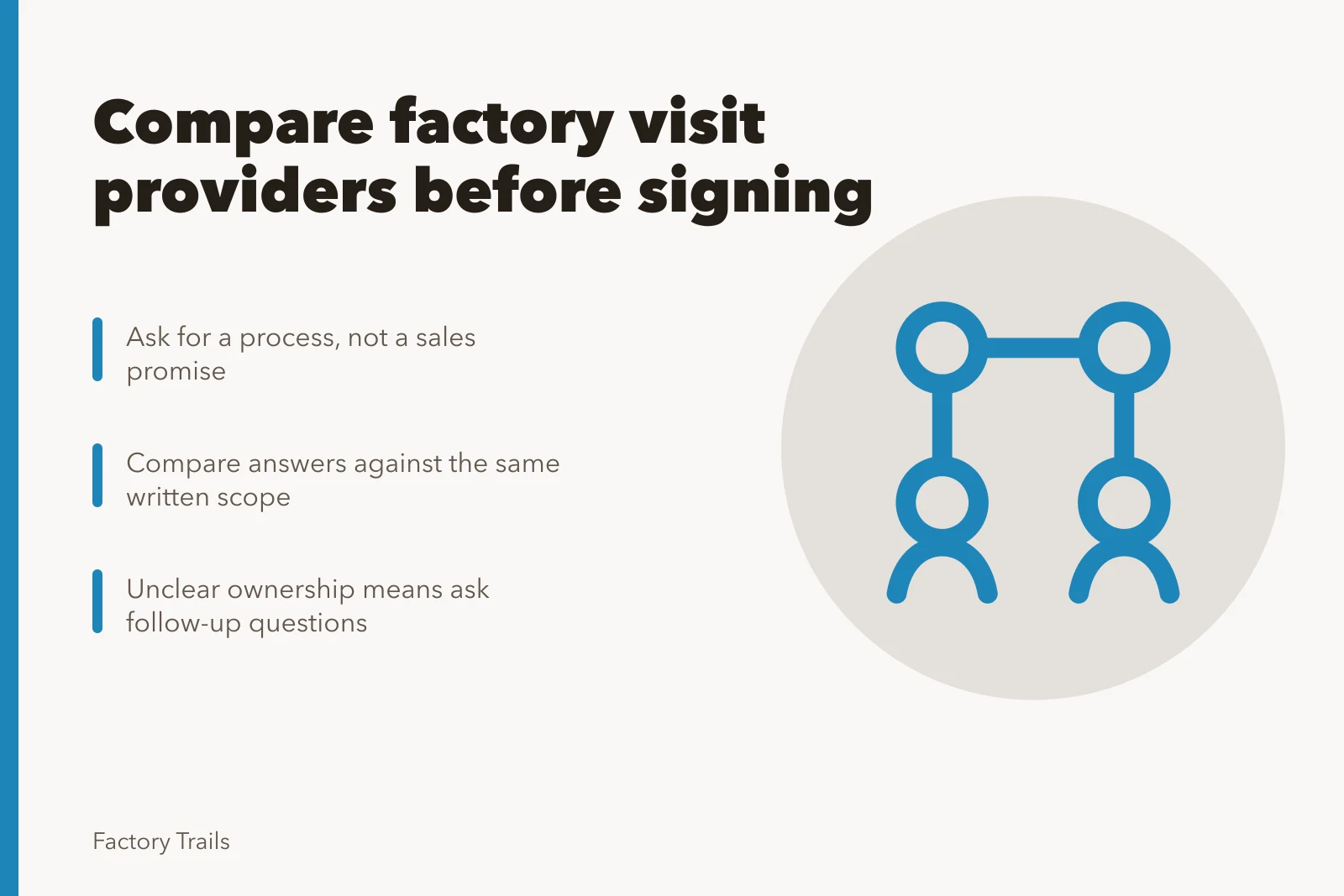
- Ask for a process, not a sales promise.
- Treat unclear ownership as a reason to ask follow-up questions.
Questions to ask
| Topic | Question |
|---|---|
| Scope | What do you understand the visitor outcome to be? |
| Experience | What comparable work shows you can deliver this? |
| Handoff | How will you give guests to the approved site host? |
| Change | What happens if the approved visit format changes? |
| Price | Which assumptions or exclusions affect your quote? |
Use the table below to score each candidate on the same scale. Weight the criteria to match the program.
| Criterion | Weight | Score 1 to 5 | What a high score shows |
|---|---|---|---|
| Scope fit | 25% | Names the visitor outcome and the facility approver | |
| Comparable work | 15% | Shows similar visits at working sites | |
| Handoff | 15% | Gives guests to a named facility host | |
| Change process | 20% | Defines triggers, approver, and price effect | |
| Price assumptions | 15% | Lists days, revisions, travel, and exclusions | |
| Records handover | 10% | Names files and rights the facility keeps |
For scope, a good answer names the visitor outcome, the facility host who approves it, and the sign-off step. For change, a good answer says what triggers a revision, who approves it, and how the quote changes.
Ask candidates to describe who needs to approve a guest-facing item. A provider who proposes a clear review path is usually easier to manage than one who promises unlimited revisions without identifying the decision maker.
Provider questions to ask
- Scopewhat visitor outcome do you understand?
- Experiencewhat comparable work shows delivery?
- Handoffhow will guests reach the site host?
- Changewhat if the approved format changes?
- Pricewhich assumptions affect your quote?
Acquisition.gov's contractor-performance guidance says evaluations should be relevant, objective, and backed by data. A private program can use the same narrow habit: evaluate a provider against the actual work and documented results, not impressions alone.
Listen for useful limits
The strongest answer may include a limit. For example, "We can draft the message, but the facility must confirm the route wording." That is a sign that the provider understands the boundary. A vague claim to handle every issue can lead to unauthorized promises.
After the interview, compare the answer with the written proposal. If the process described in conversation depends on work that is not in the scope, ask the provider to revise the proposal. A selection decision should rest on the assignment the team will actually approve, not on an informal expectation.
Keep a brief note of the answer and any follow-up. It gives the selection team a fair way to compare candidates and prevents a strong verbal discussion from being lost when the work plan is drafted later.
Ask how the provider handles a boundary
Ask candidates what they would do when a visitor request conflicts with facility policy. The Occupational Safety and Health Administration's contractor resource stresses communication of workplace conditions and responsibilities to outside workers. A visitor-program provider does not set safety rules, but a useful answer will show that the candidate pauses and refers the issue to the facility contact.
Ask for the assumptions behind the quote
Questions about price should produce a written scope, not a reassuring total. The GAO Cost Estimating and Assessment Guide explains documented assumptions, ground rules, and cost elements. Ask what days, locations, revisions, travel, accessibility work, and materials are included. Then ask how a change will be priced.
For example, a quote may assume three visit days and two review rounds with no travel. Adding a fourth visit day and a third review round changes labor and travel. A typical extra visit day plus travel can add several hundred to a few thousand dollars at US consulting rates.
Ask for the day rate and travel policy so the increase is priced before signing.
Ask how records will be handed over
The finished work should not leave with the provider's project folder. The National Archives records-management profile guidance treats recordkeeping as an assigned management responsibility. Identify which source notes, rights records, editable files, approvals, and final versions the facility receives at completion.
Document the selection conversation
Write down the answer that changed the team's view, not every sentence of the interview. A useful note records the question, the candidate's proposed method, the named facility role, and any condition still unresolved. This lets the team compare candidates fairly after several conversations without relying on the confidence of the last speaker.
Before making a selection, send a short written confirmation of the expected scope. The reply should match the proposal, including exclusions. If it introduces a new condition, decide whether that is an acceptable change before the work begins.
Keep one copy of the confirmation with the selection notes so the final work can be reviewed against the same expectation.
If the provider proposes a better method, record the change and its effect on the scope. A useful change improves the work without leaving either party uncertain about the result being purchased.
Common questions
Should every candidate receive the same questions?
Use the same core questions, then add specialist questions that relate to the stated service.
What is a warning answer?
An answer that does not name an owner, assumes site authority, or leaves cost assumptions unexplained needs follow-up.
Should a provider guarantee a visitor outcome?
The provider can commit to its defined work. Facility conditions and decisions should remain outside an unsupported guarantee.