Reviews
Factory tours budgeting options comparison: how the five formats differ
Factory tour budget options compared for 2027 help U.S. teams choose guided, viewing, self-guided, demonstration, and virtual formats by real operating tradeoffs.
Factory tour budgets vary by format. The best option is the one a site can operate safely, explain honestly, fund consistently, and improve with evidence. An active-floor tour may be powerful but impractical. A viewing route may be easier to control. A virtual or self-guided option may carry more up-front content work but reduce pressure on a restricted facility.
This comparison helps a U.S. team select a format before committing to tickets, marketing, equipment, or a public schedule. It compares operating tradeoffs and typical per-visitor budget bands.
What to take away
- Match the format to the siteactive-floor for live work, viewing route for restricted plants, demonstration for repeatable processes, self-guided for dispersed sites, virtual for remote or inaccessible areas.
- Choose a format around the site's actual access and staffing conditions.
- Compare the work needed before, during, and after each visitor experience.
- A narrower format can be a stronger public offer when it is consistently deliverable.
- Use a pilot to test the selected option under normal operations.
The five common options
What visitors receive
- Guided active-floor tour
- A hosted route near live work or equipment
- Guided viewing-route tour
- Interpretation from designated viewing points
- Demonstration program
- A planned process or object demonstration
- Self-guided experience
- Signs, map, audio, app, or defined public route
- Virtual or hybrid tour
- Video, interactive media, live remote host, or digital model
Main operating dependency
- Guided active-floor tour
- Safe public separation and production coordination
- Guided viewing-route tour
- Sightlines, sound, host skill, and route capacity
- Demonstration program
- Staff preparation, equipment readiness, and audience control
- Self-guided experience
- Accurate content, maintenance, and visitor wayfinding
- Virtual or hybrid tour
- Content production, update cycle, platform, and accessibility
These categories can overlap. A manufacturer may use a self-guided arrival area, a short host-led viewing route, and a virtual explanation for an active process that cannot be entered. The goal is not to force a single format. It is to make each component's cost and responsibility visible.
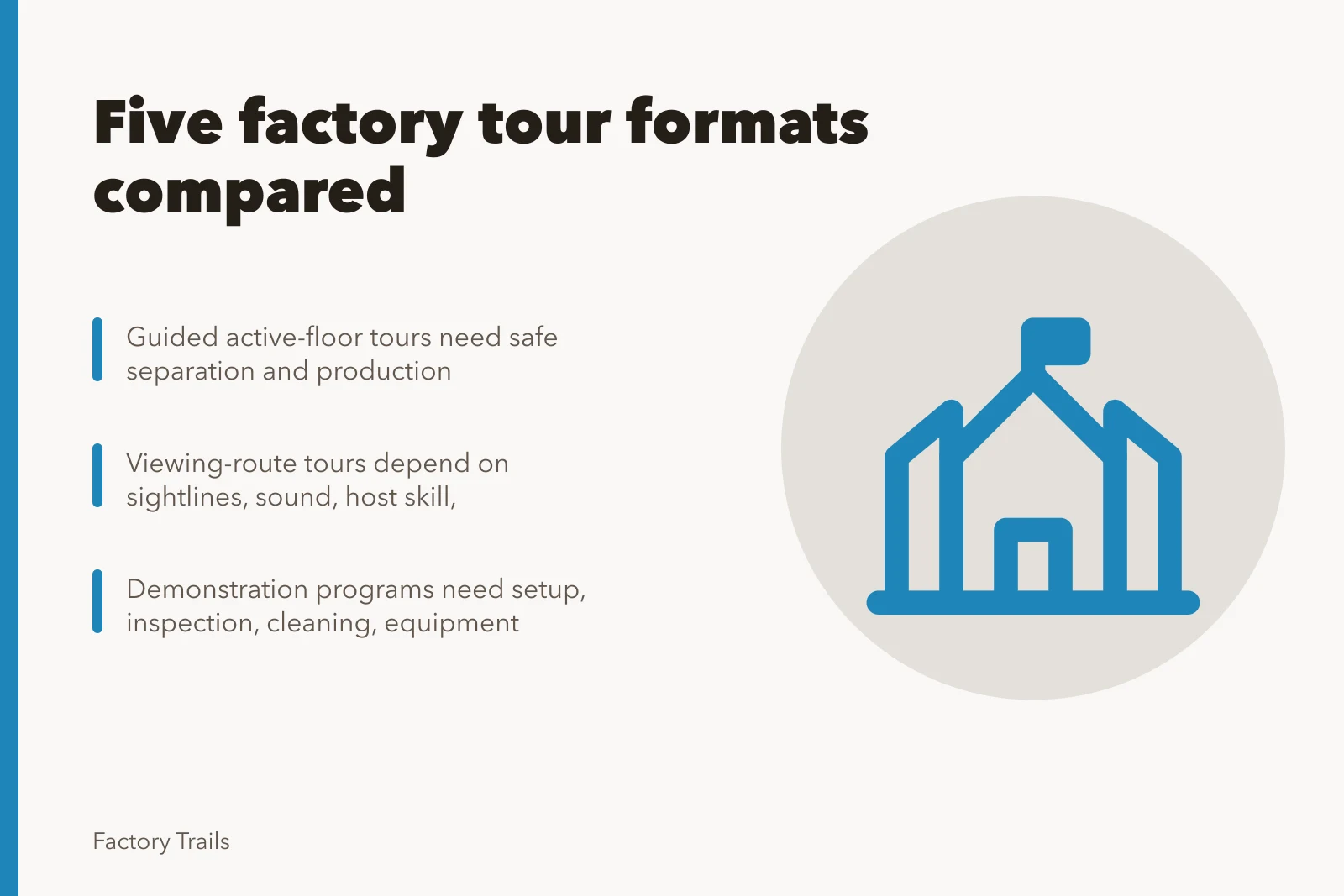
Five Factory Tour Formats Compared
Guided active-floor
- What visitors receive
- Hosted route near live work
- Main dependency
- Safe separation and coordination
Guided viewing-route
- What visitors receive
- Interpretation at viewing points
- Main dependency
- Sightlines, sound, host skill
Demonstration
- What visitors receive
- Planned process demonstration
- Main dependency
- Staff prep and equipment
Self-guided
- What visitors receive
- Signs, map, audio, app
- Main dependency
- Accurate content and wayfinding
The bands below are typical planning ranges for a small U.S. site. Actual costs depend on wage rates, group size, insurance, and season.
| Option | Typical planning band per visitor | Main cost driver |
|---|---|---|
| Guided active-floor tour | $15 to $40 | Host time, production pause, safety staffing |
| Guided viewing-route tour | $10 to $25 | Host time, route capacity, interpretation |
| Demonstration program | $8 to $20 | Staff preparation, equipment reset, audience control |
| Self-guided experience | $3 to $10 | Content design, wayfinding, maintenance |
| Virtual or hybrid tour | $5 to $15 remote; higher for live host | Production, captioning, platform, updates |
Option 1: Guided active-floor tours
An active-floor format usually has the strongest sense of immediacy. Visitors see work in context and can ask a knowledgeable guide direct questions. It also tends to have the least tolerance for vague planning.
The team needs a defined route, a process for changes in production conditions, appropriate visitor requirements, trained hosts, and a clear reason to limit or cancel access.
A U.S. example is the Ford Rouge Factory Tour in Dearborn, Michigan, which runs near live vehicle assembly. Typical planning band: $15 to $40 per visitor. A common staffing ratio is one host per 8 to 12 visitors.
Budget questions include:
- Which staff roles must be present during every session?
- What must be prepared, paused, separated, or monitored before visitors arrive?
- Does the route change during shift changes, deliveries, maintenance, or high production?
- What visitor information, equipment, or check-in process is required?
- What alternative can be delivered when access is unavailable?
Choose this option only when the site can operate the route regularly. A compelling one-off experience is not proof of a sustainable program.
Option 2: Guided viewing-route tours
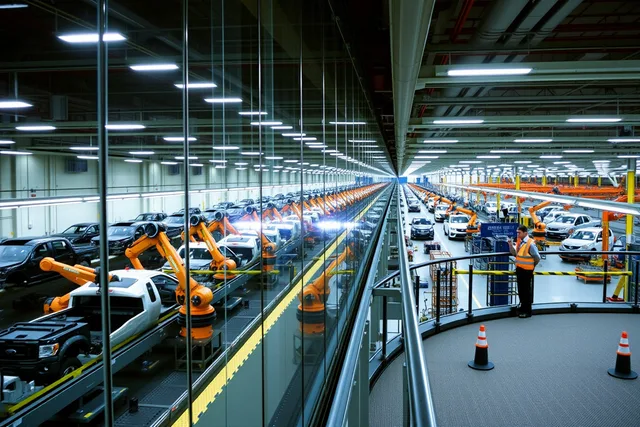
A viewing-route format is designed around controlled observation rather than broad access. It may use windows, galleries, marked stops, an overlook, a demonstration area, or a separated corridor. This can be an excellent option for an active plant because it allows the host to focus the story and protect boundaries.
A U.S. example is the Boeing Future of Flight in Everett, Washington, which uses a gallery over the 787 assembly line. Typical planning band: $10 to $25 per visitor. A common ratio is one guide per 15 to 20 visitors.
The budget shifts toward interpretation, sightlines, communications, route design, and accessibility. It may reduce some direct exposure to active production, but it does not make staffing or safety planning optional. A guide still needs to manage arrivals, explain what visitors can see, answer questions, and respond when a stop is not available.
This option works well when the process is visible but the work area itself cannot be opened to the public. It also lets a team test visitor interest before building a larger operation.
Option 3: Demonstration programs
A demonstration creates a repeatable moment for visitors: a machine in a controlled setting, a craft process, a test, a material sample, or an interpreter explaining an industrial task. It is often easier to schedule than an active-floor route because the team can select the location and timing.
A U.S. example is the Corning Museum of Glass in Corning, New York, which runs live glassmaking demonstrations. Typical planning band: $8 to $20 per visitor. Plan one demonstrator plus one audience manager for groups above 20.
The hidden cost is preparation. Someone must set up, inspect, clean, reset, and possibly maintain the demonstration equipment. The format also needs a capacity limit based on the viewing area, the host's ability to communicate, and the conditions required for safe delivery.
Use a demonstration when the goal is understanding a process, not access to every production area. It can be paired with an exhibit, video, or question period to make the value clear even on days when production cannot be shown.
Option 4: Self-guided experiences
Self-guided formats shift live labor toward design, maintenance, and content accuracy. They can include maps, signs, mobile audio, a visitor-center route, exterior interpretation, or a designated open area. They may serve more visitors at their own pace, but they still need reliable wayfinding, honest safety boundaries, current information, and a way to correct damaged or outdated materials.
The National Park Service's Coltsville self-guided tour illustrates a format that uses multiple stops and an app while clarifying that some locations are private residences and not open to visitors. A factory can use the same principle: a self-guided option must state what is accessible, what is not, and what behavior protects the site and its users.
Typical planning band: $3 to $10 per visitor. One staff member per 40 to 60 visitors is a common check-in and wayfinding ratio.
Budget the design and testing of the materials. A self-guided tour that sends visitors to a closed, restricted, or unclear stop creates more work, not less.
Option 5: Virtual and hybrid tours
Virtual formats can show areas where in-person access is limited by safety, security, noise, distance, weather, or operating schedules. They can also help people prepare for a visit. A hybrid format may use a live host at a viewing route, a short video of a restricted process, and a virtual follow-up for schools or remote audiences.
A U.S. example is The Henry Ford in Dearborn, Michigan, which offers virtual field trips for remote groups. Typical planning band: $5 to $15 per remote visitor; live-host sessions cost more. A live virtual session usually needs one producer or moderator plus content review hours.
The first investment is typically the largest line: a short filmed tour often takes 20 to 60 hours of planning, filming, editing, captioning, and review. Recurring cost is often $5 to $15 per remote visitor once the content is current, and it stays lower than live groups only if the team funds content maintenance and audience support.
Virtual does not mean generic. It should have the same clear purpose, route or sequence, visitor information, and accuracy checks as an in-person experience. A digital image of an active space should not be presented as current if it no longer reflects operations.
Compare options using the same decision grid
Do not compare an active-floor route's staff cost against a self-guided map's printing cost alone.
Tour Format Decision Grid
Active floor
- Access to live work
- High
- Live staffing
- High
- Up-front content work
- Moderate
- Production schedule dependence
- High
- Need for update process
- High
- Best early test
- Controlled small group
Viewing route
- Access to live work
- Limited
- Live staffing
- Moderate
- Up-front content work
- Moderate
- Production schedule dependence
- Moderate
- Need for update process
- High
- Best early test
- Timed route walk
Demonstration
- Access to live work
- Controlled
- Live staffing
- Moderate to high
- Up-front content work
- Moderate
- Production schedule dependence
- Lower
- Need for update process
- High
- Best early test
- Small demonstration
Self-guided
- Access to live work
- Usually low
- Live staffing
- Lower per visitor
- Up-front content work
- High
- Production schedule dependence
- Lower
- Need for update process
- High
- Best early test
- Wayfinding trial
Active floor
- Access to live work
- High
- Live staffing
- High
- Up-front content work
- Moderate
- Dependence on production schedule
- High
- Need for update process
- High
- Best early test
- Controlled small group
Viewing route
- Access to live work
- Limited
- Live staffing
- Moderate
- Up-front content work
- Moderate
- Dependence on production schedule
- Moderate
- Need for update process
- High
- Best early test
- Timed route walk
Demonstration
- Access to live work
- Controlled
- Live staffing
- Moderate to high
- Up-front content work
- Moderate
- Dependence on production schedule
- Lower
- Need for update process
- High
- Best early test
- Small demonstration
Self-guided
- Access to live work
- Usually low
- Live staffing
- Lower per visitor
- Up-front content work
- High
- Dependence on production schedule
- Lower
- Need for update process
- High
- Best early test
- Wayfinding trial
Virtual or hybrid
- Access to live work
- Digital or remote
- Live staffing
- Varies by host model
- Up-front content work
- Often high
- Dependence on production schedule
- Lower once current
- Need for update process
- High
- Best early test
- Short content prototype
The table is a starting point, not a scorecard. Your site may have a secure viewing gallery that makes guided visits easy, or a dispersed historic campus that makes self-guided discovery the best choice. Mark the site-specific evidence next to each factor.
The National Park Service's interpretive-planning guidance frames planning around the audience, the place, and the outcome a visitor should carry away. It does not approve a factory program or route. It does support a useful planning habit: define the visitor outcome before pricing a format.
A team that cannot state what a visitor should learn or do has no sound basis for choosing between a guide, a gallery, or a video.
Public-facing information still needs a named change owner. The National Archives explains that web records must be managed through their life cycle. For a tour budget, the comparable line is the staff time to check booking copy, route maps, host notes, and recorded material after a process change.
Access information needs the same owner. The Department of Justice notes that the right aid or service for effective communication depends on the nature, length, complexity, and context of the communication. Budget for that review before booking opens, not after a guest asks.
Match the option to the visitor
Different visitors need different formats. A trade group may value technical questions and a focused route. Families may need simple instructions, a shorter duration, and predictable pacing. A school group may need clear chaperone roles and a learning objective. Remote visitors may need a live question period or an accessible recording.
Start with one audience. Attempting to serve every visitor type in the first version can turn the cost model into a collection of incompatible promises. Once the team has real operating data, it can add a separate format with its own scope and budget. Document why that audience and format were selected for the first operating period.
Run a format pilot, not a publicity event
The first delivery should answer a limited question. An active-floor pilot might test group movement and host workload. A self-guided pilot might test whether visitors understand the map without staff coaching. A virtual pilot might test whether viewers can follow the narrative and use the platform.
Record the route, attendance, staff time, questions, access issues, content changes, and decision made. A format is ready to expand only when the pilot has shown that the site can deliver its stated experience under normal conditions.
Common questions
Which factory-tour option costs the least?
The least expensive format is usually self-guided at $3 to $10 per visitor, but that band assumes accurate wayfinding and a maintenance plan. A guided active-floor tour is usually the most expensive at $15 to $40 per visitor.
Can a factory use more than one option?
Yes. A defined mix can work well when each component has clear boundaries, ownership, and current visitor information.
Is a virtual tour only a backup?
No. It can be a primary experience or a useful complement when a site needs to show restricted, distant, or changing operations.
What should determine the first pilot?
Choose the option that tests the most important site constraint with the least irreversible commitment.