Guides
Factory tours maintenance plan: keeping 2027 access and cost claims current
Factory tour maintenance plan for 2027 names Boeing, Ford, Jelly Belly, Ben & Jerry's, and Toyota access and cost claims to recheck before publication.
Factory-tour content needs maintenance because the facts readers use to make a trip are live. A maintenance plan keeps 2027 access and cost claims current. Start with named claims. Boeing Future of Flight in Everett, Washington, sells timed tours online and bars children under 4. Jelly Belly in Fairfield, California, lists free self-guided tours. Ford Rouge Factory Tour in Dearborn, Michigan, is run by The Henry Ford. Ben & Jerry's in Waterbury, Vermont, sells guided tours with samples. Toyota Motor Manufacturing Kentucky in Georgetown offers free reservations. Recheck each before 2027.
What to take away
- Separate stable history from live 2027 access and cost claims.
- Keep a source, date checked, and review trigger for every claim.
- Review before seasonal changes, publication updates, and paid placements.
- Replace or remove a 2027 claim that cannot be confirmed.
- Keep image credits, source records, and sponsorship disclosures.
Sort claims into three layers
Not every sentence changes at the same pace. Divide the article into three layers.
Three Claim Layers and Review Rhythm
Stable context
- Examples
- History, architecture
- Review rhythm
- New evidence
- Source need
- Strong source
Live visitor facts
- Examples
- Hours, fees, access
- Review rhythm
- Pre-publication, seasonal
- Source need
- Exact program page
Editorial material
- Examples
- Observation, rankings
- Review rhythm
- Visit or complaint
- Source need
- Stated criteria
Examples
- Stable context
- Historical process, documented architecture, archival interpretation
- Live visitor facts
- Hours, tours, access terms, fees, reservations, transit
- Editorial material
- Personal observation, ranking criteria, sponsored placement disclosure
Review rhythm
- Stable context
- Review when new evidence or a correction appears
- Live visitor facts
- Review before publication and at a seasonal interval
- Editorial material
- Review after a visit, complaint, correction, or commercial change
The division is practical, not absolute. A historical claim still needs a strong source. A current visitor fact still needs the exact page responsible for the public program. The division tells an editor where to spend time first. It also avoids updating a ticket price while leaving a canceled tour as the article's centerpiece.
Build a 2027 claim inventory
Open the page and list every claim a reader might act on. Include program name, entry point, 2027 dates, reservation rule, and fee. Also note age rule, physical condition, contact method, and photo credit. Label each row:
2027 Claim Inventory Fields
- Program name and entry point
- 2027 dates and reservation rule
- Fee and age rule
- Physical condition and contact method
- Photo credit
- Source URL and date checked
- Next review and owner
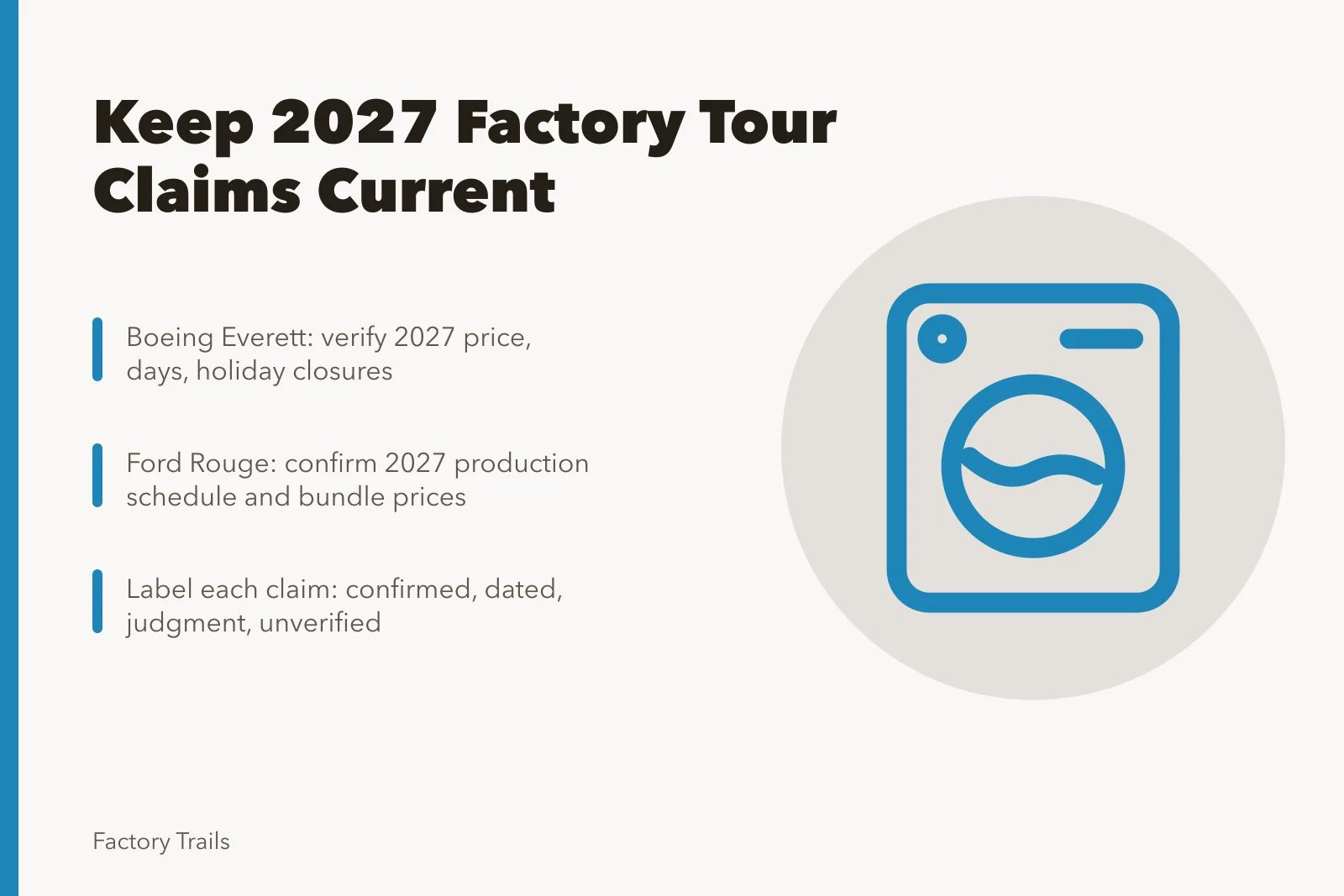
- Confirmed factlinked to a current responsible source.
- Dated observationwhat a writer saw on a stated date.
- Editorial judgmenta conclusion based on stated criteria.
- Unverified leadinformation that must not appear as a reader instruction.
Use Google Sheets for a free shared inventory. Use Airtable when you need linked records and views. Use Notion for a small editorial database. Each tool has free tiers for small teams. Add source URL, date checked, next review, and owner.
2027 access and cost claims to maintain
| Tour | Public claim to check | 2027 review action |
|---|---|---|
| Boeing Future of Flight, Everett, WA | Timed Boeing Everett Factory Tour; online tickets; adult price around $12 in 2025; no children under 4 | Verify 2027 price, tour days, and holiday closures |
| Ford Rouge Factory Tour, Dearborn, MI | The Henry Ford ticket includes factory tour; adult around $18 in 2025 | Confirm 2027 production schedule and bundle prices |
| Jelly Belly Factory Tour, Fairfield, CA | Free self-guided tour; no reservation most days | Check 2027 holiday closures and reservation policy |
| Ben & Jerry's Factory, Waterbury, VT | Guided tour with sample; adult around $6 in 2025 | Recheck 2027 ticket price and flavor schedule |
| Louisville Slugger Museum & Factory, Louisville, KY | Admission includes factory tour; adult around $18 in 2025 | Verify 2027 bat production days and admission |
| Toyota Motor Manufacturing Kentucky, Georgetown, KY | Free plant tour by reservation; age and shoe rules apply | Confirm 2027 tour days and reservation limits |
| Corning Museum of Glass, Corning, NY | Glassmaking demos; adult admission around $22 in 2025 | Check 2027 demo schedule and admission |
These are public examples, not endorsements. Prices are 2025 listings and can change. A 2027 article must date every figure and link to the operator's page, not a third-party summary.
Set review triggers, not just dates
Use Google Alerts to track operator pages for 2027 tour, ticket, and closed terms. Use the Internet Archive Wayback Machine to compare old and new pages. Use Zapier or IFTTT to send alerts when a watched page changes. Set triggers:
Review Triggers for Tour Claims
Has a source page changed?
Recheck dependent sentence
Keep monthly scan
| Trigger | What to check |
|---|---|
| Before publishing | Every 2027 access, cost, schedule, and image claim |
| Before peak season | Dates, booking links, weather, staff notices |
| After a source changes | The sentence that depends on it |
| After an editor visits | New observation vs. verified policy |
| Before renewing a sponsored listing | Public offer, disclosure, criteria |
| After a correction request | Claim, source, change date, reason |
A monthly scan of event, access, or manufacturing pages beats a dense spreadsheet no one opens. Record the last review, next trigger, and owner.
Review access claims first
Access language has the highest consequence. Ask: Is this exact tour, exhibit, visitor center, route, or program still offered? Does the source say the public may enter? Does the article send readers toward homes, offices, active worksites, service roads, or rail corridors? If unsure, revise. Keep documented history without an unconfirmed arrival instruction. Use the historic district includes rather than visit this building when the building is not confirmed as public.
The National Park Service's historic preservation overview presents preservation as carrying understanding to future generations. That perspective helps: preserving a story includes preserving the line between a documented place and a current visitor experience.
Check schedules, fees, and reservations together
A page can be open while the specific experience is unavailable. A site may have outdoor grounds, a closed visitor center, a seasonal tour, an event demonstration, or a timed activity with a separate booking step. Review all terms together.
Access Claim Review Questions
- Is this exact tour still offered?
- Does the source say public may enter?
- Does it send readers to active worksites?
- Is the building confirmed public?
- If unsure, revise the sentence
Use the operator's exact source page. Save the page title, URL, and date checked. Note whether it gives a permanent rule, seasonal notice, event schedule, or temporary closure. When the source is vague, do not make it clearer than the organization does.
For costs, keep a figure only with date, program, eligibility, and conditions. If no current amount exists, write the planning method instead of inventing a range.
Keep observation separate from policy
A writer's field notes can make an article vivid. They can say a group arrived early, found an exhibit useful, or met heat, noise, or uneven paving on a date. Those notes should not become universal statements. Use a simple pattern: state the observation and date, identify its scope, link live policy claims only to the responsible organization, and remove an observation that can no longer be presented fairly.
Maintain images and credit records
Every image needs a local asset record, alt text, credit source, and editorial role. A historic image can set tone, but it does not prove present-day access, business operation, or safety. Keep those functions separate.
The National Park Service visitor conditions guidance explains that visitor conditions can change. It does not verify another site's access or program. It supports returning readers to the responsible current source.
The National Archives' records-management fundamentals explain why factual decisions need traceable records. Keep source, date checked, claim, limitation, and next review date.
The National Park Service Museum Handbook is a professional museum reference. It does not establish a site's current visitor program. It supports the distinction between historic material and current public terms.
Handle commercial requests without weakening the record
An owner, operator, tourism organization, or agency may ask to update a listing or buy a placement. Keep those actions distinct. For a factual correction, request the responsible source, check the page, revise the sentence, record the date, and retain a short note. For a paid inclusion, explain what readers receive and label the placement. Do not let payment create a claim about quality, safety, availability, or history that cannot be independently supported.
A maintenance workflow for one factory tour article
| Step | Action | Result |
|---|---|---|
| 1 | Open the 2027 claim inventory | Live and stable material are visible |
| 2 | Recheck public access | Unsafe or stale directions are removed |
| 3 | Recheck schedule and cost | Reader-facing planning facts are current |
| 4 | Review observations and rankings | Editorial language stays dated and fair |
| 5 | Check image credit and alt text | Visual material remains traceable |
| 6 | Log corrections and commercial changes | Future updates have a record |
Complete the workflow before a major promotion, a seasonal travel period, or a listicle refresh. If information cannot support a recommendation, use a narrower history article or remove the recommendation until checked.
Schedule, Fee, and Reservation Checks
- Save page title, URL, date checked
- Note permanent, seasonal, or temporary terms
- Keep fee with date and eligibility
- Do not clarify vague sources
- Write planning method if no amount
Common questions
How often should a factory-tour article be reviewed?
Review live 2027 visitor facts before publication and whenever schedule, reservation, fee, access, or business offering could change. Stable history can follow a longer cycle.
What should happen when a source disappears?
Remove or qualify the dependent claim, search for a current responsible replacement, and record the change. Do not leave the old statement because it was once true.
Can an editor use a personal visit to update access information?
Use the visit as a dated observation. Confirm operating rules and public access through the responsible organization.
Can a paid placement remain after a business changes its offer?
Only after the new factual terms are independently checked and the placement remains clearly disclosed.