Guides
Factory tours maintenance plan scope checklist: what publishers must review
Factory tour content care checklist for 2027 helps U.S. publishers review access claims, live terms, source dates, image credits, and disclosures.
Use this checklist before refreshing a factory-tour page, republishing a list, or approving a commercial update. It keeps live travel information separate from durable historical context.
What to take away
- Review access, schedule, and cost language before promotion.
- Save a specific source and check date beside every material visitor fact.
- Keep observations and opinions clearly dated.
- Do not let a paid request bypass source checking.
The care checklist
- Open the current article record.Find its source list, prior edit notes, image credit, and publication date.
- List live claims.Mark each statement about public entry, tours, hours, fees, reservations, parking, accessibility, or photography.
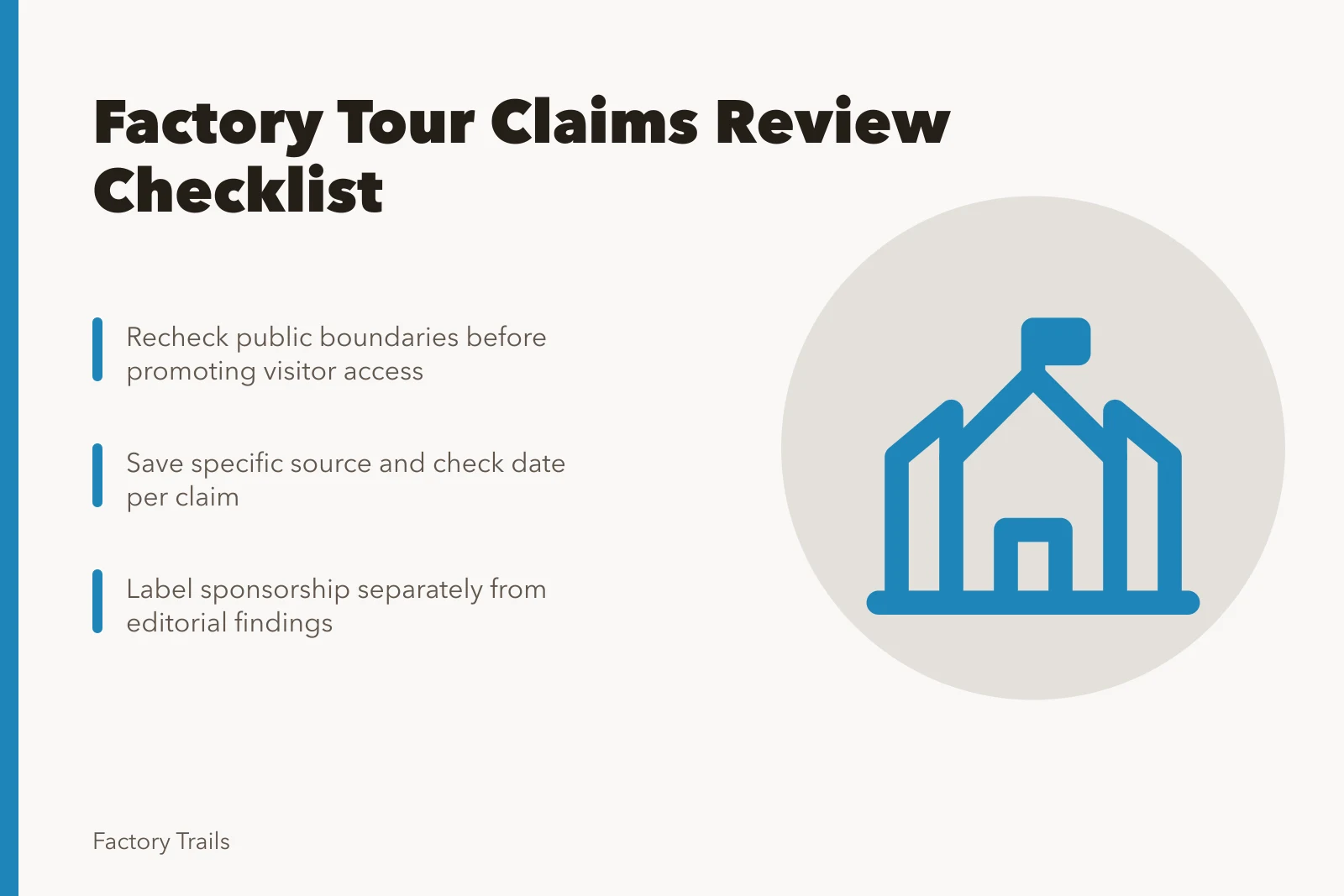
- Recheck public boundaries.Remove directions that could lead readers into private, active, residential, or restricted space.
- Check the exact activity.A site being open does not prove its visitor center, exhibit, or guided tour is offered.
- Check live terms together.Review schedule, fee, booking, arrival, group, and weather conditions as one decision.
- Separate observation from policy.Keep field notes dated and do not restate them as universal rules.
- Inspect image records.Confirm the local asset, descriptive alt text, specific credit page, and limited editorial purpose.
- Review commercial language.Disclose any placement and independently support all factual claims.
- Log the change.Save what changed, why, source used, and date checked.
- Set the next trigger.Use a seasonal opening, event date, scheduled refresh, or correction request.
Read the title, description, table, body, caption, and promotion fields together. If a source narrows a program, correct the short fields as well as the main paragraph.
The National Archives preservation page organizes preservation work around media, storage, handling, environmental monitoring, and digital preservation. That framework is useful for editorial care as well: a reliable article needs a visible system, not scattered memory.
Editorial care checklist
- Open article record and source list
- List live public entry claims
- Recheck public boundaries and restrictions
- Check exact activity offered
- Review live terms together
- Inspect image records and credits
- Log change and set next trigger
Quick review table
| Article element | Pass condition | Fail example |
|---|---|---|
| Public access | Exact program and current public boundary confirmed | Directions lead readers to a staff-only gate |
| Live planning facts | Specific responsible source and date saved | "Tours daily" with no source and no check date |
| Historical material | Supported without implying present-day access | History text implies the plant is open today |
| Images | Credit, alt text, and scope note present | Photo of a private floor with no credit |
| Sponsorship | Labeled separately from editorial findings | Paid placement reads as an editorial pick |
The National Park Service visitor conditions guidance explains that visitor conditions can change. It supports checking a responsible current page before a maintenance plan promises a route, activity, or public service.
The National Archives' records-management fundamentals explain why editorial decisions need traceable evidence.
The National Park Service Museum Handbook is a professional museum reference. It supports separating historical context from current visitor information.
Check the article in claim order
Start with the sentences a reader could act on: public activity, entry process, schedule, route, admission, access feature, and backup. Confirm each against its responsible current source. Review historical context and personal observations separately.
Keep a status beside each claim: confirmed, needs review, changed, or removed. A plant that switches from walk-in tours to timed online reservations changes entry, booking, and arrival in one decision.
Common questions
What should be checked first?
Check the exact public access claim. A reader can act on it immediately, so it deserves the fastest and strongest review.
Can I leave an old price if the historical article is still useful?
No. Remove or refresh the live price while retaining historical context that remains supported.
Does a sponsor's email count as a source?
Treat it as a lead. Confirm the factual change through the responsible public source and disclose any commercial relationship.