Reviews
Factory tour budgeting questions to compare 7 formats before you spend
Seven factory tour formats carry different cost lines, from free walk-in floors to balcony galleries and virtual walkthroughs, so compare the route before the price.
Seven factory tour formats exist, and they do not cost the same to run. A working assembly line, a preserved machine hall and a 3D walkthrough each carry their own fixed setup, per-visitor cost and shutdown-day risk. Compare the route before you compare the price. The table below gives typical ranges for each format.
What to take away
- Ask each format for three numbersfixed setup, cost per visitor, and the cost of a disrupted day.
- Public walk-in, guided group, school, active-floor, gallery, virtual and self-guided audio are seven distinct formats, not seven names for one tour.
- Keep the approved booking wording on file. When capacity or access changes, you need the old promise to correct.
- Typical setups range from near zero for an existing retail route to six figures for a new active-floor walkway.
The seven formats, with what each costs to run
| Format | Named example | Typical setup | Typical per visitor | Downtime risk |
|---|---|---|---|---|
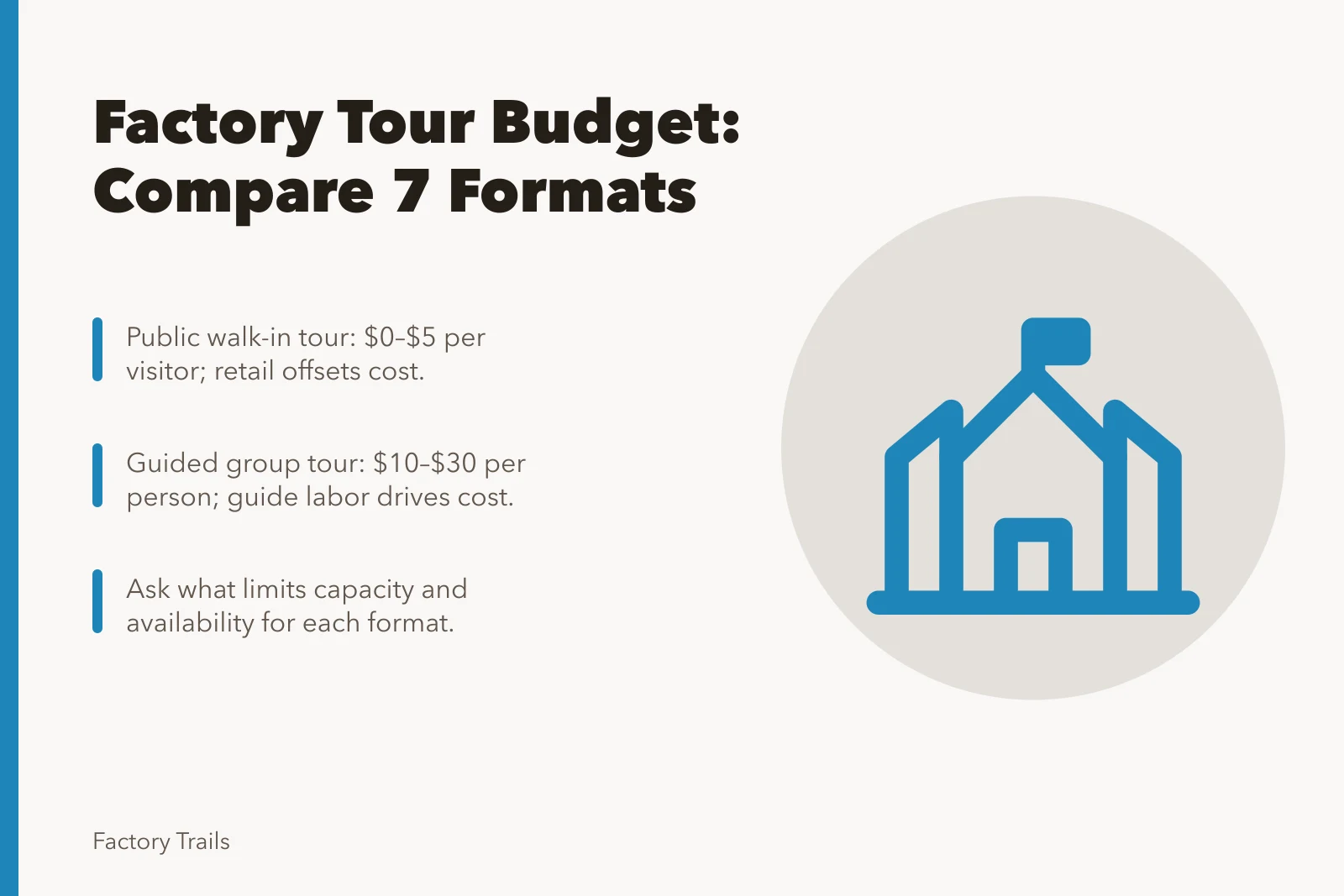
| Public walk-in | Jelly Belly Visitor Center, Fairfield, California, lists a free self-guided factory tour. | $0 to $10,000 | $0 to $5 | Low |
| Guided group | The National Park Service's Thomas Edison group-tour guidance describes limited tour windows and a maximum group size. | $1,000 to $10,000 | $10 to $50 | Medium |
| School or student | Toyota Motor Manufacturing Kentucky runs free plant tours by reservation, with age limits. | $500 to $5,000 | $5 to $15 | Medium |
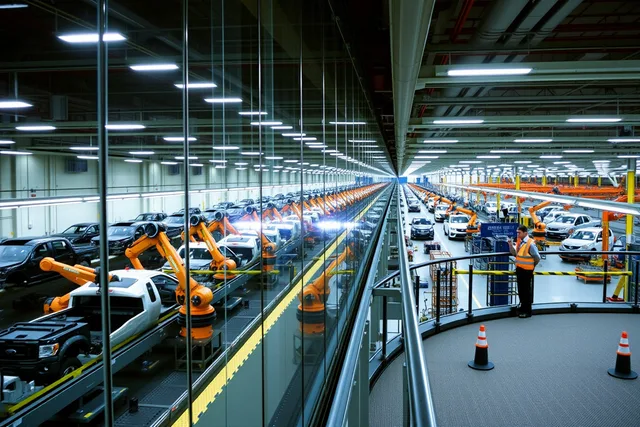
| Active-floor | Ford Rouge Factory Tour at The Henry Ford uses bus transport and walkways over an F-150 assembly line. | $50,000 to $500,000 | $25 to $75 | High |
| Viewing gallery | Boeing Future of Flight in Everett, Washington, sells balcony views of the assembly floor. | $100,000 to $1,000,000 | $15 to $40 | Low |
| Virtual | Matterport builds 3D walkthroughs of restricted spaces. | $10,000 to $100,000 | $5 to $20 | None |
| Self-guided audio | VoiceMap lets creators publish location-aware audio tours. | $1,000 to $10,000 | $2 to $10 | None |
Ticket prices and subscription rates change. To get a current number, open the operator's booking page and note the adult ticket price. If last season's note says $25 and the page now says $29, use $29. Then divide annual ticket revenue by visitor numbers to get a per-visitor figure you can compare across formats.
Seven tour formats and cost drivers
Format
- Public walk-in
- Retail offsets cost
- Guided group
- Guide labor drives cost
- School or student
- Bus and supervision outside
- Active-floor
- Tickets plus safety gear
- Viewing gallery
- Fixed railings and exhibits
- Virtual
- Capture per site
- Self-guided audio
- Low per-user price
Budget signal
- Public walk-in
- Cleaning and floor staff
- Guided group
- Second guide doubles it
- School or student
- Free by reservation
- Active-floor
- Driver time recurs
- Viewing gallery
- Gallery staffing sets cost
- Virtual
- Ongoing subscription
- Self-guided audio
- Platform handles payments
Where the money actually goes
The table above gives the numbers. Here is the single cost line that matters for each format.
Where each format's money goes
Format
- Public walk-in
- Cleaning, floor staff, lost retail space
- Guided group
- Guide labor; second guide is the trap
- Active-floor
- Bus, driver, safety glasses, downtime
- Viewing gallery
- Gallery staffing; railings already standing
- Virtual
- Subscription; capture is one-off
- Self-guided audio
- Low per-user; platform handles payment
Recurring cost
- Public walk-in
- Guided group
- Active-floor
- Viewing gallery
- Virtual
- Self-guided audio
Find the limiting condition
Write one line per format: what stops you taking more visitors? It is a viewing area, a guide, a vehicle, or the time needed to clear a production zone.
Build the schedule around that condition. Setting an attractive visitor number first and working backwards produces a plan the site cannot run.
Compare one audience at a time
A format that suits a trade delegation rarely suits a school program. Keep the assumed group, the schedule and the visitor promise beside each cost comparison.
Then test the note on someone who has not read it. Can they say what happens, what access is offered, and what changes when normal conditions block the route?
The National Park Service's interpretive-planning guidance starts with audience and outcome, not with a format. Use it to ask which option helps a visitor understand the plant, then price the answer.
The National Archives treats web records as documented information. Budget staff time to keep the approved booking statement for each format. A records review costs less than a misstated capacity promise.
The Department of Justice describes effective communication as context-dependent. Budget for clear advance information and a direct way for a visitor to ask about access details. That access work is a line item, not an afterthought.
The comparison note
One row per format. Columns for route version, capacity, staff roles, setup, recurring work and backup experience. Put the time observation beside the staff hours and the approved public copy beside the visitor promise.
A team can then see whether it is choosing a format because the site fits it, or because the name sounded right. After the first pilot, date the revised comparison and keep both versions.
Common questions
Should a factory offer every tour format?
No. Start with the format the safe route, staff capacity and purpose actually support. Pilot it before adding a second.
Is a virtual tour a lesser option?
No. It can be the most accurate way to show restricted, noisy or hazardous parts of an operation, and it removes the visitor capacity limit.
What makes two formats truly different?
They differ when route, audience, staffing, access conditions or visitor outcome differ. Two names for the same walk are one format.
Who should sign off the comparison?
Name one reviewer and one decision date. The reviewer confirms the current ticket price, group cap and access statement with the operator before the note goes to a budget meeting.