Guides
How to compare industrial tour formats before you book
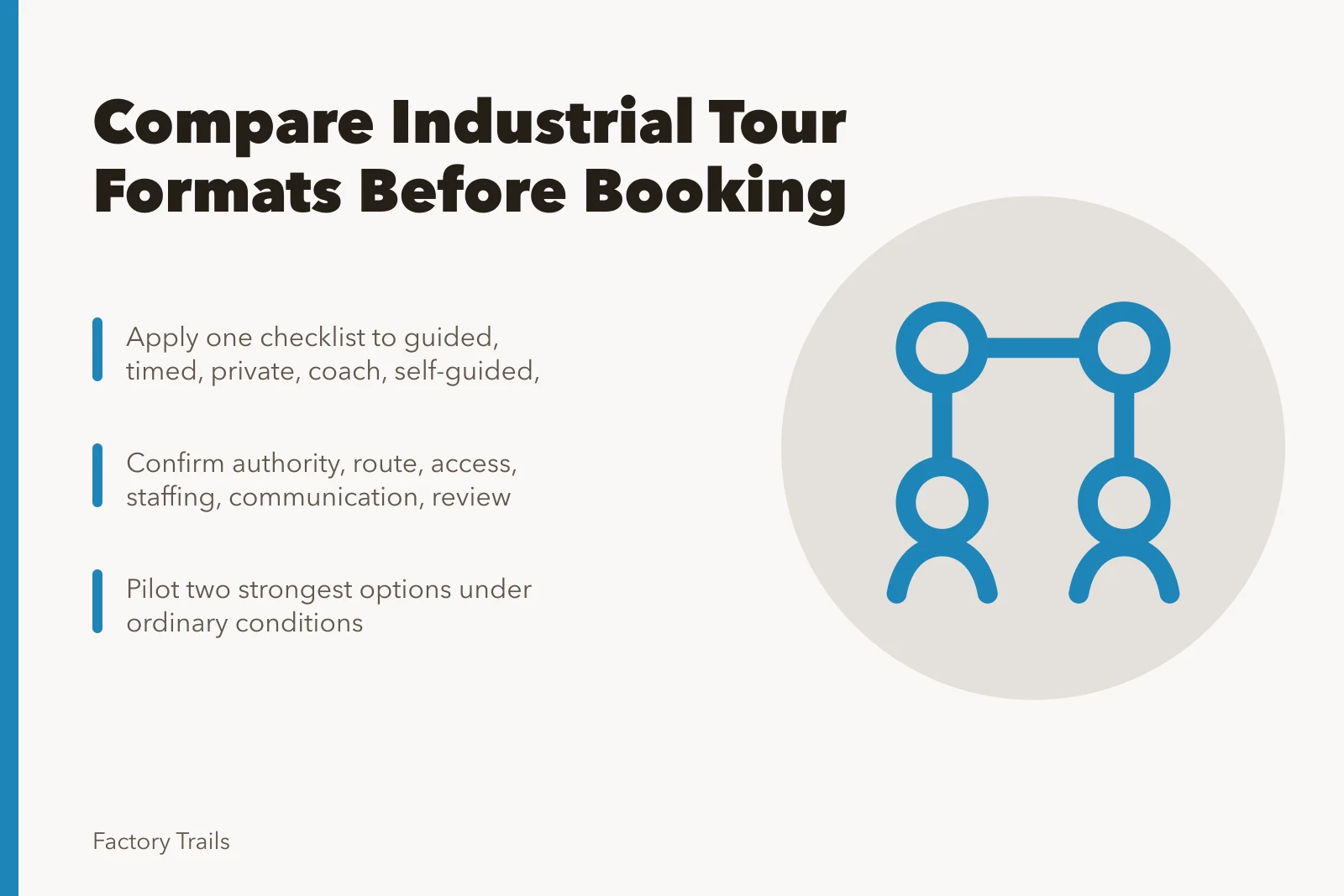
Industrial tour options checklist for 2027 helps U.S. operators compare guided, timed, private, coach, self-guided, and hybrid formats using the same site criteria.
What to take away
- Apply one checklist to every format under consideration.
- Confirm site authority and route reality before comparing price or appeal.
- Use a pilot to test the options that remain viable.
Use this checklist when deciding between guided, timed, private, coach, self-guided, or hybrid industrial tour formats. It helps the team compare options against the same operating conditions.
Compare every viable format
Confirm
- Authority
- Spaces, dates, capacity, restrictions, escort need
- Route
- Arrival, stops, exit, waiting, alternate
- Access
- Stairs, surface, seating, hearing, alternatives
- Staffing
- Guide, host, check-in, emergency contacts
- Communication
- Booking copy, map, signs, day-of instructions
- Review
- What will show the choice is working?
Evidence
- Authority
- Current site terms
- Route
- Timed walk-through
- Access
- Route notes and owner input
- Staffing
- Schedule and role list
- Communication
- Draft public materials
- Review
- Pilot observation plan
The Visitor Use Management Council's overview describes visitor-use management as a proactive, adaptive process that considers where people go, what they do, and how conditions change. A factory-tour operator can apply that same practical habit: compare options against the actual site and update the choice when conditions change.
Tour Format Comparison Checklist
- Authorityspaces, dates, capacity, restrictions
- Routearrival, stops, exit, waiting
- Accessstairs, surface, seating, hearing
- Staffingguide, host, check-in, emergency
- Communicationbooking copy, map, signs
- Reviewpilot observation plan
The U.S. Access Board guide to accessible routes explains requirements for a route that connects accessible elements and spaces. It does not certify a particular tour, but it is a sound reason to walk the arrival path, each stop, and the exit instead of relying on a building description.
Run this decision sequence
- State the visitor experience the format must provide.
- Remove any option without current authority or a workable route.
- Compare remaining options using the checklist.
- Pilot the two strongest options under ordinary conditions.
- Record the selection, evidence, and next review trigger.
Check the handoffs
Hybrid and coach formats need special attention at every handoff. Identify who meets visitors, who leads the next segment, where questions go, and what happens if the group is late or a stop closes. A format can appear efficient on paper while leaving visitors without a clear next step.
Check the public information at the same time. The National Park Service's wayside exhibit guidance is written for interpretive exhibits, yet its placement principle is useful here: put a decision-making instruction where the visitor actually needs it. Meeting instructions belong before arrival. A detour instruction belongs at the point where a guest must choose a direction.
Score only after the facts are checked
If the team needs a score, use a simple scale for each confirmed criterion and keep the notes beside it. Do not give a high score to a format merely because it is familiar or inexpensive. A guided walk may score well for interpretation but poorly for capacity. A self-guided route may score well for flexible timing but poorly for supervision. The purpose of scoring is to show the tradeoff, not to hide it behind one total.
For each option, mark the exit and alternate-route assumptions that were tested. The Occupational Safety and Health Administration's exit-route page says exit routes must be unobstructed in the workplaces it covers. This is not a substitute for a site's own emergency plan. It is a useful prompt to avoid rating a visitor route without considering how a group clears a stop when normal movement is interrupted.
Save the evidence with the decision
Keep the completed checklist with the route map, site approval, pilot notes, cost assumptions, and the name of the person who made the choice. Date the record. A later manager should be able to see whether an option failed because of group size, a physical constraint, a staffing gap, or a temporary condition. That distinction matters when the team revisits the same option in a different season.
Do not treat a checklist as a permission slip. It is a comparison tool. The property owner or authorized site manager still controls whether a tour may enter a space, use a vehicle stop, or change a visitor route.
Before the selection meeting, ask one person who did not build the comparison to read the checklist as a visitor would. That review often exposes a missing arrival instruction, an unexplained term, or an option that was scored without evidence. Correct the record before anyone treats the score as a decision.
Common questions
Should cost decide the format first?
No. First remove options that cannot meet site, route, access, or visitor requirements. Then compare the full operating cost of viable options.
Can a checklist select an option automatically?
No. It makes the tradeoffs visible so the authorized team can make a documented choice.
When should options be compared again?
Review after a material change in route, site authority, staffing, visitor demand, or operating conditions.