Guides
How to choose industrial tour providers before booking
Choosing industrial tour help in 2027 helps U.S. operators select guides, hosts, transport, access, and specialist partners with a clear operating scope.
What to take away
- Choose help for a defined route and role, not a vague title.
- Separate site authority, visitor interpretation, transportation, and operational support.
- A small pilot reveals more than a polished proposal alone.
An industrial-tour operator may need outside help for interpretation, site hosting, transport, reservations, accessibility planning, route safety, historical research, photography, or local coordination. The best choice is not automatically the provider with the most impressive title or largest portfolio. It is the person or organization that can perform a defined role on the actual visitor route, within the site's limits, and in coordination with the people who control access.
Start with the work, not the vendor category. A guide who is excellent at regional history may not be the right person to manage a live production-floor boundary. A transportation company may deliver reliable vehicles but not solve a difficult loading plan. A site host may know every detail of the facility but need support translating it for first-time visitors. Clear scope prevents an operator from hiring one party to silently absorb responsibilities it does not control.
Define the role before asking for proposals
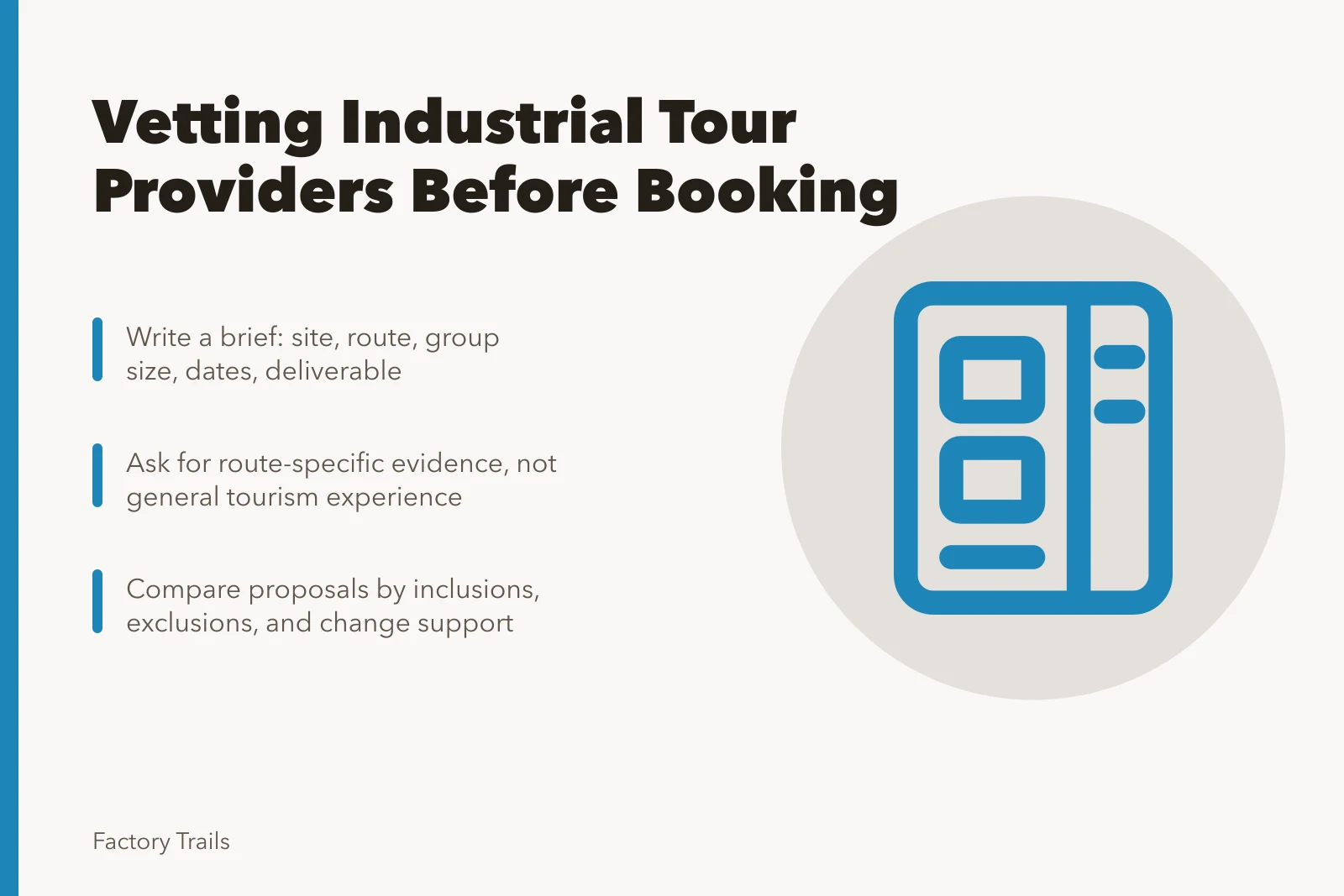
Write a brief for the help you need. Include the site, current route, group type, expected size, date range, work to be done, site restrictions, visitor information to be delivered, people who approve changes, and the outcome you expect. Avoid a request such as "make the tour better." Instead ask for a specific deliverable: lead two departures, build a route card, provide coach transport, review an access arrangement, or coordinate site confirmation.
Tour Provider Roles and Boundaries
Role
- Tour guide
- Lead, interpret, manage pace
- Site host
- Confirm route and conditions
- Transport provider
- Vehicle, driver, loading, timing
- Historian/interpreter
- Research and explain context
- Access specialist
- Advise on visitor arrangement
- Operations coordinator
- Assemble plan and communications
Main responsibility
- Tour guide
- No restricted-area approval
- Site host
- No booking or guest support
- Transport provider
- No route capacity decisions
- Historian/interpreter
- Needs site-approved scope
- Access specialist
- No facility change promise
- Operations coordinator
- Needs final decision authority
Boundary to confirm
- Tour guide
- Site host
- Transport provider
- Historian/interpreter
- Access specialist
- Operations coordinator
Define the role
| Role | Main responsibility | Boundary to confirm |
|---|---|---|
| Tour guide | Lead, interpret, and manage group pace | Does not approve restricted-area access |
| Site host | Confirm route and operational conditions | May not handle booking or guest support |
| Transport provider | Vehicle, driver, loading, and timing | Does not determine site route capacity |
| Historian or interpreter | Research and explain local context | Needs site-approved factual scope |
| Access specialist | Advise on an approved visitor arrangement | Does not promise a facility change alone |
| Operations coordinator | Assemble current plan and communications | Needs authority for final decisions |
Ask for route-specific evidence
Do not ask only whether a candidate has "industrial tourism experience." Ask what type of site, group, route, and operating condition the experience involved. Request a relevant example, a description of the role performed, and the limits that applied. A candidate may properly protect confidential client details. They should still be able to explain their approach to group control, visitor communication, route changes, and coordination.
Ask the same questions of each candidate:
Route-Specific Evidence Questions
- Which part of this route would you own?
- What information do you need before you begin?
- What conditions would cause you to change the plan?
- Who must approve that change?
- What would you provide after the visit?
The Internal Revenue Service worker-classification guidance explains that worker status depends on the relationship and facts of the engagement. This article does not determine a worker's classification. The planning lesson is to avoid treating title alone as the relationship. Put the actual duties, control, payment terms, and decision authority in the appropriate agreement and follow applicable professional advice.
If outside help affects access, ask exactly what it can assess and what decision remains with the property or program owner. The U.S. Access Board guide to accessible routes explains how the ADA Standards address routes from arrival points to accessible entrances and spaces. It does not select a provider or decide every facility question. It does support inspecting the full visitor path rather than assuming the main tour stop tells the whole story.
Check ownership and communication paths
A provider can be capable and still be a poor fit if the decision path is unclear. Identify who controls the site, who leads the visitor group, who communicates a closure, who approves an alternate, and who contacts guests. Do not let multiple parties believe someone else is responsible for a material step.
Tour Date Handoff Document
- Current route
- Group size
- Meeting point
- Required equipment
- Visitor restrictions
- Access arrangement
- Site contact
- Transportation plan
Create one handoff document for a tour date. It should name the current route, group size, meeting point, required equipment, visitor restrictions, access arrangement, site contact, transportation plan, alternate stop, and emergency contact. Give each person the version that applies to their role. This reduces errors at the transitions where a visitor is most likely to be confused.
Compare proposals by operating fit
Price matters, but a low number can hide missing work. Compare what is included: preparation, route check, travel time, equipment, insurance or site requirements, guest communication, reporting, change support, and cancellation terms. Ask candidates to state what is excluded. That makes the comparison more useful than a single total.
Compare Proposals by Operating Fit
Comparison point
- Scope
- What happens before, during, after?
- Route
- Which itinerary version is assumed?
- Capacity
- What group size can this role support?
- Change control
- What happens when a stop closes?
- Cost
- What is included and excluded?
- Records
- What will be documented?
Question to ask
- Scope
- Tasks, owner, deliverables
- Route
- Stops, limits, alternate
- Capacity
- Transition and viewing limits
- Change control
- Approval path and guest notice
- Cost
- Assumptions, fees, timing
- Records
- Reporting format and timing
What a complete answer contains
- Scope
- Route
- Capacity
- Change control
- Cost
- Records
The U.S. Small Business Administration guide to writing a business plan discusses describing operations and financial projections. A provider comparison benefits from the same approach. Tie each quote to a route assumption, deliverable, staffing level, and approval point. A lower quote may be suitable, but only when the operator can see which work is and is not included.
Question to ask
- Scope
- What happens before, during, and after the tour?
- Route
- Which version of the itinerary is assumed?
- Capacity
- What group size can this role support?
- Change control
- What happens when a stop closes?
- Cost
- What is included and excluded?
- Records
- What will be documented?
What a complete answer contains
- Scope
- Tasks, owner, and deliverables
- Route
- Stops, limits, and alternate
- Capacity
- Transition and viewing-area limits
- Change control
- Approval path and guest notice
- Cost
- Assumptions, fees, and timing
- Records
- Route changes, issues, and follow-up
Use a pilot when the stakes are high
A small pilot can be more informative than a long proposal. Run one departure, a route walk, or a planning session. Observe whether the provider arrives prepared, asks useful questions, respects the site boundary, communicates with the host, and leaves a usable record. The pilot should have a defined scope and evaluation criteria, not be an informal free test.
Pilot Evaluation Process
- Run one departure, route walk, or planning session
- Observe preparation, questions, boundaries, communication, records
- Ask site host, guide, operations lead, and visitors for feedback
- Review timing, route clarity, pace, equipment, questions, changes
- Decide to adjust scope, improve handoff, or select different partner
After the pilot, ask the site host, guide, operations lead, and a small group of visitors what worked and what caused friction. Review facts: timing, route clarity, group pace, equipment readiness, visitor questions, and any change required. Decide whether to adjust the scope, improve the handoff, or select a different partner.
Avoid common provider-selection mistakes
Common Provider-Selection Mistakes
- Selecting a partner before the site confirms the route
- Assuming a guide can authorize access
- Asking transport to solve site-capacity issues
- Promising a visitor arrangement before approval
- Relying on a verbal agreement for guest communication or route changes
The strongest relationships are transparent about limitations. A provider who says a site condition requires a smaller group, different time, extra host, or alternate stop may be protecting the experience. The concern is a provider who cannot describe what it owns, what it needs from the operator, or what it will do when the normal plan changes.
Onboard a provider before the first group
Selection is only the beginning. A capable provider can still fail if it begins with an incomplete handoff. Hold a short onboarding meeting with the site host, operations lead, guide or transport contact, and the new provider. Walk through the route in order. Confirm the meeting point, group boundary, visitor rules, capacity at each transition, required equipment, access information, alternate plan, and contact method for a day-of change.
Provider Onboarding Checklist
- Walk through the route in order
- Confirm meeting point and group boundary
- Review visitor rules and capacity at transitions
- Check required equipment and access information
- Confirm alternate plan and day-of contact method
- Provide current materials and resolve contradictions
- Confirm weather decision thresholds
Give the provider the current materials rather than links to old versions: booking language, confirmation email, route card, map, emergency process, public history notes, and site-specific restrictions. Ask the provider to identify any contradiction. A transportation partner may spot a loading problem; a guide may notice a missing transition note; a host may find that a stop has changed. Resolve these facts before visitors receive the plan.
For an outdoor approach or a building without climate control, confirm the weather decision in the onboarding meeting. The National Weather Service heat-safety resource notes that heat can strain the body and affect some people more than others. A provider should know the host's threshold for rest breaks, an indoor change, or a shortened route. It should not be left to a day-of guess.
| Onboarding check | Question to settle | Evidence of readiness |
|---|---|---|
| Route ownership | Who leads each segment? | Named role on the route card |
| Visitor boundary | Where may the group not go? | Clear briefing and physical control |
| Change authority | Who can approve an alternate? | Contact and escalation path |
| Communication | Who updates guests and staff? | Current template and contact list |
| Handoff record | What is saved after the tour? | Issue and follow-up log |
Set an early review date after the first live tour. Discuss what the provider saw, what the group needed, where the route slowed, and whether any assumption in the scope was wrong. An early review is less costly than allowing a small misunderstanding to become the default operating model for a season.
If the provider cannot describe the route, limits, or responsible site contact after onboarding, delay the launch and correct the handoff.
Document the corrected plan immediately.
Review the relationship after each season
Keep a small performance record: dates supported, route changes, communication quality, visitor feedback, unresolved issues, and costs against assumptions. Use it to decide whether the role should continue, be adjusted, or end. This prevents a convenient relationship from becoming an unexamined dependency.
Choosing help well is an operational decision. The provider should make the route clearer, the group better supported, and the site relationship stronger. When responsibilities are specific and the plan is documented, outside help becomes a reliable part of the tour rather than another unknown on the day.
Common questions
What is the first question to ask a tour provider?
Ask which part of the actual visitor route the provider will own and what authority it needs to do that work.
Should a provider be selected only on price?
No. Compare scope, route assumptions, change support, communication, and the costs that are excluded from the quote.
Is a pilot useful for every provider?
A pilot is especially useful when a provider affects site access, guide leadership, transportation, or a complex visitor route.