Guides
How to run a manufacturing museums provider selection in 2027
Choosing help for manufacturing museums in 2027 helps U.S. sites define scope, match expertise, compare proposals, set safeguards, and document decisions.
What to take away
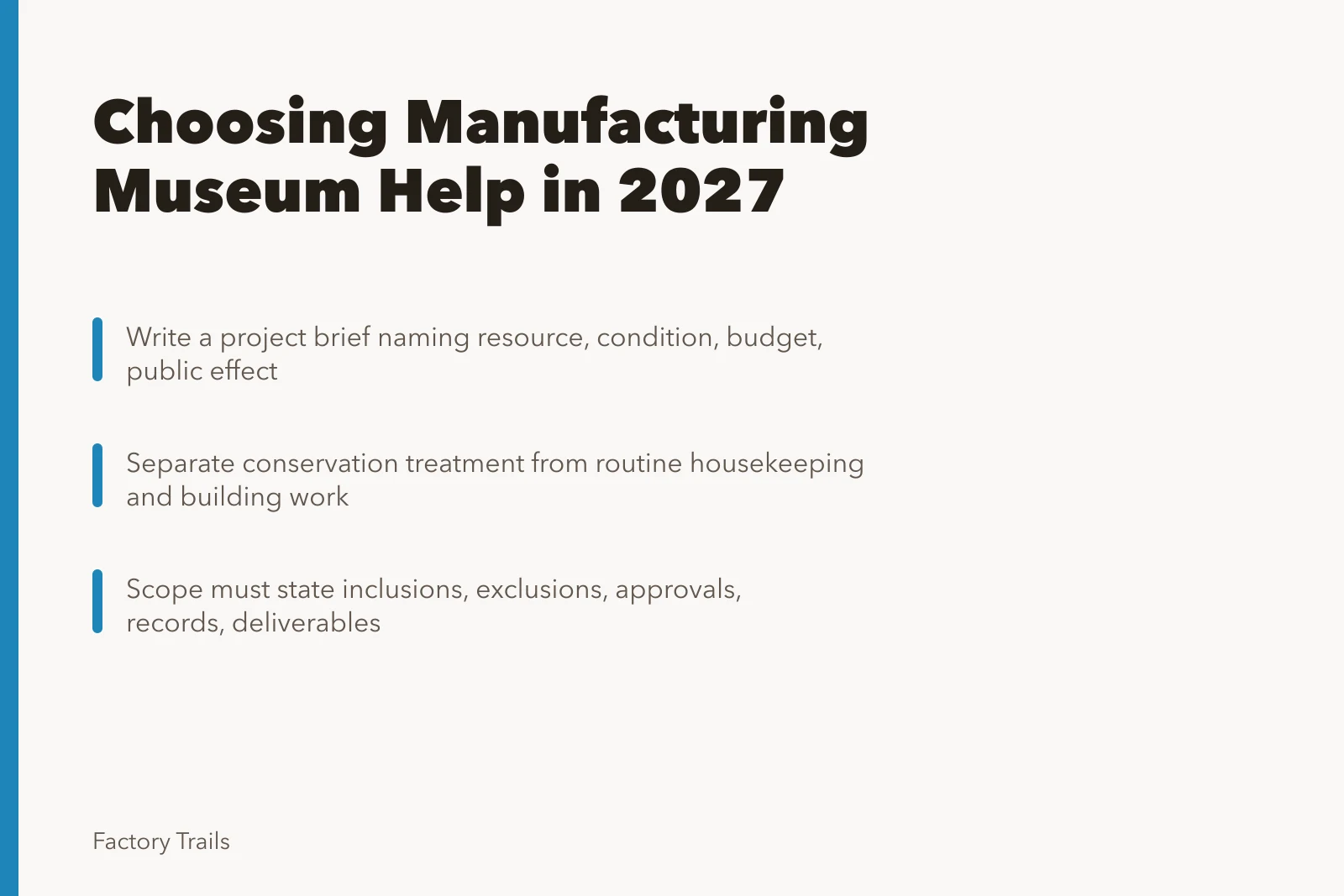
- Write a one-paragraph brief naming the resource, the decision, the evidence, and the deliverable.
- Match the provider to the task. Treatment, facilities, interpretation, research, and content are separate contracts.
- Search the AIC Find a Conservator directory, the NPS Museum Handbook, your state historic preservation office, and regional conservation centers.
- Plan a typical 6 to 12 week cycle from brief to award, and budget assessment, treatment, and content as separate lines.
- Set approval points at the start, after assessment, before a material change, and before any public statement.
Start with a one-paragraph brief
A museum that cares for machines, mill buildings, or company records needs specialist help, not a generic consultant. Manufacturing museums face heavy objects, historic finishes, tight routes, and visitors who expect to see production.
Write one paragraph. Name the resource, the location, the condition or visitor need, the decision to be made, the records you hold, the constraints, the budget stage, and the public effect.
Vague requests fail. "Restore the museum" gives a professional nothing to price.
Example brief
Assess the condition and safe display options for three static machine components in the 1912 foundry room. The work supports a board decision in June 2027 on open display. Records: a 1978 accession file and 2019 photographs. Constraints: no removal, weekend access only. Deliverable: a written condition report with treatment options and cost ranges. Budget stage: assessment only.
Match the need to the expertise
| Project need | Expertise to consider | Wrong assumption |
|---|---|---|
| Object condition or treatment | Conservator with the relevant material background | General maintenance is treatment |
| Historic machinery interpretation | Curatorial or engineering specialist | A historic machine should run |
| Route or access change | Preservation, accessibility, or safety professional | A historic interior is public by default |
| Exhibit planning | Exhibit design with collections and interpretation | A good display is safe for every object |
| Public content | Editor, photographer, or web professional | Content can make technical claims without sources |
A complex project may need several roles. Peer comparison questions help you write the visitor-facing part of the brief, as the museum comparison questions show.
Project Need vs Expertise
Project need
- Object condition
- Qualified conservator
- Machinery interpretation
- Curatorial or engineering
- Route or access change
- Facilities or safety
- Exhibit planning
- Exhibit and design roles
- Research and writing
- Historian or archivist
- Public content
- Editor or communications
Expertise to consider
- Object condition
- Maintenance is treatment
- Machinery interpretation
- Machine should operate
- Route or access change
- Interior is public
- Exhibit planning
- Display is safe
- Research and writing
- Narrative confirms operations
- Public content
- Claims without sources
Do not assume
- Object condition
- Machinery interpretation
- Route or access change
- Exhibit planning
- Research and writing
- Public content
Separate treatment from routine work
Treatment changes or stabilizes an object. Housekeeping, building work, and display maintenance are different services. Do not hand a treatment decision to a general contractor or an untrained volunteer because an item looks simple.
The NPS Museum Handbook chapter on conservation treatment covers contracts that address insurance and object transport. Those rules govern NPS work, but they show the shape of a proper agreement: scope, safeguards, documentation.
Where to find qualified providers
For treatment work, search the AIC Find a Conservator directory. Regional conservation centers serve museums without in-house staff, including the Midwest Art Conservation Center and the Conservation Center for Art and Historic Artifacts.
For building and route changes, call your state historic preservation office. The NPS Museum Handbook sets out documentation and accountability for collections.
Seven fields for the written scope
- Objective
- which decision or result must the work support?
- Resource
- which object, room, collection group, route, or page is in scope?
- Evidence
- what records, images, measurements, or sources exist?
- Constraints
- what access, schedule, safety, or privacy limits apply?
- Deliverable
- what report, treatment proposal, or copy is required?
- Acceptance
- who checks the work, and against which criteria?
- Update path
- what happens if evidence changes the approach?
Written Scope Fields
- Objectivedecision or result
- Resourceobject, space, or article
- Evidencerecords, images, measurements
- Constraintsaccess, schedule, safety
- Deliverablewritten or visual output
- Acceptancewho checks and criteria
- Update pathif evidence changes
A typical selection timeline for 2027
- Weeks 1 to 2write the brief, confirm funding, get internal sign-off.
- Weeks 2 to 3search directories and shortlist four to six providers.
- Weeks 3 to 5issue the scope and arrange site visits.
- Weeks 5 to 7receive written proposals.
- Weeks 7 to 9compare against the scope and call references.
- Weeks 9 to 10interview finalists and check insurance, access, and safety.
- Weeks 10 to 12award, contract, kickoff.
Six to twelve weeks is a typical range for a small or mid-size project. Public funding, treatment work, or a historic building review adds time.
Cost structure
| Cost line | What it covers | Typical range |
|---|---|---|
| Assessment | Condition survey, options report, photographs | $3,000 to $15,000 |
| Treatment | Stabilization, conservation work, documentation | $10,000 to $100,000 or more |
| Content | Research, writing, editing, photography, web copy | $2,000 to $20,000 |
| Coordination | Project management, records, closeout | 10 to 20 percent of the lines above |
These are typical ranges, not quotes. Ask each candidate to split the scope into these lines so proposals compare. Pair this with the factory tour budgeting checklist when visitor operations are also in view.
Compare proposals against the scope
- Does the proposal address the stated resource, or a different project?
- Are the method, deliverables, and schedule specific enough to check?
- Are the provider role, the museum role, and the budget lines clear?
If proposals cannot be compared, revise the scope. Do not choose the most confident language.
Change control, records and closeout
New findings do not mean the provider failed. Record what was found, who reviewed it, what changed, and what the public will hear. Use a written change order before extra work starts.
The National Archives' records-management fundamentals explain why organizations keep records that document action. Date the scope, name the approver, and keep the approved public wording.
At closeout, collect reports, source files, photographs, condition notes, and any recommended next review. List unresolved items and the next step.
The Smithsonian Institution Archives describes conservation work as examination, treatment, and preservation management. That split shows why one contract rarely covers everything.
The institution keeps decision rights over its collection, building, records, and public message. The working factory visits guide explains how to phrase access that is still under review.