Guides
How to keep working factory visit option records that last
Option records show why a factory visit format was chosen and what guests were told, with comparison notes, approvals and change logs kept short.
What to take away
- Five records carry a factory visit decisionthe format comparison note, the decision and approval note, the guest message as sent, image and permission notes, and the change log.
- Write the decision as one dated sentence naming the choosing role and the condition behind the choice.
- Save the guest message exactly as sent, with its version number and channel.
- Name the file for the format and the decision date, and keep one master copy in the program folder.
- Mark a superseded format as replaced rather than deleting it.
Decision sentence template: "On [date] the [role] chose the [format] for [month or group] after [role] confirmed [condition]; message version [n] goes out."
The five records and their minimum content
The file holds five records. Each one answers a question a new coordinator asks early: what is live, who chose it, what guests were told, what may be reused, and what changed.
| Record | Minimum content |
|---|---|
| Format comparison note | The criteria, each format scored against them, and the format that won |
| Decision and approval note | The dated decision sentence, the confirming role, and the condition attached |
| Guest message as sent | The exact wording sent, the version number, the channel and the send date |
| Image and permission notes | Source, licence or written permission, credit wording and placement |
| Change log | Date, what changed, why, who confirmed it, pages updated and next review date |
Five records that carry the decision
- Comparison noteoutcome, formats, criteria, decision date
- Approval resultconfirming role, condition, alternate status
- Guest messagedated invitation, directions, restrictions, contact
- Pilot noteguest experience, material issue, follow-up owner
- Change lognew decision, reason, owner, effective date
A document can support a sentence in the note without granting the right to republish its photographs. Fair use is decided case by case, as the U.S. Copyright Office fair-use FAQ sets out, so keep source, permission and credit wording together.
The comparison itself belongs with the money. The factory tour budgeting options comparison scores route formats by cost per guest and capacity, and it is worth reading before you set your criteria, because a format the program cannot fund is not a live option.
Escort ratios, induction content and photography rules come from the plant rather than the operator. Ask its safety officer before the comparison note is written, not after.
Write the decision in one sentence
A comparison note does not need prose. One factual sentence carries it.
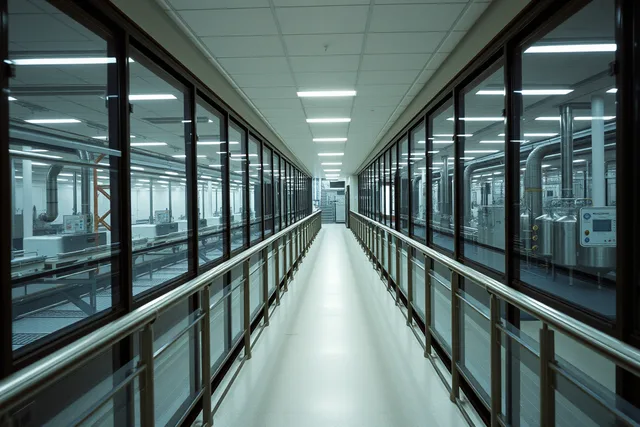
"On September 20 the program owner chose the observation gallery for October groups after the facility contact confirmed the viewing platform; message version 2 goes out."
That sentence answers four questions at once.
- Which format is live, and for which period.
- Which role chose it.
- Which condition had to be confirmed first.
- Which message version guests received.
Safety records stay in their own file. A safety record set covers induction, PPE issue and incident logs, and it needs its own retention schedule; merging it into the option file makes both harder to audit.
Compare formats on stated criteria
Name the criteria before you score the formats, so the note shows why a format lost.
On-floor route
- Guests per guide
- Set by the plant escort ratio
- Access needed
- Full induction and PPE
- Runs during maintenance
- Rarely
- Weather exposure
- High
- Photography
- Per site permission
Observation gallery
- Guests per guide
- Higher, no floor access
- Access needed
- None beyond the visitor area
- Runs during maintenance
- Often
- Weather exposure
- None
- Photography
- Per site permission
Host-led walk
- Guests per guide
- Lowest
- Access needed
- Induction, no PPE
- Runs during maintenance
- Depends on the shutdown calendar
- Weather exposure
- Mixed
- Photography
- Per site permission
Where a route needs protective equipment, the controls come from the site. OSHA's general PPE rule, 1910.132, requires employers to supply protective equipment where hazards are present, and plants commonly hold visitors to the same kit.
Format choice is rarely the only risk in the file. Late route checks and thin safety briefings force unplanned swaps, and the failures listed in industrial tour operator mistakes are worth scoring beside the criteria above.
Example: a mid-season route swap
A mill site ran an on-floor route from March 3 to June 27, 2026. The line shutdown began June 30, so the observation gallery took over for July. The program owner decided on June 12, after the maintenance planner confirmed the window.
2026-06-12. Format switched from on-floor route to observation gallery for July only. Reason: annual line shutdown, confirmed by the maintenance planner on June 9. Confirmed by the plant safety officer. Pages updated: /visit/on-floor-route marked suspended; /visit/observation-gallery gained July dates. Next review 2026-08-03. Owner: visitor program owner.
The log names both public pages, so anyone can see which description guests saw in July and which one was retired. Without that line, two live descriptions survive and neither can be trusted.
File naming, storage and retention
- Save the master file as option-record_[format]_[decision date]_v[number], for example option-record_observation-gallery_2026-06-12_v2.
- Put it in the shared program folder for the site, not in a personal mailbox.
- Write the retention date and the next review date on the first page.
- Add a change log line every time the live format changes.
The National Archives describes records as managed across their life cycle, with inventories and schedules deciding how long each one lives, and a visitor program needs a compact version of that idea (records management fundamentals).
Retention is usually set by the operator, not by a federal schedule, unless the site is publicly funded. Many operators use a three-to-seven-year window. Treat that as a typical range and confirm your number with the site records officer.
If a swap went badly, the fixes in eight common factory visit mistakes cover late briefings and unclear guest instructions.
Common questions
Who owns the option record?
A named program owner. That person writes the comparison note, the decision sentence and the change log, and asks the plant safety officer to confirm the conditions behind the format.
What survives a pilot?
The format used, what guests experienced, the issue found, the action owner and the review date. A pilot note that records only praise tells the next team nothing.
How long do option records stay available?
Long enough to explain the current format, plus whatever the operator's schedule requires. Confirm the number with the site records officer and write it on the first page.
Does the record need to be long?
No. It answers three things: what guests were told, what the program could deliver, and who approved it.