Guides
How to keep factory tour safety records at U.S. sites without gaps
Factory tour safety records guide for U.S. sites in 2027 explains what to document before, during, and after public visits so changes and hazards are not lost.
What to take away
- Safety records should capture a condition, the decision made, the owner, and the follow-up date.
- Keep route checks, incidents, closures, training, and repairs in one retrievable place.
- Good records prevent the next shift from reopening a problem that a prior shift already found.
Record the decision, not just the event
A useful safety record does more than say that rain occurred or a guest slipped. It explains what staff observed, what they did next, who was notified, and whether a tour route changed. Those details help the next guide make the same safe choice without reconstructing the situation from memory.
Safety Record Types
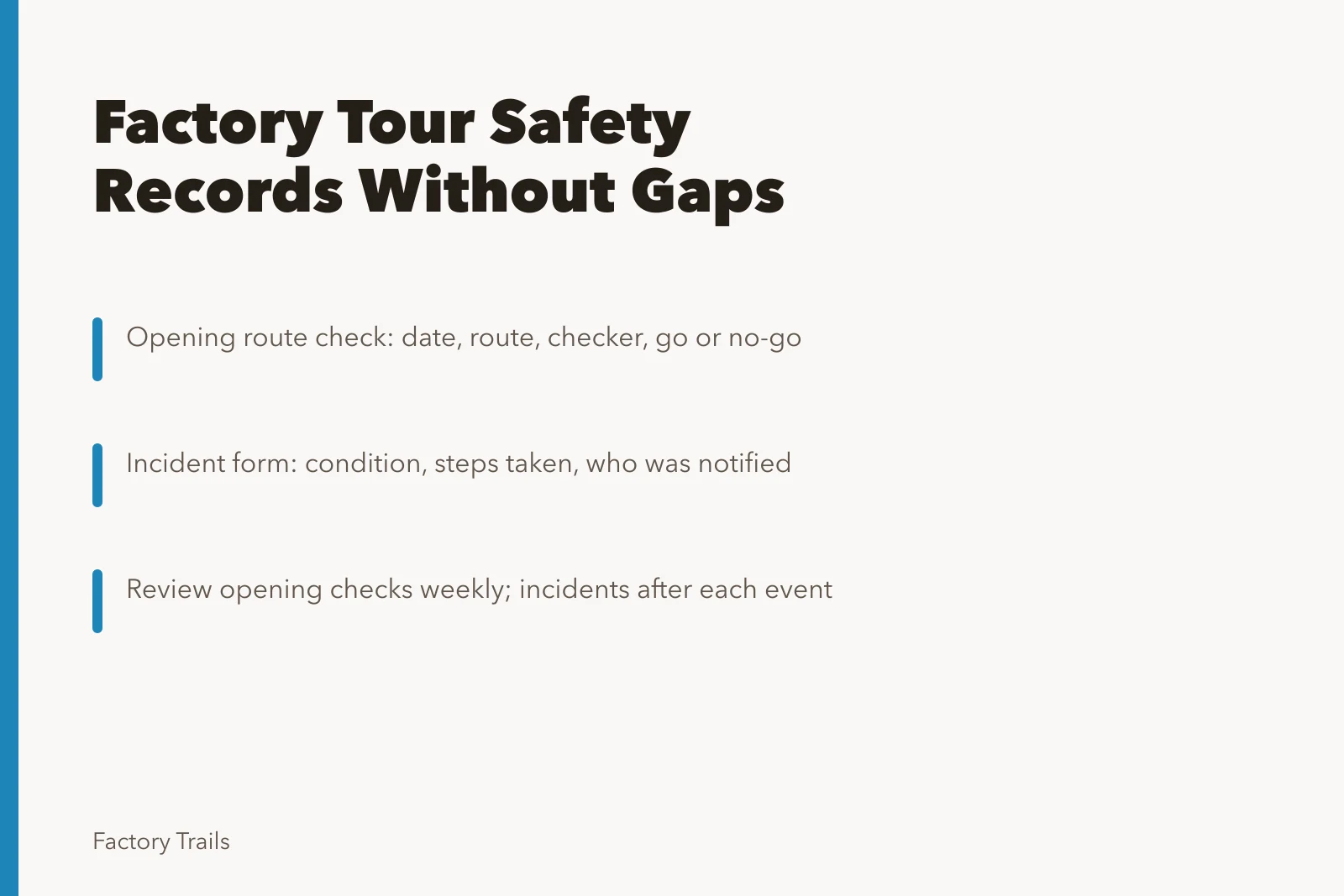
- Opening route checkdate, route, checker, condition, decision
- Incident or near misstime, location, facts, action
- Closure or modificationtrigger, affected stop, alternate activity
- Repair requesthazard, photo, owner, target date
- Training logstaff, date, route, scenario, instructor
Record the decision
| Record | Minimum information | Use it for |
|---|---|---|
| Opening route check | Date, route, checker, condition, go or no-go decision | Daily operating readiness |
| Incident or near miss | Time, location, facts, immediate action, notifications | Follow-up and pattern review |
| Closure or modification | Trigger, affected stop, alternate activity, guest notice | Consistent program decisions |
| Repair request | Hazard, photo, responsible owner, target date | Preventing repeat exposure |
| Training log | Staff, date, route, scenario, instructor | Confirming current roles |
Tie records to the physical site
Use a route map with stable names for stops, exits, stairs, and demonstration areas. "Near the old mill" is hard to retrieve later. "South ramp, stop 4, lower handrail" gives the maintenance team and program staff the same reference point.
The National Park Service's guidance on building codes notes that public-health and safety requirements may address access and egress, special events, hazardous materials, and emergency planning. Preservation Brief 51 is focused on historic and existing buildings, but it supports a key records practice: write down safety decisions in a way that connects them to the exact building condition and applicable operation.
Create a short incident format
Keep the incident form factual. Do not guess why someone fell or promise an outcome. Capture the information staff will need for a follow-up:
Short incident format
- Date, time, location, and program name.
- Objective description of the condition and what was seen.
- Immediate steps taken, including route closure or emergency call.
- Names or roles of staff notified.
- Whether the area was reopened, and by whose authorization.
- Required repair, review, or training action with a due date.
If privacy or reporting rules apply, follow the site's approved procedure and limit access to the record. A public program log should not become an informal medical file.
Review records on a schedule
Review opening checks weekly during busy seasons and review incidents, near misses, and closures after each event. Look for repeated references to the same step, doorway, weather window, or visitor behavior. Patterns point to a design or operating change that may eliminate the problem.
At season end, make a short safety summary: what changed, what was repaired, which routes were modified, and what must be funded or trained before reopening. That summary turns scattered notes into a better plan for next year.
For route records, name the component and observed condition. The U.S. Access Board's accessible-route guide identifies walking surfaces, doors, ramps, curb ramps, elevators, and permitted lifts as common components. That makes an inspection record more useful than a note that simply says "access issue."
Use the site's approved retention rules for the record. The National Archives' records-management FAQ describes systematic control of record creation, maintenance, use, and disposition. The federal guidance does not set a private site's retention schedule, but it supports assigning a purpose and responsible owner to each safety record.
Record both the correction and the later check. The Visitor Use Management Council's monitoring guidance distinguishes whether an action happened from whether it worked. This is a helpful test for a barrier, route change, briefing revision, or staff retraining.
Use a consistent location name across records, work orders, and visitor notices. That simple choice helps a facilities lead connect a guide's observation to a repair request and helps the next guide recognize the same place before a tour begins.
Common questions
How long should safety records be kept?
Retention periods depend on the organization, insurer, and applicable rules. Establish a written schedule with the site's records manager or legal adviser.
Should a near miss be recorded?
Yes. It may reveal a recurring condition before an injury, complaint, or cancellation occurs.
Who can reopen a closed route?
Only the role named in the operating plan should authorize reopening after confirming that the condition has been corrected or safely controlled.