Guides
Part of Working factory visits safety checklist: 2027 planning guide for program teams
Factory visit safety records: who owns the working checklist?
Factory visit safety records guide for 2027 helps U.S. teams keep booking details, approved messages, host briefs, and change logs without duplicating site records.
What to take away
- The visitor-program coordinator owns the record set. Each record inside it also has a named owner.
- Five records cover the workbooking entry, approved guest message, host brief, change log, follow-up note.
- A version label and a fixed file-naming pattern stop an old confirmation from being reused.
- No universal retention period exists for visitor communication. Check your own records schedule first.
- Controlled facility detail stays out of the visitor folder. Record the contact who holds it.
Who owns the checklist
The coordinator owns the checklist. It is not the plant safety system and not a copy of it. Ownership means four jobs: write the record, get its wording approved, date it, and pass it on.
Approval and upkeep sit in different hands, so each record carries its own owner. The table below sets the five types with their minimum content and review trigger.
Five Visitor Record Types
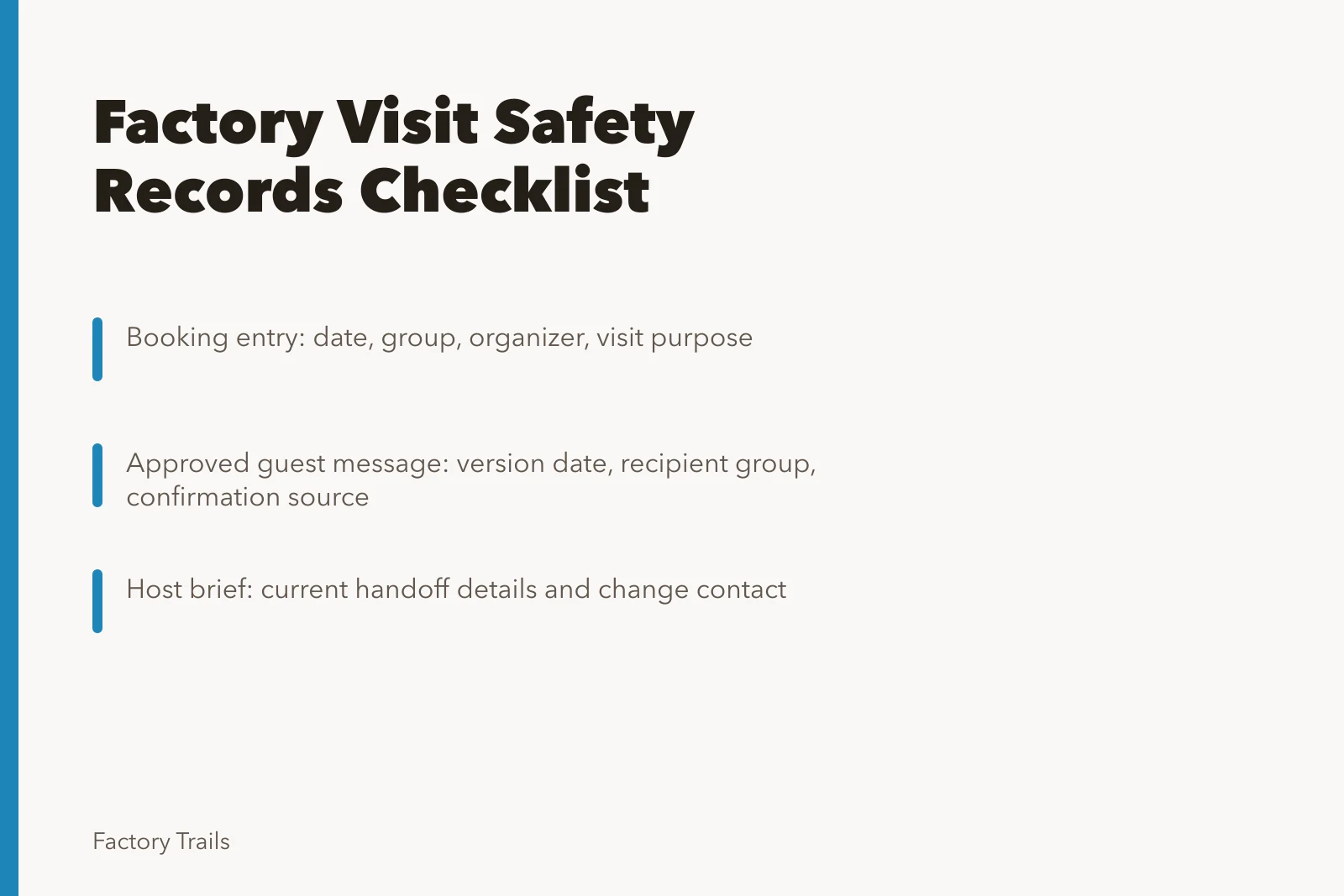
- Booking entrydate, group, organizer, purpose
- Approved guest messageversion date, recipient, source
- Host briefhandoff details, change contact
- Change logvisitor effect, wording, channels
- Follow-up notequestion, owner, completion date
| Record | Minimum content | Owner | Review trigger |
|---|---|---|---|
| Booking entry | Date, group, organizer, visit purpose | Program coordinator | At booking, then one week before the visit |
| Approved guest message | Version date, recipient group, confirmation source | Program owner | Any route or schedule change |
| Host brief | Current handoff detail and change contact | Host or program owner | Start of each tour day |
| Change log | Visitor effect, approved wording, channels updated | Program coordinator | Same day as the change |
| Follow-up note | Question, assigned owner, completion date | Program owner | Within one week of the visit |
If the route requires guest eye protection or safety footwear, the host brief records what was issued. OSHA 1910.132, 1910.133 and 1910.136 are the employer rules that usually drive those requirements.
Handoff gaps usually show up as an unowned record or a stale confirmation. The eight mistake prevention fixes for 2027 cover both patterns.
Name files and versions so the live copy is obvious
- Start with the record typebooking-log, guest-message, host-brief, change-log, follow-up.
- Add the version date as YYYY-MM-DD, for example guest-message_2027-03-14.
- Tag the replaced copy as archive and move it into an archive subfolder.
- Write the path of the live file into the change log so nobody has to guess.
A label such as guest-message_plant-a_2027-03-14_v3 keeps the site, the age and the sequence visible at a glance.
Timed tours raise the stakes. How to book a Britannia Mine Museum underground tour shows a site where one booking record drives a fixed slot.
The National Archives file-plan template names office, preparer, date and review among its core fields, and that list transfers well to a visitor program even though it is a federal scheduling tool.
Example: one change-log entry
A change log entry works when the next coordinator can read it without asking anyone. This entry covers one route change.
2027-04-02. Guest-facing effect: the walkway past Line 4 is closed, so the tour now ends at the packing hall. Approved wording: "Today's route ends at the packing hall." Approved by: plant visitor coordinator. Channels updated: booking confirmation template, host brief, front desk script. Status: closed the same day.
Two details make it reusable. The approved wording is quoted in full, and every channel that carried the old line is named. The entry describes only what guests were told.
Run one handoff review
Set the review before the owner changes, not after it. Use a short checklist:
- Open all five active files and confirm the live version of each.
- Match the guest message, host brief and contact list to the next visit plan.
- Note the reviewer, the date and anything still open.
- Move superseded material into the archive under your own records policy.
Sites with steady tour traffic, such as Lowell National Historical Park, reuse one approved guest message across many bookings, which is why the live version has to be unmistakable.
Where an outside provider delivers the tour, the interpretation provider selection guide puts wording approval in the contract instead of a shared folder.
Never copy controlled safety, security, personnel or emergency procedures into the visitor folder. Record the facility contact who holds them instead. The visitor center model shows why this works: at Hershey's Chocolate World the guest program runs on its own, because the working plant is not open to public tours.
Set a retention date before the file closes
No universal retention period applies to visitor communication records. Your organization's records schedule sets the clock. The National Archives records management basics explain inventories, schedules and file plans, and a retention period comes out of one of those.
If no schedule covers the file, pick a default and write it down. A typical starting point for a small visitor program is three years after the last visit, reviewed once a year. Treat that as a working assumption, not a rule.
Keep sources and permissions beside the record
A source note shows where a claim or an image came from. A permission note shows that you may reuse it. Keep both with the visitor file, next to the message they support.
Fair use is decided case by case. The Copyright Office fair-use FAQ states that fair use is a fact-specific doctrine, so material found online is not blanket permission. Save licenses, credit lines and photo permissions where the next owner will find them.
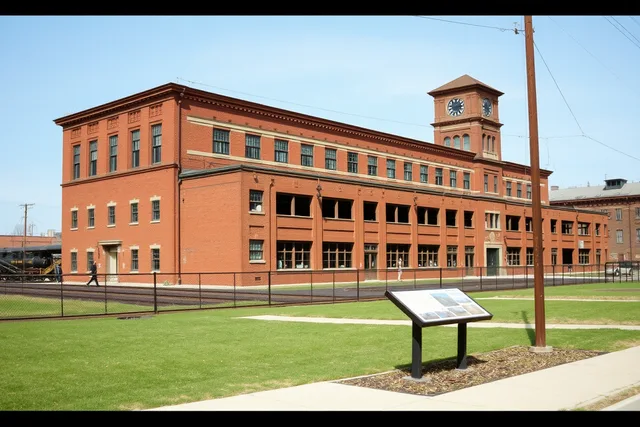
The same record set serves a museum housed in an old mill. How to run a manufacturing museums provider selection covers the brief that provider needs.