Reviews
Part of Working factory visits safety checklist: 2027 planning guide for program teams
Factory visit safety questions to ask before your 2027 program starts
Factory visit safety questions for 2027 programs help teams confirm who owns each answer, what changed since last year, and which checklist version guests hold.
A working plant is not a museum with a gift shop. The line runs, the forklifts move, and the person who can approve your group is often on a shift. Questions are how you find that person before the coach pulls in.
This is the question set to run alongside the factory visit safety planning checklist when the checklist is the wrong shape for the problem. Checklists close items. Questions find owners.
What to take away
- Every guest-facing answer needs a named facility contact, not a coordinator's best guess.
- Ask by decision type. Access, operations, safety and emergency answers come from different people.
- A change invalidates the old message. Re-confirm who approves the new one.
- Keep one open-question list with owner, date and result. Close an item only when the approved answer reaches the guest plan.
- Escalate anything touching controlled site areas to the site's own safety officer and published visitor rules.
Ask by decision type, not by topic
The common failure is asking one coordinator everything. That person then guesses at a question that belongs to maintenance, security or the safety officer.
Who owns each decision
Group approval -> Site visitor or community relations lead
Arrival and check-in -> Security or front desk
Hosting and cover -> Operations scheduler
| Decision | Who owns it | What the coordinator must not answer |
|---|---|---|
| Group approval | Site visitor or community relations lead | Whether an area is safe to enter |
| Arrival and check-in | Security or front desk | Which control measure applies |
| Hosting and cover | Operations scheduler | Whether a restriction can be relaxed |
| Change and messaging | The approver who set the change | Why a condition changed |
Questions for the facility contact
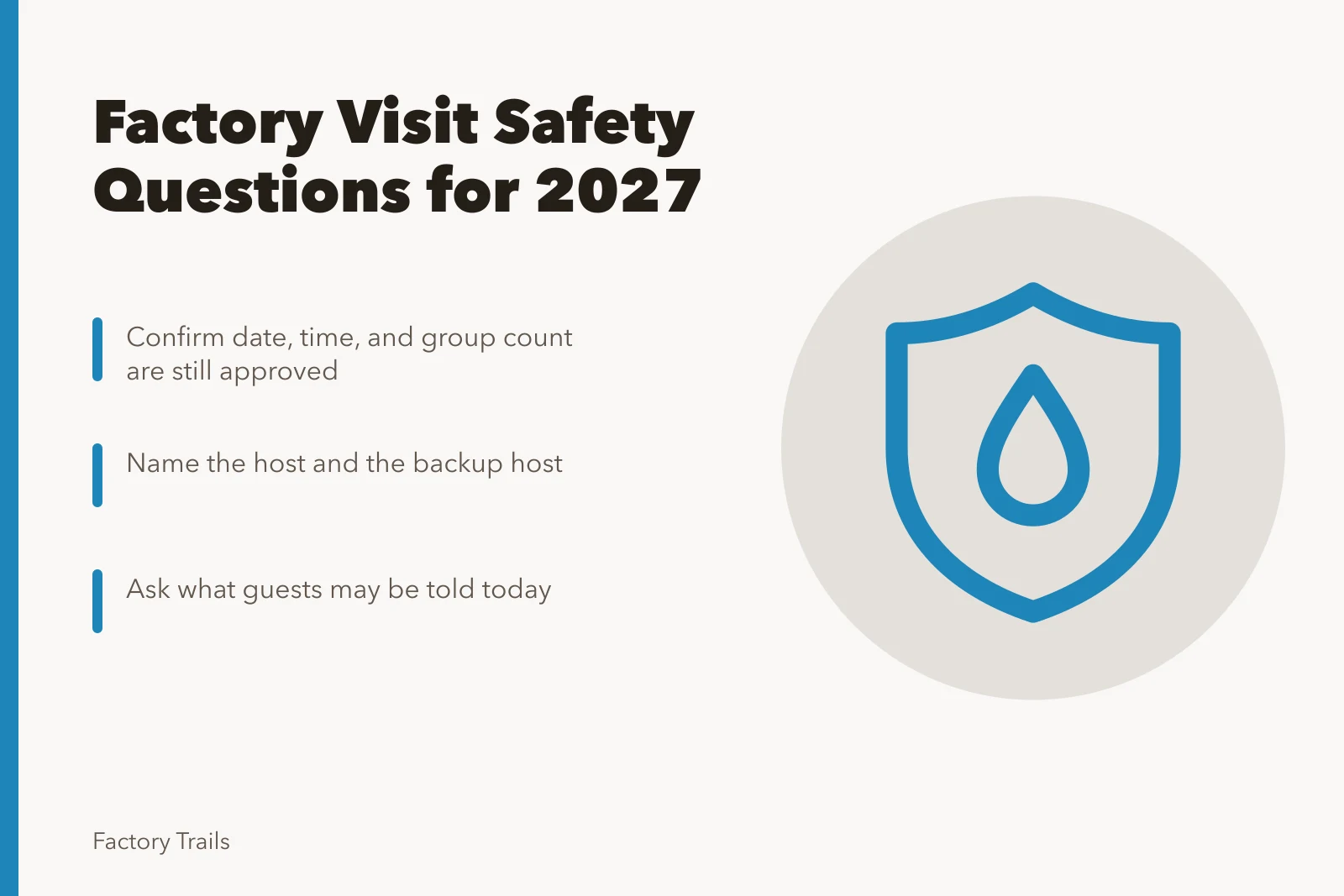
- Is the date, time and group count still approved, and who approved it?
- Where do guests report, and what does check-in involve on the day?
- Who hosts, and who covers that person's absence?
- What is the current approved route or format for visitors?
- If a planned stop is unavailable, what may the host say?
- Who takes a question that falls outside the host's role?
- What should reach a guest who has stated an access need?
The Smithsonian National Museum of Natural History publishes group-visit information covering entry, group behavior and route planning. A museum is not a plant, and its rules do not transfer. The pattern does: groups get current, practical detail before arrival instead of a generic welcome.
Facility contact questions
- Is the date, time and group count still approved?
- Where do guests report and check in?
- Who hosts and who covers absence?
- What is the current approved visitor route?
- If a stop is unavailable, what may the host say?
- Who takes questions outside the host's role?
- What reaches a guest with an access need?
Questions for the organizer
Ask for the real group count, late-arrival risk, access requests, language needs and a day-of phone number. Ask whether guests hold the most recent confirmation.
A preserved site such as Sloss Furnaces can absorb a late coach.
A plant running a July or December maintenance shutdown cannot, and the organizer is the only person who knows if the coach is running behind.
Do not ask the organizer to recite facility rules from memory. That is how a coordinator's paraphrase becomes a guest instruction.
Questions after something changes
A change breaks the message, not just the schedule. Ask what changed for guests, who confirmed the wording, who must receive it now, whether the alternative is approved, and what the host needs in writing.
The OSHA contingency-plan guidance treats defined responsibilities as the core of workplace planning. The narrow version for a tour program: record which facility contact approves a guest-facing answer, and never fill that gap yourself.
Questions about individual communication
The Department of Justice effective communication guidance ties effective communication to the length, complexity and context of the exchange and to the person's usual method. A single group email will not fit every request.
Send an access question through the responsible process early enough for a confirmed reply. The site's accessibility statement and the visitor's own medical professional settle what a person can do on site. A coordinator does not.
Questions about which version is current
The National Archives web-records guidance manages information across its whole life cycle, including what replaces it. Borrow that habit for visitor messages.
Keep the current version, its date, the approving contact and one line on what it replaced. An old email forwarded by a guest is the most common source of a wrong instruction.
Questions that stay open
Keep one short list. Each row carries the question, the owner, the date and the result. An item closes when the approved answer appears in the guest plan, or when the detail is deleted from it.
The list covers guest communication only. Anything touching controlled site material points to the responsible facility contact, and legal, insurance or liability questions go to a qualified attorney in the relevant jurisdiction.
Common questions
What is the most useful day-of question?
Ask the facility contact for the current approved guest message and who will deliver it to the group. That single answer outranks every detail in the itinerary.
Should guests get a detailed site-risk explanation?
No. Give approved, visitor-relevant information and let the site team handle controlled procedures. The plant's own safety officer and published visitor rules are the authority.
When should a coordinator stop asking and escalate?
Escalate when the answer needs authority over access, operations, safety, security or emergency response. If nobody in the room holds that authority, the question is not yours to close.
How do we know a question is really closed?
The approved answer is in the guest plan, the owner and date are recorded, and the superseded wording is gone. A forwarded email is not a closed item.