Guides
Part of Working factory visits safety checklist: 2027 planning guide for program teams
Factory visits safety checklist: how to scope working tasks before you book
Factory visit safety scope checklist for 2027 helps U.S. coordinators separate guest communication tasks from facility decisions about access and operations.
What to take away
- A visitor coordinator owns guest communicationthe invitation, the approved guest message, the host brief and the change log.
- The facility owns access, the permitted route, PPE requirements and emergency procedure. Ask for each in writing.
- Secure the approved route description and the guest message before you book.
- Keep one named day-of backup contact, since the primary contact may be on the floor.
- Route any question that needs operational authority and wait for the answer.
Sort tasks by owner
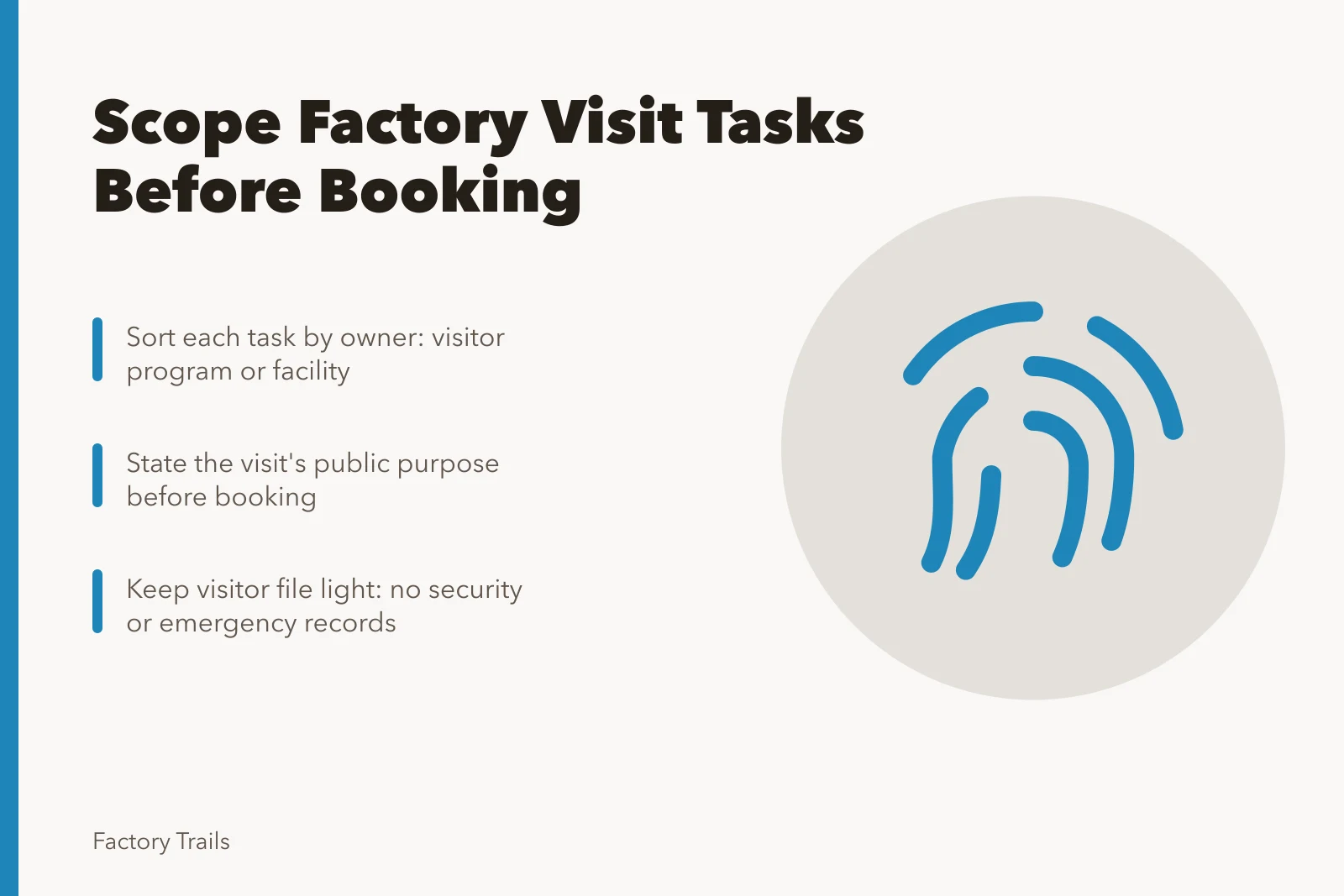
Start with a scope checklist before you send a single invitation. Put every task into one of two columns. The coordinator prepares and sends guest-facing material. The facility decides anything that depends on site conditions, machinery, access control or emergency arrangements.
Visitor-program task / Facility decision
- Send the arrival confirmation
- Approve the arrival point and entry method
- Prepare the host brief
- Determine the permitted route
- Collect an access request
- Confirm what is feasible
- Tell guests that something changed
- Decide what changed and why
- Ask what PPE will be issued
- Set the PPE required in each area
Task Ownership Split
Visitor-program task
- Arrival confirmation
- Send
- Host brief
- Prepare
- Access request
- Collect
- Change notice
- Tell guests
Facility decision
- Arrival confirmation
- Approve point
- Host brief
- Determine route
- Access request
- Confirm arrangements
- Change notice
- Decide change
Foot protection, eye protection and hard hats follow from the facility's own hazard assessment. Under OSHA's general PPE requirements, the employer supplies the equipment that assessment calls for. Ask what will be issued. Never promise it.
Test each draft sentence. If it begins "I think the rule is", it belongs in a question to the facility, not in the guest message.
The pre-booking checklist
- State the public purpose of the visit in one sentence.
- Name the facility contact who approves visitor arrangements, plus a backup name and number.
- Confirm group type, date, headcount and host need.
- Request the approved route description in writing.
- Ask which PPE the facility issues and which items guests bring themselves.
- Record what the program can promise and what stays conditional.
- Note who confirms day-of changes.
The National Park Service asks larger groups at Weir Farm to arrange program and parking details with the park in advance. A plant is not a park, but the order holds. Settle group details with the venue before guests travel.
If the venue cannot yet describe the route in writing, run a scoping call first. The factory visit planning guide sets out how to frame that call and what to send afterwards.
Example: an approved route line and a guest message
Both come from the facility. The coordinator copies them without edits.
Approved route: Group of 20 enters at Door 4, follows the marked walkway to the packaging hall gallery, stops at Station 3 and returns on the same path. No photography past the yellow line.
Guest message: Meet your host at the Door 4 sign at 9:45 a.m. Wear closed-toe shoes. Safety glasses are issued at the desk. Restrooms are on the visitor side of the yellow line.
The pair gives a replacement host everything needed. Neither text reveals a control detail the program does not own. If a fact in either one changes, route the replacement wording back to the facility contact first.
Keep the visitor file light
The file holds the booking record, the approved guest message, the host brief, the confirmation date and a plain change log. It should not become a second copy of security, technical or emergency records.
National Archives records-management profile guidance treats assigned responsibility as part of the record itself. That is why the file needs one named owner and a stated scope.
For a repeat programme, the working factory visits checklist shows how one file carries from visit to visit without collecting detail the program does not own.
When the facility contact is unreachable
Do not decide in their place. Hold the group at the approved arrival point and read the approved message as written. Call the backup name in the file.
If nobody answers, ask the gatehouse or front desk to reach the shift supervisor. A delayed section causes less trouble than an improvised route.
Write the outcome into the change log afterwards, with the time and the name of whoever gave the instruction.
One final check before release
Run one pass before the group arrives. Compare the host brief and the guest message line by line: date, arrival point, named contact, PPE list and open questions. Every line should have an owner, and unanswered items belong to the facility.
Where one version carries a fact the other lacks, find the approved source and revise both. The check keeps a coordinator inside their authority instead of widening it.
Teams that skip it repeat the same gaps, and the common factory visit mistakes list shows what those gaps cost on the day.