Guides
How to pick an industrial site interpretation provider for 2027 work
Pick an industrial interpretation provider by scoping the work, checking research process, and fixing who approves facts before proposals arrive.
Choosing help for an industrial interpretation project starts with the work itself. A site may need historical research, source review, oral-history support, or editorial planning. It may also need exhibit writing, mapping, design, or public-program development. It may need media production or accessibility review of published material.
One provider can be strong in one of those and wrong for another. The comparison only works if you know which one you are buying.
What to take away
- Write the scope before you read a single proposal. Providers bid against what you describe.
- Separate research, interpretation, design and visitor-information duties, because one contract rarely covers all four well.
- Ask how a provider handles a missing source, not how committed it is to accuracy.
- Name the four approval roles and the person behind each one before work starts.
- Keep operational, safety, preservation, legal and access decisions with the authority that owns them.
The scope table that ends most bad hires
Fill this in before you approach anyone. Each row is a decision you make, not a question you ask a provider to answer for you.
Scope decisions before hiring
- Subjectplant, period, workforce in scope
- Evidence baserecords, collections, workers
- Deliverablespanel, route, exhibit, script
- Audiencereaders with no industrial background
- Review chainresearch, context, rights, facts
- Maintenancewho updates public details
- Exclusionsoperations, preservation, engineering, security
The scope table
- Subject
- Which plant, period, workforce or process is in scope, and which is explicitly out
- Evidence base
- Which records, collections, former workers and site materials exist, and who holds them
- Deliverables
- Interpretive panel, walking route, exhibit text, audio script, map, school program or source record
- Audience
- Who must be able to use the material, including readers who arrive with no industrial background
- Review chain
- Who checks research, local context, media rights and current visitor facts
- Maintenance
- Who updates public details after publication, and how often
- Exclusions
- What the project will not decide: operations, preservation treatment, engineering, security, legal questions, access authorization
The exclusions row does more work than the rest. A historical interpretation assignment that drifts into building operations, preservation treatment or visitor-access authorization has left its lane, and no contract wording rescues it afterward.
A scope that asks a provider to "tell the whole story" cannot be evaluated. A scope that asks for a source-based interpretation of a defined subject, with named review points and a format visitors can use, can.
Eight questions that separate providers
Portfolios show finished work. These questions show process, which is what you are actually buying.
Eight provider process questions
- How is a source record built?
- Who checks historical context and names?
- How are facts marked from conclusions?
- What happens when sources conflict?
- How are image credits and licenses recorded?
- Which public facts need site confirmation?
- How are post-copy corrections handled?
- What files arrive at handoff?
- How do you build a source record for a public claim, and what does it look like at handoff?
- Who on your team checks historical context and local names, and what are that person's credentials?
- How do you mark the line between a documented fact and an interpretive conclusion in a draft?
- What do you do when two sources conflict, and who decides which one carries the exhibit?
- How do you record image credit, license terms and caption detail as you go, rather than at the end?
- Which public facts must the site owner confirm, and how do you flag them in the draft?
- What happens when a reviewer asks for a correction after the copy is written?
- What exactly does the client receive at handoff, in what file formats?
The National Park Service heritage-area planning toolkit separates interpretive specialists, subject-matter experts, partners, stakeholders and interested residents, and notes that subject-matter experts fill gaps in a team's knowledge and keep themes based on documented facts and current scholarship.
Use that division when you read the answers. No single proposal needs to claim every form of authority.
See the NPS team-planning guidance for the cited roles.
Question three matters most on industrial subjects. A furnace that ran until 1971 is documented. What the last crew felt on the final shift is interpretation, and it should read as interpretation.
The National Archives document-analysis worksheets split observation, interpretation and use of an item as evidence. Ask a provider how those three stay separate in the project record, and who decides when a claim needs more support before it goes public.
Compare proposals on one grid
Give every provider the same brief and the same questions. A comparison breaks the moment one proposal prices research and review while another assumes you will supply finished text and sign-offs.
Proposal comparison grid
Usable answer
- Scope understanding
- Restates assignment
- Research method
- Names citations
- Team roles
- Named fact-checker
- Local context
- Method for input
- Rights handling
- Cleared credits
- Revision terms
- Number of rounds
- Handoff
- Editable files
Warning sign
- Scope understanding
- Inflates scope
- Research method
- Vague sourcing
- Team roles
- Unnamed roles
- Local context
- Promise to consult
- Rights handling
- Credits at end
- Revision terms
- Unlimited assumed
- Handoff
- PDF only
| Comparison area | What a usable answer looks like |
|---|---|
| Scope understanding | Restates your actual assignment without inflating it |
| Research method | Names how claims get supported, cited and reviewed |
| Team roles | Names who researches, writes, designs and fact-checks |
| Local context | Describes a method for partner or community input, not a promise to consult |
| Current information | Leaves visitor facts with the responsible site contact |
| Rights handling | States when credits and licenses are cleared |
| Revision terms | Gives a number of rounds and what counts as a round |
| Handoff | Lists editable files, source notes, credits and update instructions |
Price belongs on the grid as one line, not as the grid. A low bid that leaves research, review, credits or maintenance undefined tends to cost more once the omissions surface. A high bid is still wrong if it assumes control of decisions the site authority must keep.
Name the four approval roles
Approval by email with no record of what was approved is how a public page ends up claiming an endorsement nobody gave. Assign each role to a person before work begins, and put the names in the schedule.
Four approval roles
- Content lead approves structure and style
- Subject reviewer approves interpretation
- Local partner reviews names and context
- Media-rights reviewer confirms credits
- Site contact confirms current visitor facts
- Content leadapproves structure, house style and reading level.
- Subject reviewerapproves the research interpretation inside their stated competence, and says so when a claim sits outside it.
- Local partnerreviews names, places and community context.
- Media-rights reviewerconfirms the credit or license attached to every image and audio clip.
A site contact confirms current visitor facts. That is a fifth signature on a different kind of fact, and it should not be folded into the subject reviewer's role.
The Visitor Use Management Framework describes using monitoring information to assess conditions and inform changes. Applied to interpretation, that becomes a short reader test before final approval: can a visitor tell what is historic context, find the approved current information, and trace a material claim to its source? Revise the copy if that path is unclear.
Where the responsibility lines fall
Turn the scope into a one-page responsibility sheet. It states who supplies the initial records, who can request extra research, who decides a claim is ready for public use, and who breaks a tie when reviewers disagree.
Outside-scope items
- Structural assessment
- Condition evaluation
- Operational procedures
- Security decisions
- Legal interpretation
- Access authorization
- Emergency response
Do the same for practical information. A provider can draft an arrival note. The site contact confirms the wording and the date on it.
The sheet also lists what sits outside the contract:
- structural assessment
- condition evaluation
- operational procedures
- security decisions
- legal interpretation
- access authorization
- emergency response An outside-scope item does not vanish because nobody priced it. It goes to the organization that owns it.
Agree on how a pause works. If a source is missing, a rightsholder objects, or a local reviewer raises a substantive concern, the provider stops the affected draft, states the question and waits for an authorized decision.
That beats publishing a plausible answer nobody can support later. The National Archives research-visit instructions make the same point about practical details: contact the facility before you rely on them, because they vary by location and change.
The review meeting that saves the schedule
Book one review meeting before final files are prepared. Compare the draft against the written scope, the cited sources, the list of current visitor facts and the agreed handoff.
Pre-final review meeting
- Compare draft against written scope
- Check cited sources
- Check current visitor facts
- Check agreed handoff
- Ask each reviewer for three items
- Record decisions in project record
Ask each reviewer for three items: one that is ready, one that needs correction, and one that belongs outside the assignment. Record the decision in the project record. The provider gets a clear basis for final edits, and you get a record of what was checked and by whom.
Common questions
Should one provider do everything?
Only when the assignment is small and the provider's demonstrated role covers it. Larger projects usually need separate research, interpretation, design, local review and site-information roles, because the skills rarely sit in one team.
How many proposals should we compare?
Enough to see the range of approaches, using the same scope and the same eight questions for each. The right number depends on your procurement rules and how much time your reviewers have.
Who confirms visitor information?
The responsible site contact or authority confirms public arrival, access, schedule and contact details. A provider can format approved information and flag it for confirmation, but should never supply it from memory.
What belongs in the final handoff?
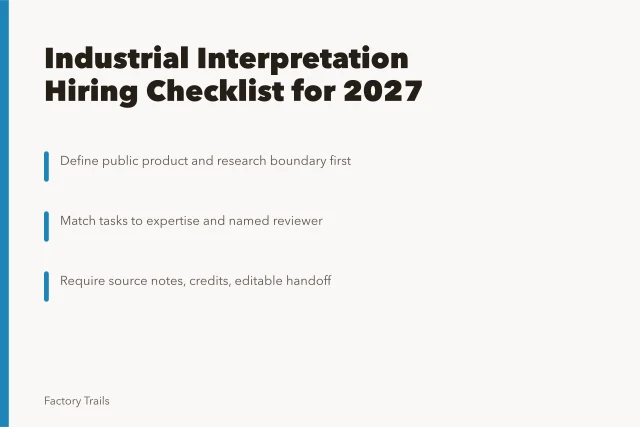
Public materials, editable files where applicable, source notes, image credits, the review record and a list of details that need future confirmation. A site cannot maintain what it cannot locate. Before the first proposal arrives, build the brief and the handoff with an industrial site interpretation hiring checklist so every provider answers the same questions.
In this guide
- Industrial site interpretation hiring checklist: how to build the brief and the handoffIndustrial interpretation hiring checklist for 2027 helps project owners define scope, compare expertise, set approvals, and request a maintainable final handoff.
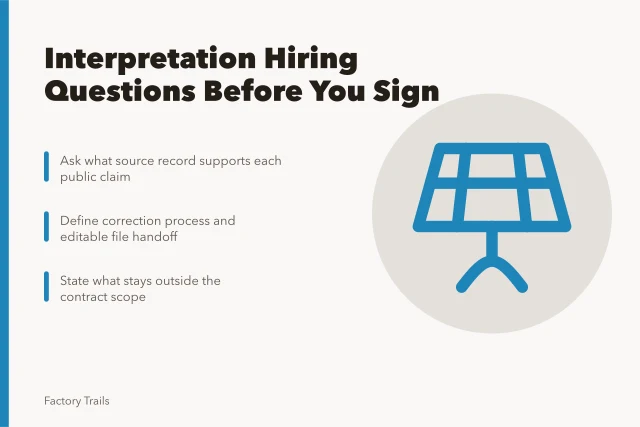
- Industrial site interpretation hiring questions to ask before you signIndustrial interpretation hiring questions for 2027 help project owners compare scope, source methods, local review, provider limits, handoff, and corrections.
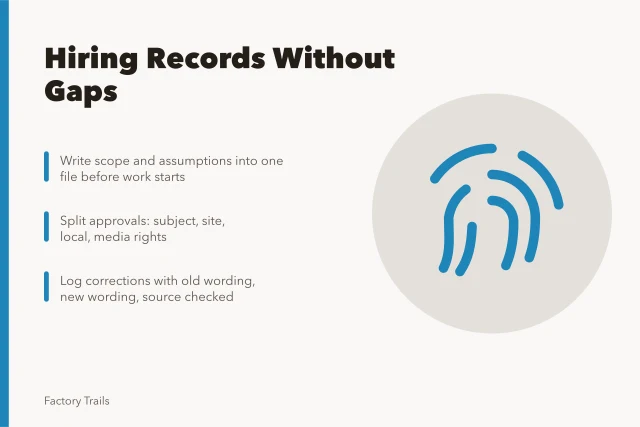
- How to keep industrial site interpretation hiring records without gapsA hiring record tracks what an interpretation provider was asked to do, what the industrial site supplied, and who approved each public claim.