Guides
Part of How to pick an industrial site interpretation provider for 2027 work
Industrial site interpretation hiring checklist: how to build the brief and the handoff
Industrial interpretation hiring checklist for 2027 helps project owners define scope, compare expertise, set approvals, and request a maintainable final handoff.
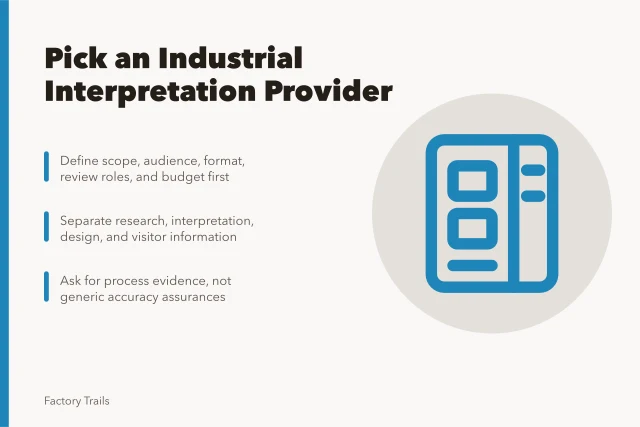
Use this checklist before hiring a researcher, writer, designer, planner, media specialist, or project team for industrial interpretation. It helps a client compare roles and proposals. It does not authorize a provider to make site, safety, access, preservation, or legal decisions.
What to take away
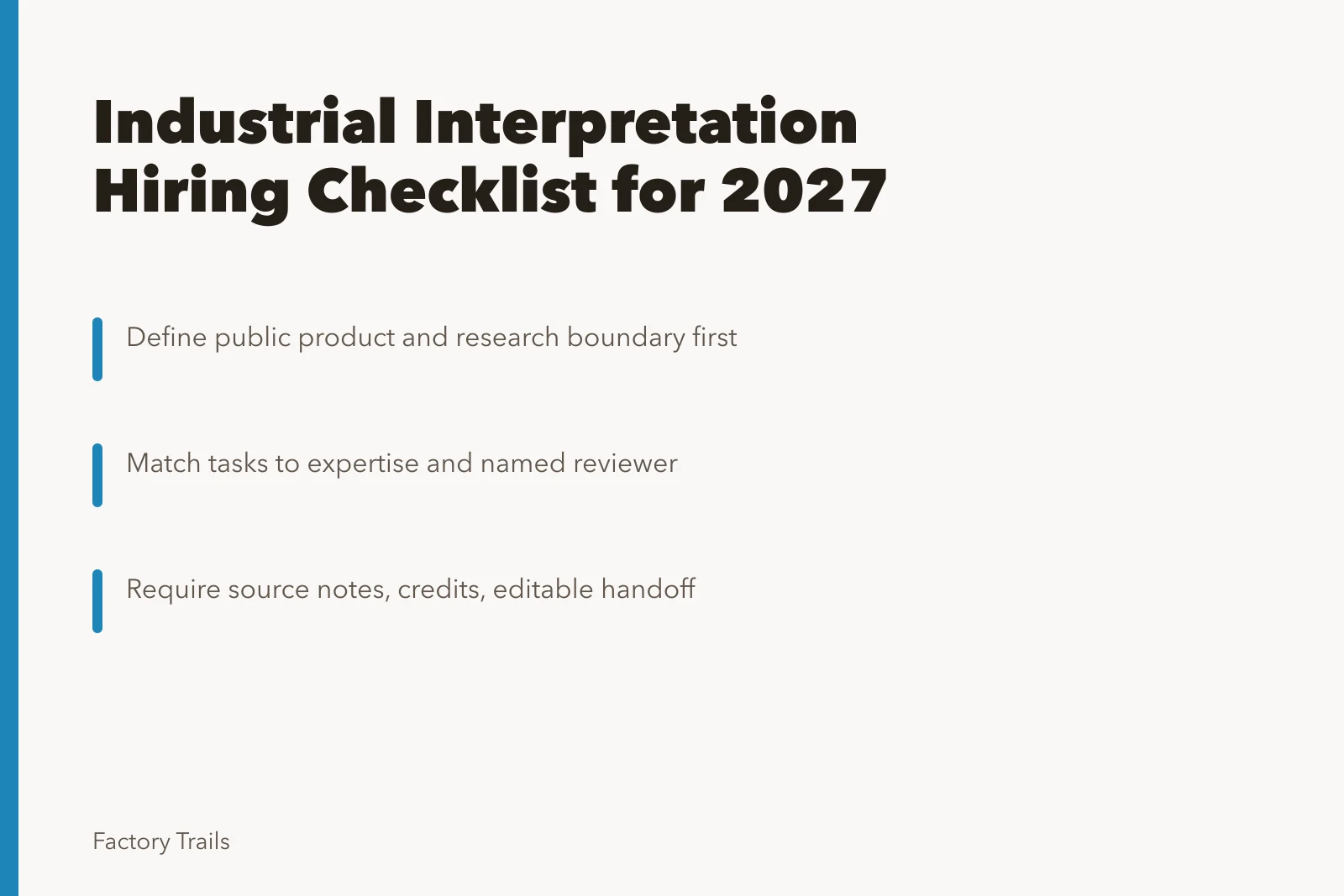
- Define the exact public product and research boundary first.
- Match each task to demonstrated expertise and a named reviewer.
- Keep current visitor facts with the responsible site contact.
- Require source notes, credits, and editable materials at handoff.
Complete the brief
- State the industrial subject, place, time period, and intended audience.
- List the available records, collections, local contacts, and current site materials.
- Name the needed deliverablesweb page, map, exhibit copy, script, source record, or another approved format.
- Define what the project excludes, including operational and access decisions.
- Identify who approves historical claims, local context, media credits, and current visitor facts.
- Set the review dates and final handoff requirements.
Do not ask for a proposal until the client can answer these points. A vague assignment encourages vague prices and makes it hard to see whether two providers are offering the same work.
Brief completion checklist
- Subject, place, time period, audience
- Available records, collections, contacts
- Deliverablesweb, map, copy, script
- Exclusionsoperational and access decisions
- Approvers for claims, credits, visitor facts
- Review dates and handoff requirements
Compare the right qualifications
| Task | Relevant evidence to request |
|---|---|
| Historical research | Source process, scope examples, and research notes |
| Interpretation planning | Experience connecting resources, audiences, and public formats |
| Writing | Clear, sourced public work with defined revision steps |
| Design or mapping | Accessible, maintainable examples and source-credit practice |
| Local review | Method for gathering and recording place-based feedback |
| Visitor information | Process for getting current facts from the site authority |
NPS preservation-planning guidance encourages broad public participation, analysis of information with partners, named leads and supporters for actions, and progress monitoring. That is a good reason to evaluate a provider against the actual format and review needs of the assignment rather than a generic portfolio. See the NPS preservation-planning guidance for the cited planning context.
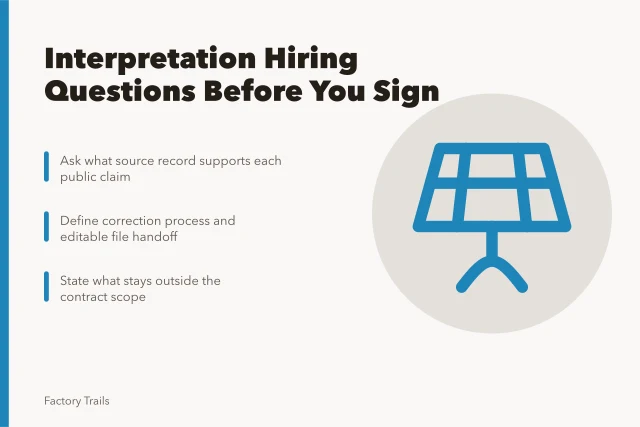
Ask for the provider's source-review method in writing. The National Archives document-analysis worksheets use observation, interpretation, and evidence as distinct steps. A checklist can require the provider to keep those steps separate in source notes, so the client can see whether a sentence is direct support or an editorial conclusion.
Set the approval lines
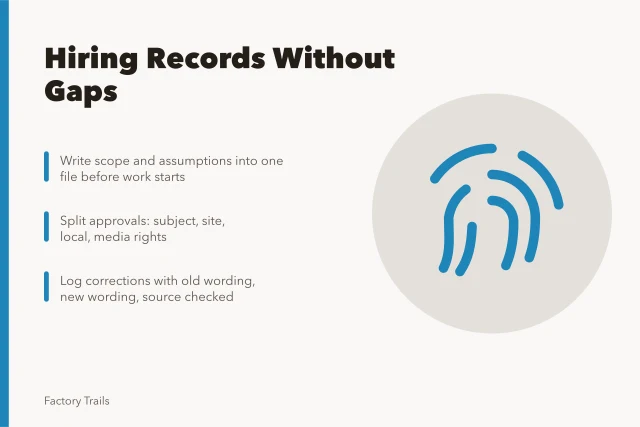
Write down who can approve each kind of work. A subject reviewer may check a historical claim. A site contact may confirm a public arrival note. A rightsholder or collection contact may confirm a credit. A client may approve the final style and budget. Keep these tasks separate.
An approval should state what was reviewed. "Approved" is not useful if no one can tell whether it covers the whole page, a single caption, a name, or a current contact detail.
Set a current-information check before launch. The National Archives visit-planning guidance recommends confirming that records are held at the intended location before travel. Use the same habit for a site's public directions, open status, and contact details. Record the source, the confirming person, and the date.
Request a complete handoff
The provider should return the public copy, source record, media-credit list, captions and alt text, review notes, editable files where applicable, and a list of facts that must be reconfirmed later. Ask how corrections will be handled after launch and who will have access to the material.
Add a practical reader check to the handoff. The Visitor Use Management Framework treats monitoring as a way to assess conditions and make adjustments. Before accepting the final files, ask a reader to find a claim source, distinguish historic material from current facts, and report any unclear instruction. Include the resulting fixes in the final record.
Keep this checklist attached to the signed scope. It gives the client a simple way to compare what each proposal includes, what it excludes, and who owns every final decision. That record also helps a later editor see why a provider was selected and what material was expected at handoff.
Common questions
Can one provider handle research, writing, and design?
Sometimes. Confirm that the provider has a process for each role and that the project still has independent subject and site review where needed.
What should a proposal make clear?
It should state assumptions, exclusions, deliverables, review steps, source handling, media-credit work, timeline, price, and handoff.
Who approves current visitor instructions?
The responsible site contact or authority. A provider can prepare the wording after that information has been confirmed.