Reviews
Part of How to pick an industrial site interpretation provider for 2027 work
Industrial site interpretation hiring questions to ask before you sign
Industrial interpretation hiring questions for 2027 help project owners compare scope, source methods, local review, provider limits, handoff, and corrections.
The best hiring questions expose the work behind a proposal. They show whether a provider understands the difference between research, interpretation, design, current visitor information, and decisions that must remain with the site or qualified authority.
What to take away
- Ask what the provider will verify and what it will return to the client.
- Compare source handling, local review, and handoff on the same basis.
- Request examples of process, not only finished visual work.
- Keep site, access, safety, preservation, and legal decisions outside the editorial assignment.
Compare strong questions with weak questions
Strong questions with weak questions
| Strong question | Weak question |
|---|---|
| What source record will support each main public claim? | Can you make the story sound more important? |
| Who checks local names and missing context? | Can you write everything without review? |
| Which visitor facts must the site confirm? | Can you tell visitors where to go from old materials? |
| What happens when evidence contradicts the draft? | Can you avoid delays caused by questions? |
| What files and records are included at handoff? | Can you send one final PDF? |
The first column makes responsibilities visible. The second often produces a proposal that looks complete while leaving difficult work to the client after the contract begins.
Strong vs weak hiring questions
Strong question
- Source record
- What source supports claim?
- Local review
- Who checks local names?
- Visitor facts
- Which facts must site confirm?
- Contradictions
- What if evidence contradicts draft?
- Handoff
- What files included at handoff?
Weak question
- Source record
- Make story sound important?
- Local review
- Write without review?
- Visitor facts
- Use old materials?
- Contradictions
- Avoid questions?
- Handoff
- Send one final PDF?
Ask about capacity and role fit
Ask the provider which parts of the work it can do directly, which parts require client materials, and which questions require another expert. A researcher may need access to collections and a subject reviewer. A designer may need approved copy and media rights. A writer may need a local reviewer and current visitor facts. A provider that names these dependencies is usually easier to manage than one that claims to handle every decision alone.
NPS guidance for assembling a cultural-resources team recommends identifying partners who can sustain involvement and selecting organizers with a relevant mission and demonstrated capacity. It also emphasizes identifying staffing roles and leadership commitment. Use the same basic test when choosing project help: fit the provider's role and capacity to the actual assignment. See the NPS partner-and-team guidance for the cited planning ideas.
Ask the provider how a claim moves from source to draft. The National Archives document-analysis worksheets set out observation, interpretation, and use as historical evidence as separate stages. A provider should be able to explain who performs each stage, where notes live, and when a claim will be returned for more research.
Ask about corrections before signing
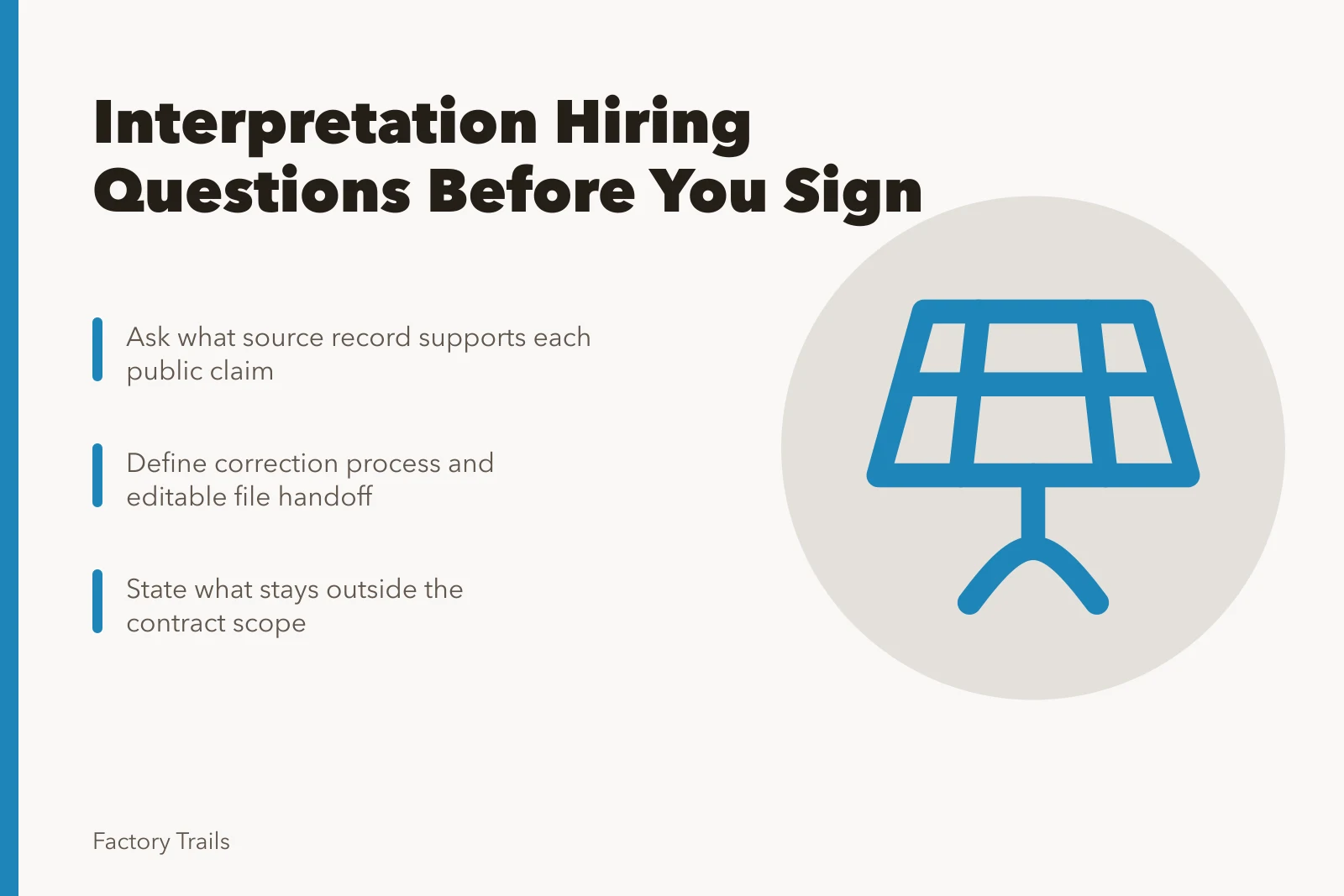
A correction process should be part of the proposal. Ask how a provider records a reported error, checks the source, revises the text, updates image credit, and identifies related material that may contain the same issue. Ask whether the client receives editable files and source notes after the work closes.
Do not accept a vague promise to make revisions. Define how many routine editorial rounds are included, what counts as new research, who makes the final historical decision, and how current visitor facts will be confirmed. This prevents a small correction from becoming an argument about scope.
Ask what remains outside the contract
An interpretation provider should be able to state its limits. It may explain a historical source or format approved visitor information. It should not decide whether a building is safe, authorize access, prescribe a preservation treatment, interpret a legal requirement, or direct an emergency response.
Ask how the provider will flag an outside-scope question. The best answer identifies the question, pauses the affected claim or instruction, and returns it to the client or responsible authority.
Ask who confirms present-day visitor facts. The National Archives research-visit guidance tells visitors to contact the intended facility before travel because locations hold different records and practical details differ. An interpretation provider should follow the same division: write the approved information, but do not substitute historical research for the site's current authority.
Ask how the provider checks the public result after publication. The Visitor Use Management Framework describes assessing conditions through monitoring and using the result to guide adjustments. A simple contract version is a reader check for source visibility, current-fact labels, and an accessible correction path.
Common questions
Should providers be asked for references?
Ask for relevant work examples and, when appropriate, references who can describe the provider's research, review, communication, and handoff process.
What is a useful proposal comparison sheet?
Use the same columns for scope, research approach, local review, deliverables, revisions, source record, media credit, current facts, price, and handoff.
Who owns the final source record?
Set this in the agreement. The client should receive enough documentation to maintain the published material after the provider's work ends.