Guides
Factory tour budgeting options comparison: owner records to keep for 2027
Compare factory tour budgeting options for 2027, from FareHarbor and Matterport to Zoom, plus owner records for routes, budgets, content, and reviews.
An option record explains why a factory chose a guided, viewing, demonstration, self-guided, virtual, or hybrid format. It also preserves the boundaries that make the option accurate: what visitors can access, what they only see through media, and what happens when the normal route changes. The budget behind that choice needs the same record.
What to take away
- Compare format costs before locking the visitor promise.
- Keep the format choice and the evidence behind it together.
- Separate current live conditions from recorded material.
- Maintain a version history for routes, visitor copy, and media.
- Set a 2027 review date for every budget line and record owner.
Budget options compared for 2027
Direct answer: booking fees and card processing outweigh hosting for a small factory program. Only a paid 360 plan or a paid live-session plan adds a fixed monthly charge, usually under 1,000 USD a year for one line and one host.
| Format | Budget option | Rate to expect | Coverage and currency |
|---|---|---|---|
| Guided | FareHarbor booking | No monthly fee. Per-booking fee commonly quoted near 6 percent, plus card processing near 2.9 percent plus 30 cents. | US and Canada. Bills in USD or CAD. |
| Viewing | Eventbrite ticketing | Free for free events. US paid tickets commonly 3.7 percent plus about 1.79 USD per ticket, plus processing. | US and Canada. Canada bills in CAD. |
| Demonstration | Peek Pro booking | No monthly fee. Per-booking fee is quote-based, so ask for the 2027 rate card in writing. | US and Canada. Bills in USD or CAD. |
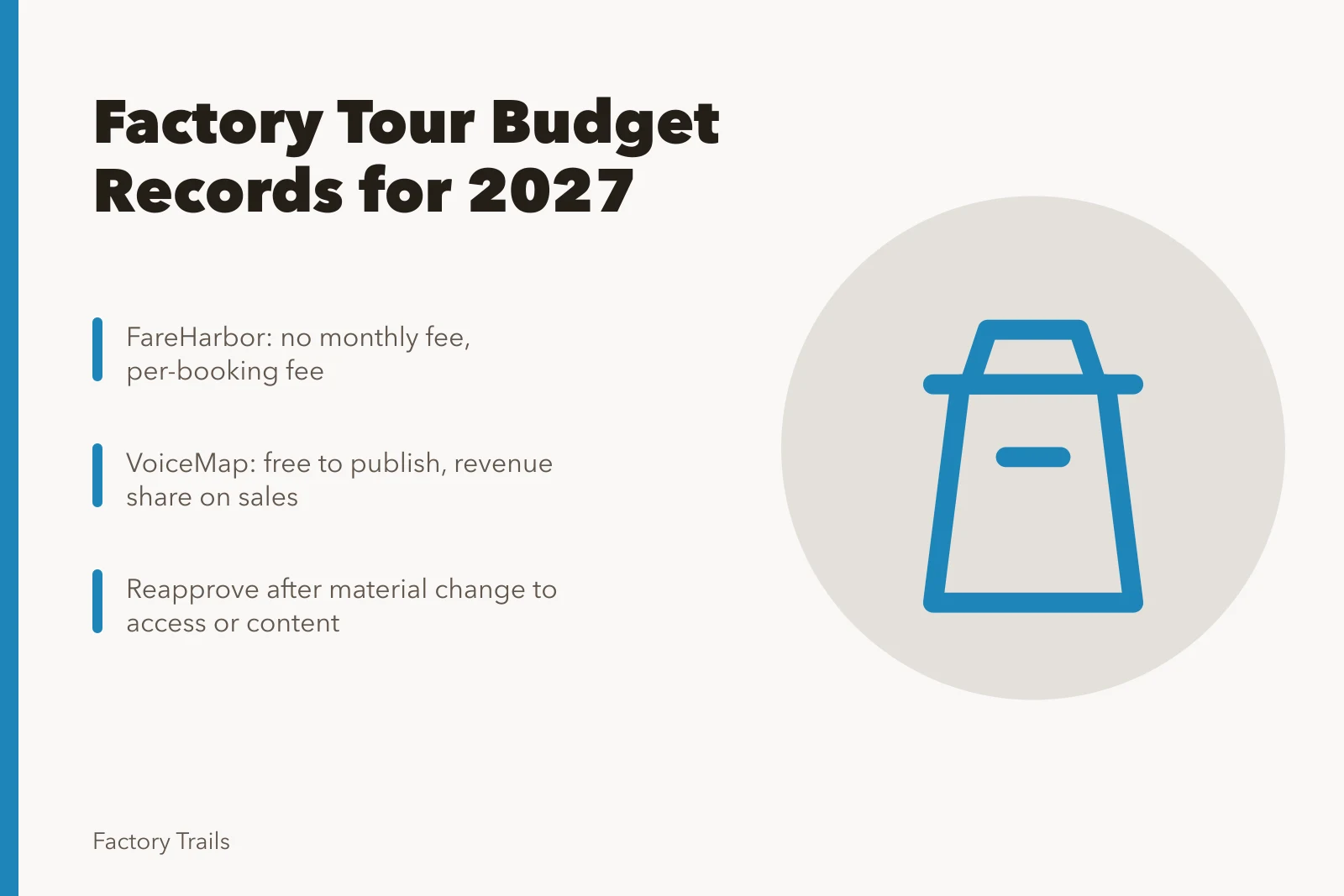
| Self-guided | VoiceMap audio tours | Free to publish. Revenue share is commonly half of each sale. | Global. Payout currency follows the store price. |
| Virtual | Matterport 360 hosting | Free plan allows one active space. Paid plans typically about 10 to 100 USD a month by space count. | Global. Billed in USD. |
| Hybrid | Zoom live sessions | Free plan caps group meetings at 40 minutes. Paid plans typically about 13 to 16 USD a month per host. | Global. Billed in USD or CAD. |
These are 2026 published rates used as the 2027 planning basis. No vendor above has published a 2027 card, so verify each figure before you budget. Ask for a written quote in the billing currency.
Add Kuula for low-cost 360 images. Its free plan has upload limits, and paid plans typically run about 12 to 30 USD a month, billed in USD worldwide. Track those trade-offs in the option log.
Tour Budget Options 2027
Format
- Guided
- FareHarbor
- Viewing
- Eventbrite
- Demonstration
- Peek Pro
- Self-guided
- VoiceMap
- Virtual
- Matterport
- Hybrid
- Zoom
Budget option
- Guided
- per-booking fee
- Viewing
- per-ticket fees
- Demonstration
- per-booking fee
- Self-guided
- revenue share
- Virtual
- free one space
- Hybrid
- 40-minute free cap
Cost or trade-off
- Guided
- Viewing
- Demonstration
- Self-guided
- Virtual
- Hybrid
A small factory program that sells 1,200 admissions at 15 USD grosses 18,000 USD a season.
- 6percentFareHarbor fee at the typical : about 1,080 USD.
- 2.9percentCard processing at plus 30 cents: about 880 USD.
- 120Matterport paid plan for one line
- 160Zoom Pro for one host
Platform and hosting cost lands near 2,250 to 2,550 USD, or about 12 to 14 percent of gross ticket revenue. Canadian operators billed in USD should add a conversion spread of 2 to 3 percent, which is roughly 50 to 80 USD on this example.
Choosing between the six formats
- Guided or demonstration
- visitors must watch the line run, and staff can hold the group.
- Viewing
- the plant cannot admit visitors near live equipment.
- Self-guided audio
- the route is long, repeats, or runs outdoors.
- Virtual
- travel or capacity blocks visits.
- Hybrid
- reach plus a live presence, when staffing covers both.
Decision rule: take the cheapest format that keeps the visitor promise honest. Under 3,000 USD a year, run viewing or self-guided and skip paid 360 hosting unless one flagship line carries the marketing.
Option records to keep
| Record | What it should show |
|---|---|
| Option decision | Chosen format, alternatives, visitor purpose, budget line, and known limits |
| Route or sequence | Live stops, viewing points, digital sequence, restricted areas, and fallback |
| Content register | Script, image, video, map, source, date checked, owner, next review, and equipment change date |
| Pilot evidence | Audience, conditions, duration, staff roles, questions, and changes required |
| Public-copy log | Booking-page, confirmation, signage, and event-listing versions |
| Review note | Decision to maintain, revise, pause, or expand the option |
Use one identifier for the option version. For example, viewing-route-v2 should appear in the route sheet, host script, booking description, and pilot note. This avoids a common mistake: staff deliver a new route while a visitor reads an old promise.
The National Park Service's Museum Handbook Part III overview covers documenting the use of museum collections, including publications and exhibits. When a tour uses photographs, videos, historic objects, or interpretive content, record what material is used, why, and which version is approved.
Close the record loop
After each scheduled review, either confirm the existing version or issue a new one. Record the person who approved the change and the visitor information that was updated. This turns an option from a one-time choice into a maintained program.
The National Archives describes a records-management profile as a way to identify responsibilities, systems, and practices that govern recorded information. A visitor program can borrow the questions: who owns the record, where is the current copy, and who decides when it changes?
Start with records that document a decision or public promise. The National Archives' basic records-management training explains that records provide evidence of organizational actions. For a factory-tour option, keep the choice memo, the approved visitor copy, the source list for historical claims, and the pilot note.
Decide how long each class of material must remain easy to find. The National Archives' overview of records scheduling explains why organizations set retention rules for records. It supports a practical policy for factory tours: set a review date and a retention owner for superseded maps, outdated videos, old confirmations, and any script naming a retired machine.
Create one option log with a simple row for each change. Include the date, owner, materials affected, and next review date. Do not make the log a diary. It should help a new owner answer quickly: Which route is current? Which video still fits the history? Which booking statement did visitors see last season?
Review the log before reopening a seasonal program or approving a material change. Add the 2027 budget renewal date to the same review.
Common questions
What is the most important option record?
The current visitor promise linked to the approved route or digital sequence. It keeps staff and visitors aligned.
Should old videos be deleted after a process changes?
Keep them if they have documented value, but label and use them honestly. Do not present outdated footage as a live current view.
When should an option be reapproved?
Reapprove it after a material change to access, content, operating conditions, audience, or the fallback experience.