Guides
Industrial site interpretation: how regions adapt a shared story
Regional industrial site interpretation guide for 2027 helps U.S. heritage teams build local stories, shared themes, and clear visitor routes without losing place.
What to take away
- Write a regional boundary statement before choosing stopsactivity, period, scope.
- Use the same theme questions at every site; let each answer in its own words.
- Prepare three visitor paths, from a two-hour first stop to a deeper research route.
- Launch small, with a reviewer name and review date on every time-sensitive item.
Write the regional boundary statement first
Industrial history rarely fits inside one property line. A mill ties to a river, a rail spur, a port, and a company town across several counties. A regional frame shows those links without flattening the stops.
A tourism boundary is not automatically the right historical one. "Regional" can mean a watershed, a production corridor, a group of linked towns, or a travel area.
Answer four prompts before selecting any stop.
- Which industrial activity connects these places?
- Which period does the interpretation cover?
- Which communities and routes belong inside the story?
- What stays outside the scope?
Working statement questions
- Industrial activity connecting these places
- Period or periods covered
- Communities, places, routes, institutions included
- What project leaves outside scope
The fourth prompt does the most work. A guide goes vague when it tries to include every related place.
Example: a boundary statement and theme for an iron district
The Red Mountain iron district covers the ore mines, blast furnaces, rail spurs, and company housing inside Jefferson County, Alabama, from the first commercial furnaces to the end of local ironmaking. It leaves out the deep-water port at Mobile.
Treat that as template wording. Dates, names, and exclusions come from local records, not from a tourism map. Alabama's industrial heritage sites guide lists the stops such a district guide reaches next.
The theme follows: how ore, fuel, rail, and labor turned one ridge into an industrial district, and what stayed after the furnaces stopped. Sloss Furnaces in Birmingham is the anchor site for that frame.
Build the local record before the shared text
Start with what each place holds: buildings, machinery, maps, company records, union material, photographs, and oral histories. Those sources do not carry equal weight.
Create an evidence sheet for every site: the resource, its source, its date range, the claim it supports, the reviewer, and any open questions.
Mark uncertain claims as uncertain. The National Archives document analysis worksheets separate what an item shows, what it means, and how it serves as evidence.
Local review matters most for contested stories: labor conflict, migration, housing, pollution, closure.
Choose one theme that leaves room for difference
A theme is a lens, not a slogan. It lets sites connect without making the same point at every stop. A district theme might follow how raw material moved or what happened after a plant closed.
The NPS interpretive planning toolkit asks for a significance statement: why the place matters and why a visitor should care. How to pick an industrial site interpretation provider for 2027 work covers the scope questions to settle before hiring one.
Question at each stop / What it protects
- What can a visitor see or enter here?
- Grounds the story in the place
- What evidence supports the claim?
- Keeps interpretation traceable
- Whose experience is present?
- Blocks one voice from taking over
- How does this stop connect to the region?
- Justifies inclusion
- What should the visitor do next?
- Gives the route a sequence
Answers differ between stops, and that difference gives visitors a reason to travel.
Plan routes as a set of choices
Visitors arrive with different amounts of time, and school groups need predictable hours.
- First stop
- address, hours, parking, step-free entry.
- Themed loop
- two to four stops, drive times, a food stop.
- Deeper route
- archive hours, appointment rules, staff contact.
Do not describe access from memory. Publish only details the site has approved, with a review date. A closed or private place can still be interpreted through an approved viewpoint or a partner program.
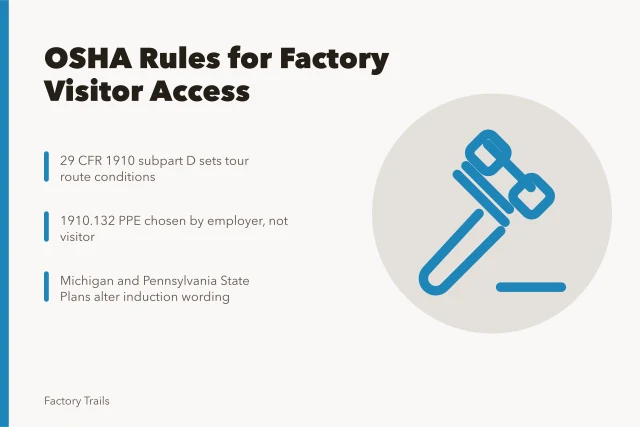
Routes that include a working plant add safety gear. OSHA rules at 29 CFR 1910.132 to 1910.136 cover eye, face, and foot protection. Factory visit mistake prevention covers the booking errors that show up on those routes.
Give every partner a defined role
Regional work pulls in museums, archives, libraries, local governments, schools, businesses, and community groups. Each needs an explicit job.
| Role | Task | Review point |
|---|---|---|
| Content lead | Maintains the regional narrative | Before publication |
| Site contact | Confirms visitor-facing facts | Before each change |
| Local reviewer | Checks place names and context | During drafting |
| Collection partner | Verifies source description and credit | Before media use |
| Route owner | Confirms public directions | On a set schedule |
Sharing a photograph is not an endorsement. Record the actual approval in writing.
Staffing is usually lighter than expected. One common arrangement is a part-time coordinator at a typical 10 to 15 hours a week during start-up, plus site staff review time. A contracted planner can carry drafting, review scheduling, and the change log.
Start with a small publishing set
- A regional landing page with the shared story and the route choices.
- One short page for each site or community.
- A route map built from approved public access details.
- A source and credit page for readers who check the research.
- A change log with a named owner and review date for each time-sensitive item.
Set the publishing budget as its own line rather than folding it into site operations. Factory tour budgeting fundamentals shows how to write scope items a vendor can price.
Common questions
How long should the boundary statement be?
Do all sites need the same text?
What if a site is closed or privately owned?
How often should the guide be reviewed?
In this guide
- How to build a regional industrial site interpretation checklistRegional industrial interpretation checklist for 2027 helps heritage teams confirm local evidence, shared themes, partner review, and current visitor information.
- Regional industrial interpretation questions to ask before you trust a claimRegional industrial interpretation questions for 2027 test whether a route connects real local evidence or just files familiar sites under one label.
- How to organize regional industrial interpretation records before you publishRegional industrial interpretation records work best when the place boundary, contested wording and source status are settled before anything goes public.