Guides
Part of Industrial site interpretation: how regions adapt a shared story
How to organize regional industrial interpretation records before you publish
Regional industrial interpretation records work best when the place boundary, contested wording and source status are settled before anything goes public.
A regional record fails quietly. The page reads well, the sources exist, and nobody can say which county the photograph came from. Fix the boundary first, then the wording, then the source list.
What to take away
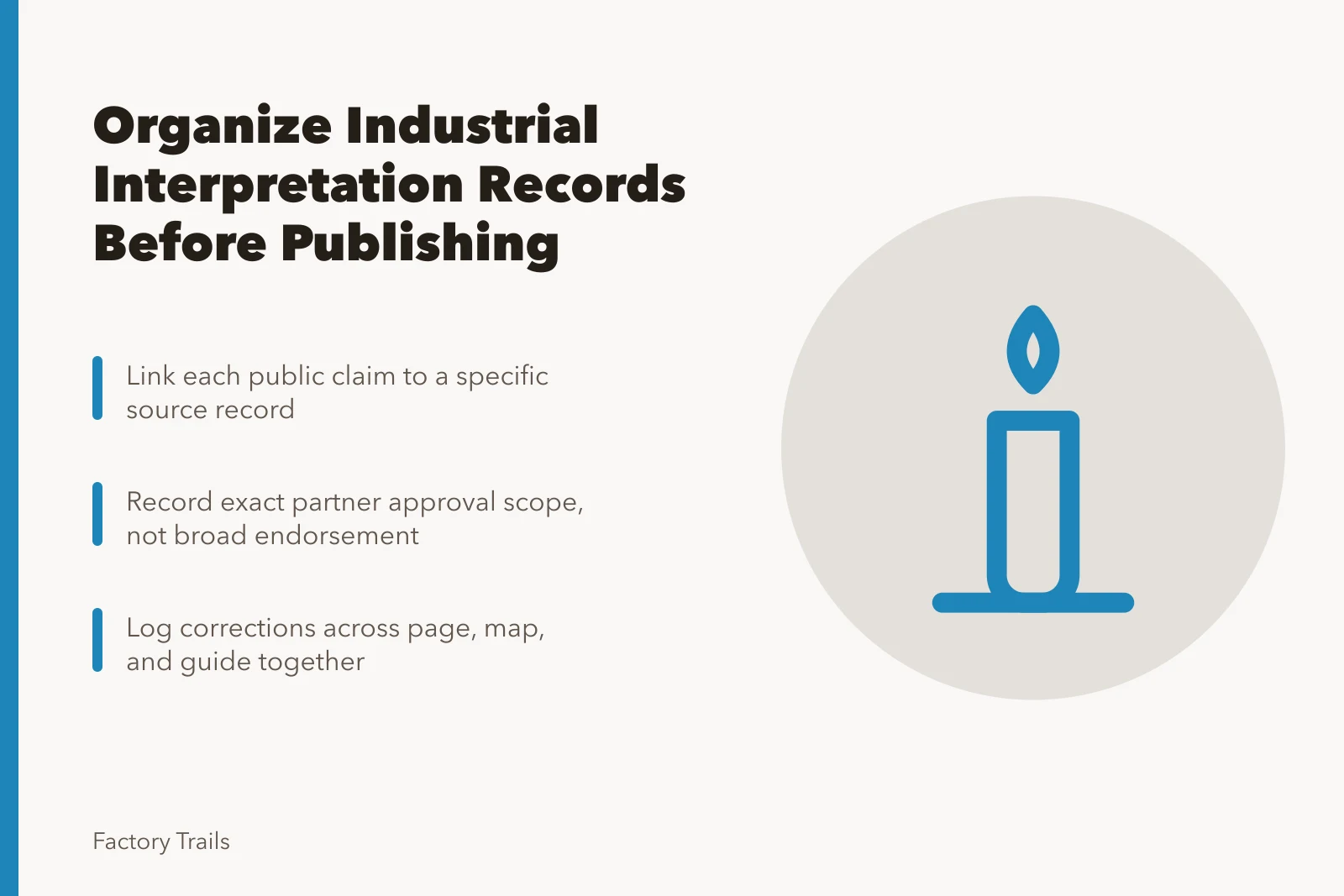
- Write the place boundary into the record before you write the claim. A source about one town is not evidence for a corridor.
- Keep contested wording and the comments behind it in the same file, so a later editor sees why the sentence is narrow.
- Label each source as observed, interpreted, or used as evidence. Do not publish a research lead as a fact.
- Keep an internal source list that is longer than the published citation list, and say which items cannot be published.
- Give every visitor-facing detail its own review date and named contact, separate from the historical research.
Define the place before you define the claim
Local history is studied within a bounded place. The Library of Congress treats it as such. That place can be a region, state, county, or city. It can also be a town, village, or neighborhood. That list is the practical part. Pick one boundary and write it into the record, because the boundary decides which sources are admissible.
A furnace photograph taken in one borough does not document a whole valley. A wage ledger from a single plant does not describe an industry. When the boundary is unstated, every later editor widens it by accident, and the page slowly claims more than its sources carry. See the Library of Congress local-history guide for the definition in full.
Keep contested wording, not just the winning version
Industrial sites carry disputes that outlast the people who argued them: which company closed the works, whether a closure was a lockout, who built the first furnace on the site. A record that keeps only the published sentence loses the reason it was phrased that way.
Keep the comments, the conflicting sources, and the draft lines that were rejected. Then narrow the public wording instead of picking a side. "The plant changed ownership in 1931" survives a dispute that "the company abandoned the town" does not. Narrowing is not evasion; it is the honest version of what the sources support.
Label what each source can carry
The National Archives document-analysis worksheets separate observed detail, interpretation, and the use of an item as historical evidence. Borrow those three labels for your own source notes. They stop an editor from promoting a promising lead into a published fact.
A useful test: if the source disappeared tomorrow, would the sentence still stand on something else? If not, the sentence needs a second source or softer wording.
Do not publish every source you hold
Some material stays internal. Deeds, donor correspondence, staff contact details, and collection items under restriction belong in the record and not on the page. Publishing everything you hold is a rights problem and a privacy problem, and it also buries the citations a reader actually needs.
Keep two lists. The internal list holds every source consulted. The published list holds what rights, privacy, and collection rules allow, with the credit line each one requires.
Worked example: a route stop with a disputed claim
A trail stop reads "Men and boys as young as twelve worked the screens here." Three sources support it, one contradicts it, and the photograph is credited to a county archive that permits reuse with attribution.
- Boundary writtenthe stop sits in one township, and all three sources address that township.
- Contested line narrowed to what the sources agree on, with the contradicting source noted in the record.
- Source labels appliedtwo observed records, one interpretation, one used as evidence.
- Internal list holds the donor letter that cannot be published; published list carries the archive credit.
- Visitor detail checked against the site's own page, with a named contact and a next review date.
The stop ships with a narrower sentence and a credit line that matches its licence. Nothing was lost except a claim nobody could defend.
Separate visitor facts from research
A digitized photograph stays a stable source for years. An entrance, an open day, or a contact changes without warning. Put a review date and a responsible contact beside every visitor-facing detail, and ask that contact to confirm it.
The National Archives visit-planning guidance tells researchers to identify a facility and contact it before travelling. Apply the same habit to a route page: record the official page, the contact, the date checked, and the date it needs checking again.
The Visitor Use Management Framework treats monitoring information as the trigger for adjusting conditions. A reader report about an unclear route or a dated contact should end in a dated decision and a list of the public items checked.
Common questions
Who should own the record?
One named content owner, even when sources and approvals come from several people. That person keeps the boundary, the source labels, and the review dates consistent across every item in the region.
When does a record need reviewing?
Before publication, after any reported correction, and whenever a visitor-facing detail or a major interpretation changes. The visitor facts will usually need it first.
How long should the internal source list be kept?
As long as the public item exists, and longer if rights or privacy conditions still apply. The internal list is what lets a future editor answer a challenge without rebuilding the research.