Guides
Part of Industrial site interpretation: how regions adapt a shared story
How to build a regional industrial site interpretation checklist
Regional industrial interpretation checklist for 2027 helps heritage teams confirm local evidence, shared themes, partner review, and current visitor information.
Use this checklist when a local industrial story will appear in a regional route, map, exhibit series, or guide. It is an editorial planning tool. It does not determine site operations, preservation treatment, legal status, or access permissions.
What to take away
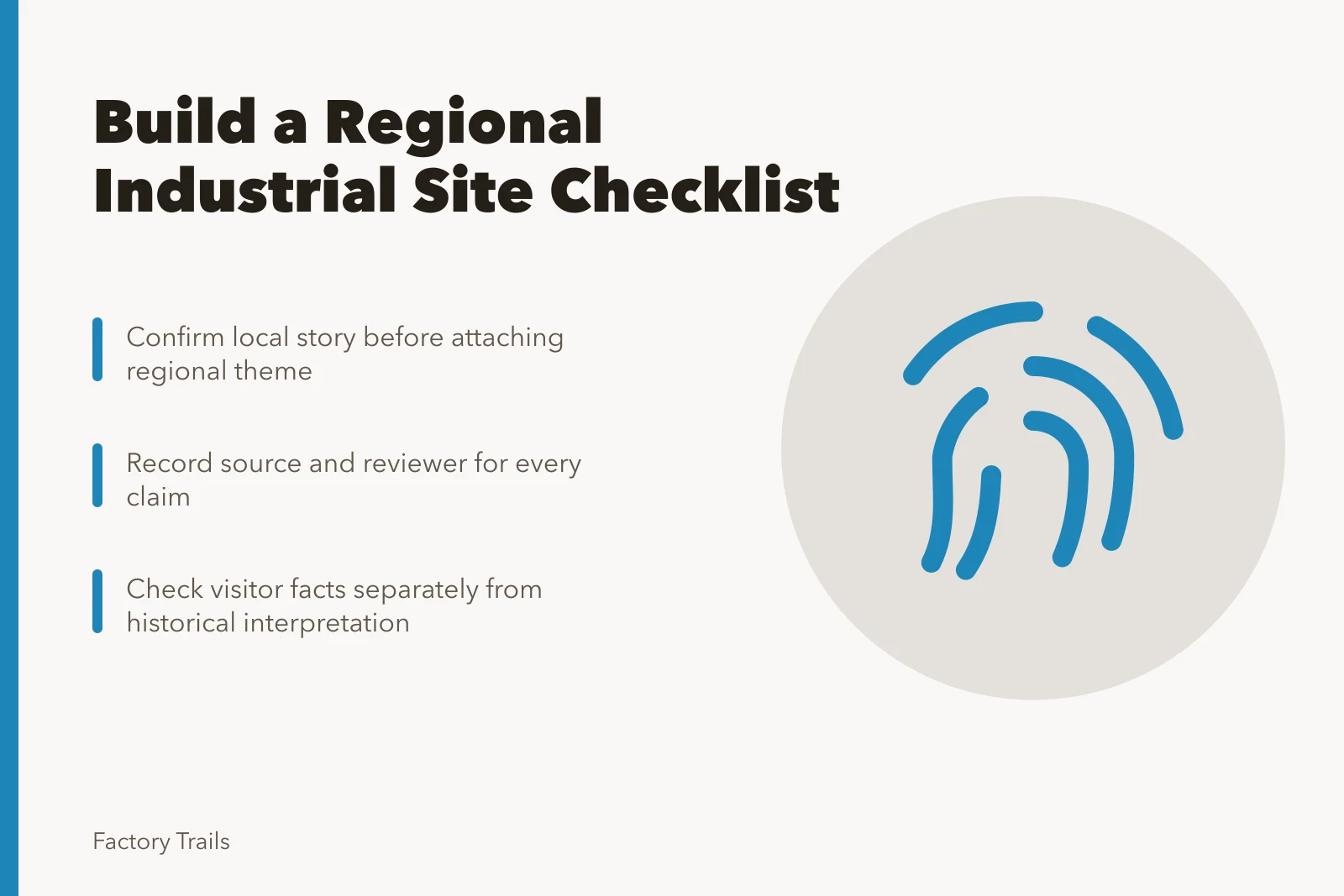
- Confirm the local story before attaching it to a regional theme.
- Record the source and reviewer for every public historical claim.
- Give partners clear approval points instead of assumed endorsement.
Check the local foundation
Before drafting regional copy, complete these checks for each site or community:
Local foundation checks
- Identify visible resource, record set, or story
- List specific sources supporting main claims
- Separate facts from interpretation and questions
- Confirm current place and community names
- Ask local reviewer for missing experiences
- State public access or interpretation method
- Identify the visible resource, record set, or story that anchors the page.
- List the specific sources that support the main claims.
- Separate documented facts from interpretation, recollection, and unanswered questions.
- Confirm current place names and the names people use for the community.
- Ask a local reviewer to identify missing experiences or misleading wording.
- State whether the place is open to the public, viewable only from an approved public area, or interpreted through a collection or program.
The checklist prevents a common regional mistake: assigning a site to a broad story before anyone has verified what the site itself can responsibly say. The MotorCities National Heritage Area in southeast Michigan works this way. Each stop ties to a documented plant, labor event, or riverfront site, not to a generic theme.
Copyable checklist template
Copy this table into a project file. Use one row per site.
| Check | Record | Who confirms | Review date |
|---|---|---|---|
| Local anchor | Visible resource, record set, or story | Local reviewer | YYYY-MM-DD |
| Main claims | Source for each public claim | Source reviewer | YYYY-MM-DD |
| Regional link | One plain sentence | Content owner | YYYY-MM-DD |
| Visitor facts | Current access, schedule, contact | Site contact | YYYY-MM-DD |
| Publication record | Evidence sheet, credits, published wording | Project lead | YYYY-MM-DD |
What is new for 2027
The 2027 edition adds three requirements. Every public claim gets a named source reviewer. Every visitor fact gets a fixed review date. The regional connection sentence gets its own approval line before layout.
No external deadline applies to this checklist. If a partner agreement or grant sets a 2027 review cycle, align the review date column with that cycle.
Check the regional connection
The connection should be visible in the draft. A visitor needs to know why this stop belongs with the others. Write one plain sentence that connects the local material to the regional subject, then test it against the evidence sheet.
| Review question | What a good answer contains |
|---|---|
| What is local here? | A place, record, person, process, or community story |
| What is regional? | A supported connection to another place or pattern |
| What is the visitor asked to notice? | A concrete detail, not a slogan |
| What must be reviewed? | Names, sources, access, credits, and current facts |
The National Park Service's Star-Spangled Banner National Historic Trail plan describes a unified approach for partners, shared messages and themes, target audiences, visitor-experience goals, and an action plan. That example supports checking both the story and the visitor use of a regional interpretation project. See the NPS trail interpretive plan for the cited planning elements.
Check visitor information last
Historical copy and visitor directions need separate reviews. A well-sourced history page may still have an outdated address, schedule, route note, or contact. Ask the responsible site contact to confirm any practical instruction before publishing it. Give time-sensitive details a review date.
Do not turn a history checklist into access advice. If a location is private, closed, or subject to changing conditions, say only what the responsible organization has authorized for public use. Route visitors to a current official contact when needed.
Finish with a record
Keep the evidence sheet, partner comments, published wording, image credits, and review date together. The record makes corrections easier and helps a new editor see why the page says what it says. Update it when a source, name, route, or public instruction changes.
Run a source check before approving the shared sentence that connects a stop to the region. The National Archives document-analysis worksheets move from observation to interpretation and then evidence use. Place the draft sentence beside that record so the editor can see whether it needs another source or narrower wording.
The National Archives research-visit instructions advise visitors to contact the intended facility because holdings and local arrangements vary.
Test the checklist's public result with someone unfamiliar with the area. The Visitor Use Management Framework describes a public-result test for visitor conditions. Ask the reader to identify the local evidence, the regional connection, and the current public-information path. Fix any unclear label before final release.
Common questions
Does every site need the same amount of content?
No. The depth should match the available evidence, partner review, and visitor role. Do not stretch a small record into a large claim.
Who approves a local page?
The project needs a clear content owner, source reviewer, and site contact for visitor-facing facts. Sequence: content owner drafts, source reviewer checks each claim, site contact confirms visitor facts, project lead approves. The same person may hold more than one role.
Can a site join later?
Yes. Add it after the same local evidence, connection, and visitor-information checks have been completed.