Guides
Part of Industrial heritage travel safety checklist: what to know before you go
Industrial heritage travel safety checklist: how owners keep records usable
Industrial heritage safety records for 2027 help U.S. visitors retain current sources, route notes, closures, group plans, and safe public alternatives.
What to take away
- A usable record carries six fieldsdestination, current source, check date, access note, change note, public fallback.
- The check date decides whether the record still works. Without one, it is a guess with a file name.
- Historical material sits in its own labelled field and never inside a live access claim.
- Name the page you actually read, not an agency homepage or a travel summary.
- Keep one shared copy in the trip packet so the leader and any publisher read the same version.
Example: one record for Sloss Furnaces
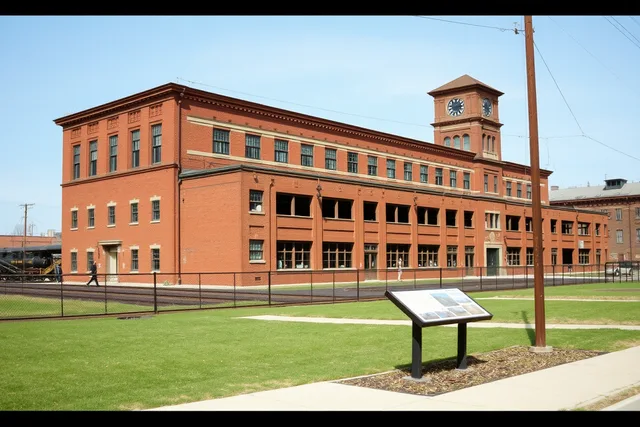
Sloss Furnaces National Historic Landmark in Birmingham, Alabama, is a former iron works with public grounds and a visitor center. Write its record against the site's own visitor page.
| Field | Sample entry |
|---|---|
| Destination | Sloss Furnaces National Historic Landmark, Birmingham, Alabama |
| Current source | Sloss visitor information page, checked 12 March 2027 |
| Historical source | Archival furnace photographs, kept in a separate labelled field |
| Access note | Enter at the visitor center, follow posted public paths |
| Change note | Nothing logged at check, recheck before travel |
| Fallback | Second Alabama site on the same loop, with its own source and date |
Two fields carry the weight. The current source tells the next reader where the claim came from. The check date tells them whether to trust it or check again.
Sloss is one stop on a wider Alabama circuit, and our guide to Alabama's industrial heritage sites beyond Sloss Furnaces lists the neighbouring works that each need their own record.
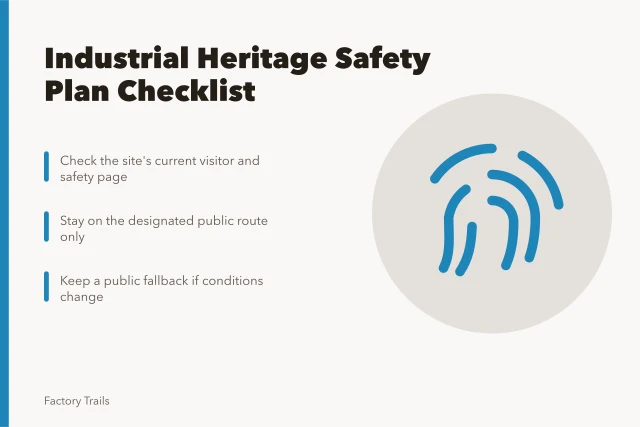
Six fields, one line each
- Destinationexact site, public entrance or program name.
- Current sourcethe page you read, with its full URL.
- Check datethe day you read it.
- Access notedesignated public route, opening hours, required gear.
- Change noteclosure, weather or staff instruction, with the date.
- Fallbacka public alternative plus its own source and date.
[figure 1]
Safety record fields
- Destinationexact site or public entrance
- Current sourcevisitor page and date checked
- Historical sourceseparate context record
- Route notepublic path or transit instruction
- Changeclosure, weather issue, staff instruction
- Fallbackpublic alternative and its own source
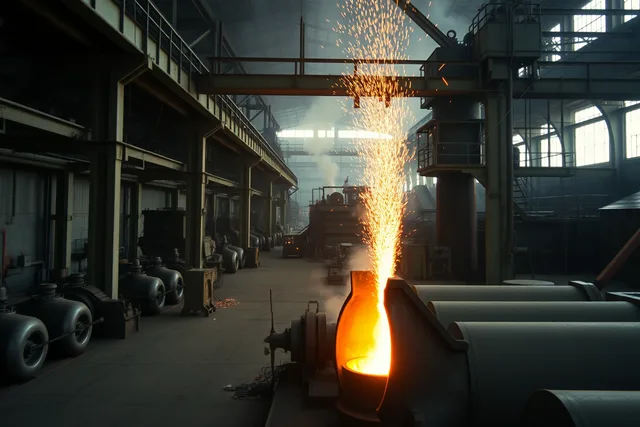
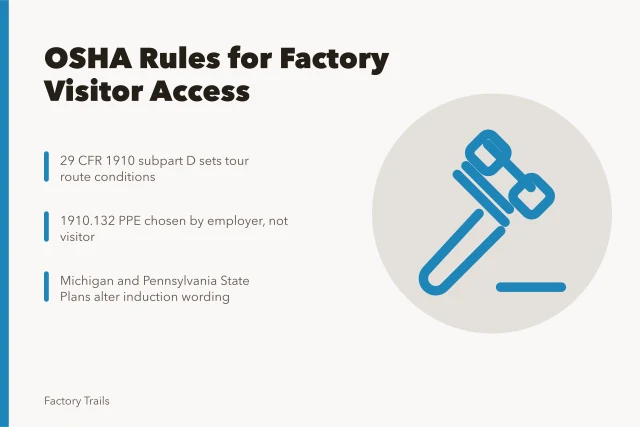
Gear belongs in the access note whenever a tour enters a production area. OSHA's general PPE rule, 1910.132, places the duty to supply protective equipment on the employer, so confirm who provides it before you write "closed shoes required" as a settled fact.
Where to look for 2027 conditions
Start with the owner's page. For a federal site, that is the park's own conditions or plan-your-visit page. The NPS publishes visitor conditions guidance because a published condition can change after you read it.
Manufacturers publish their own tour pages too. The Royal Canadian Mint separates its Winnipeg production tour from the Ottawa boutique, so one brand can offer two different visits. Canada is a second market here; keep two sites in two rows even under one brand.
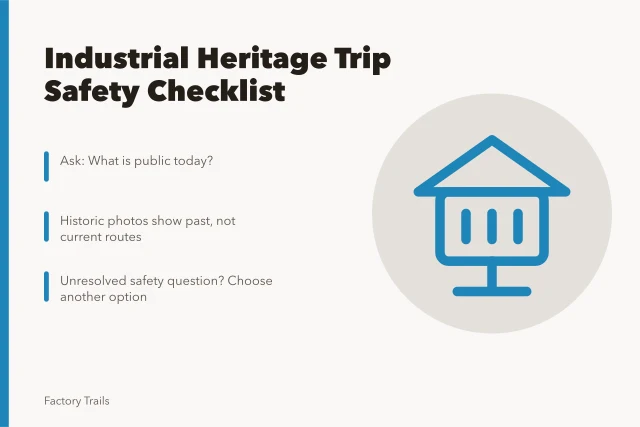
Archival pages, scanned maps and old photographs are context. None can carry a claim that a route is open this season.
Route changes are the commonest reason a record goes stale. Our comparison of route changes at U.S. sites sets owner announcements against the 2027 season, which helps you date a change the moment it appears.
Store it with the trip packet
The record only helps if it answers the questions a visitor will ask. Our factory tour visitor safety checklist covers what to scope before you go, and the storage habit below keeps those answers in one place.
One file, one place, one named owner. A shared document beats six browser bookmarks, because the trip leader and the publisher then read the same version instead of two half-updated ones.
Before the packet is printed or the article goes live:
- Open the current source beside the record.
- Compare the page with the claim, not with your memory of the claim.
- Update the check date if the page still supports the wording.
- If it does not, move the old line into a dated history field and write the replacement next to it.
- Confirm the fallback is still public.