Reviews
Part of Industrial heritage travel safety checklist: what to know before you go
Industrial heritage travel safety checklist questions to ask before you book
Industrial heritage safety questions for 2027 help U.S. visitors distinguish current site rules, historic context, access limits, and reliable fallback choices.
What to take away
- Ask five things before you paycurrent access status, the booking channel, group size limits, required gear, and the fallback if the tour is cancelled.
- A historic photo or a map pin is not permission. Only the operator's current page or a staff instruction confirms entry.
- Hershey's Chocolate World in Pennsylvania is a visitor center. The working factory is not open for public tours.
- Royal Canadian Mint tours differ by city. Winnipeg runs production floor tours; Ottawa is a boutique mint.
- Record every answer with the date you checked it, which the scoping checklist turns into a repeatable routine.
The questions to ask before you book
- Confirm the site is open on your date, and that the specific tour is running rather than only the grounds.
- Confirm the booking channeloperator website, phone line, or a timed-entry system.
- Ask the maximum group size, and whether your party needs one booking or several.
- Ask what eye protection, hearing protection, or footwear the site supplies, and what you must bring.
- Ask what happens if the tour is cancelled or the weather turns.
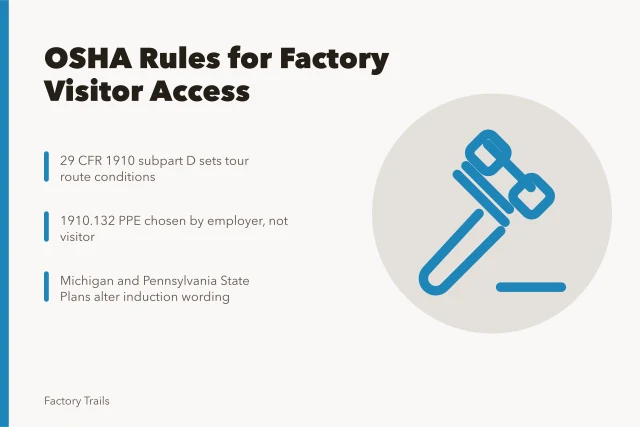
Some industrial sites hand out their own safety glasses. U.S. PPE rules place the duty to provide protective equipment on the employer, not the visitor (OSHA 1910.132). Ask who supplies the gear before you pack it.
Footwear matters on wet mill floors. Ask whether closed-toe shoes are enough or whether the site issues boots for the tour route.
What changes for 2027
No single 2027 rule covers every industrial site. The changes that matter are local and annual.
- Operating calendars
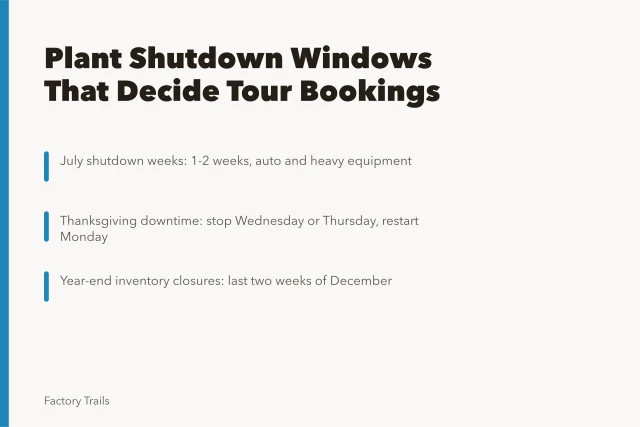
- restoration closures and winter shutdowns are set year by year.
- Booking systems
- more sites sell timed entry online only, with no walk-up places.
- Group limits
- staffing and insurance decide how many visitors one guide takes.
- Gear rules
- what you must wear follows the route in use that season.
Ask for the current-year answer in writing. Treat a brochure from an earlier season as no answer at all.
Sites you can check by name
Access status differs enough that generic advice fails. Each of these five needs a direct check before you commit.
Britannia Mine Museum in British Columbia takes visitors into an underground tunnel, and its reservation rules change with the season. Our Britannia booking walkthrough explains what the reservation step involves.
| Site | Country | What to confirm |
|---|---|---|
| Lowell National Historical Park, Massachusetts | U.S. | Tours of working textile machinery. Which mills are open and when the looms run. |
| Sloss Furnaces, Birmingham, Alabama | U.S. | Preserved iron furnaces. Hours, and whether the visit is self-guided or led. |
| Hershey's Chocolate World, Pennsylvania | U.S. | A visitor center. The working factory is not open to the public. |
| Royal Canadian Mint, Winnipeg | Canada | Production floor tours. Ottawa is a boutique mint, not a factory tour. |
| Britannia Mine Museum, British Columbia | Canada | Underground tunnel tour. Whether timed booking is required. |
Lowell is the clearest U.S. case of a working textile mill that visitors can walk through. The park's history pages describe the mill operations (NPS Lowell history).
Two Canadian options show why the city matters. The Royal Canadian Mint runs production tours in Winnipeg, while Ottawa is a boutique visit, so ask which facility the booking covers (mint.ca tours page).
Route each question to a current source
The operator's current page answers access questions. An archive or a museum handbook answers what the machinery did. State and provincial sources fill gaps that national pages miss, and the Alabama industrial heritage guide shows how widely sites spread within one state.
Route each question to the page or person most likely to answer it. Skip any question that only restates history.
Four questions before you book
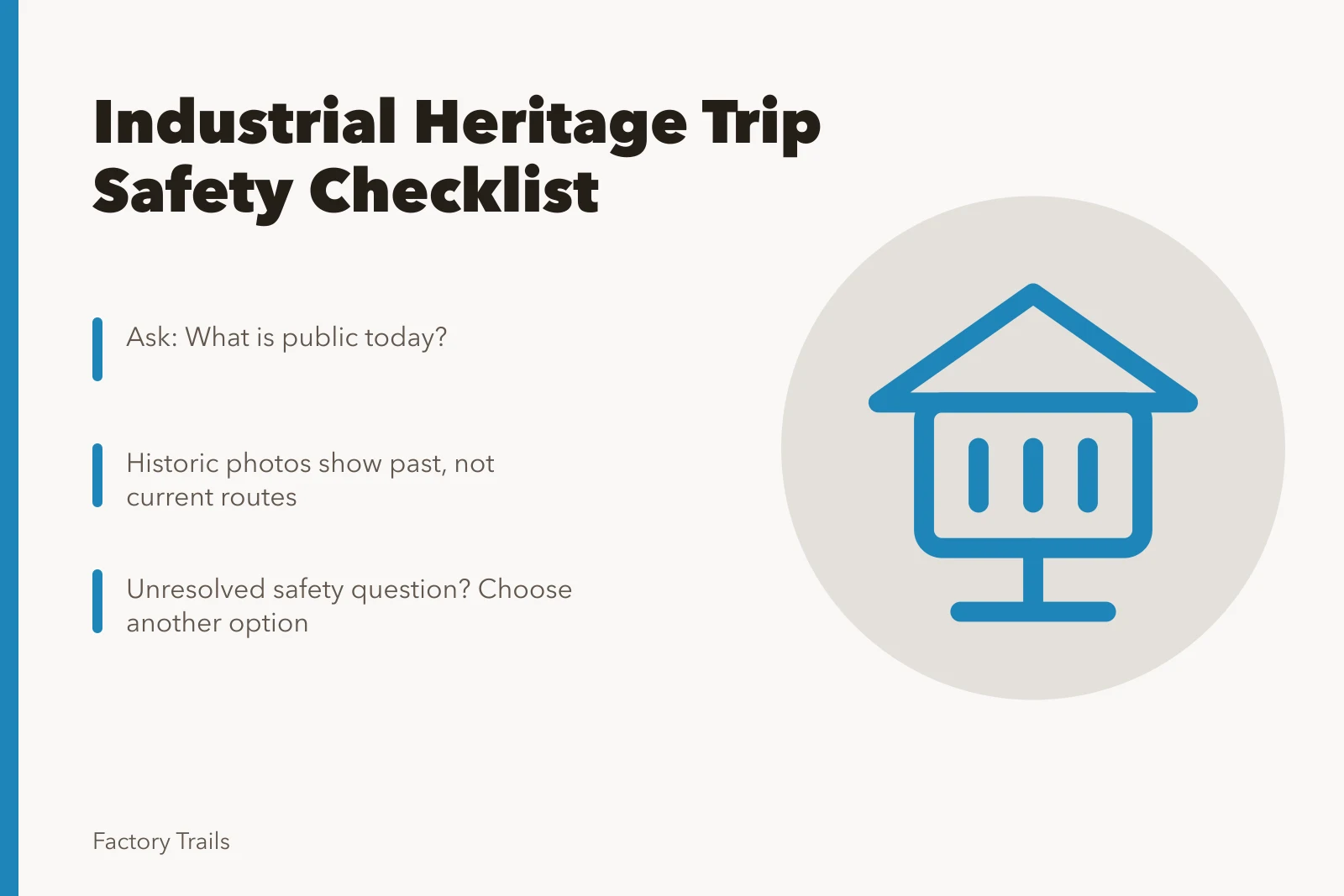
- What is public today?
- Which route is designated?
- What did the feature do historically?
- What happens if conditions change?
Example: a filled-in question log
A question log turns scattered tabs into a decision. Give it four columns: question, source, date checked, status.
| Question | Source to check | Date checked | Status |
|---|---|---|---|
| Is the mill floor running on our date? | Park tour schedule page | 9 January 2027 | Confirmed |
| Does our group need one booking? | Park reservation line | 9 January 2027 | Confirmed |
| Which footwear is required? | Site safety page | 10 January 2027 | Still open |
| What is the fallback stop? | Visitor center hours page | 10 January 2027 | Confirmed |
The dates are sample entries. Fill the status column with what you actually hear, and leave a row open rather than guess.
One open row is enough to change a plan. If footwear and route questions have no answer, choose a site with published terms.
Groups that want the legwork handled can use a provider, and the U.S. plant-site help guide explains what a provider does and does not handle.
Common questions
Do I need to re-check everything for 2027 if I booked in 2026?
Yes. Calendars, closures, and gear rules are set per season, so ask again before you travel.
What if a site never replies to my question?
Treat it as open and book a site with published terms.
Is a public road enough to see a furnace or mill up close?
No. Follow posted parking, property boundaries, and the operator's instructions.
Which source wins when two conflict?
The operator's current page or a staff instruction. A photo or a third-party blog does not override it.