Guides
How to build a regional factory tour plan across U.S. regions
Factory tour regional guide for U.S. sites in 2027 helps operators adapt routes, visitor preparation, staffing, access, and seasonal plans to local conditions.
What to take away
- A national tour concept needs local operating rules before it can be safe, accessible, and useful.
- Heat, snow, flooding, humidity, wind, transportation, and staffing shape a tour differently by region.
- Adapt the route, schedule, briefing, and alternate program together instead of treating weather as a last-minute problem.
Regional planning starts with the site, not the map
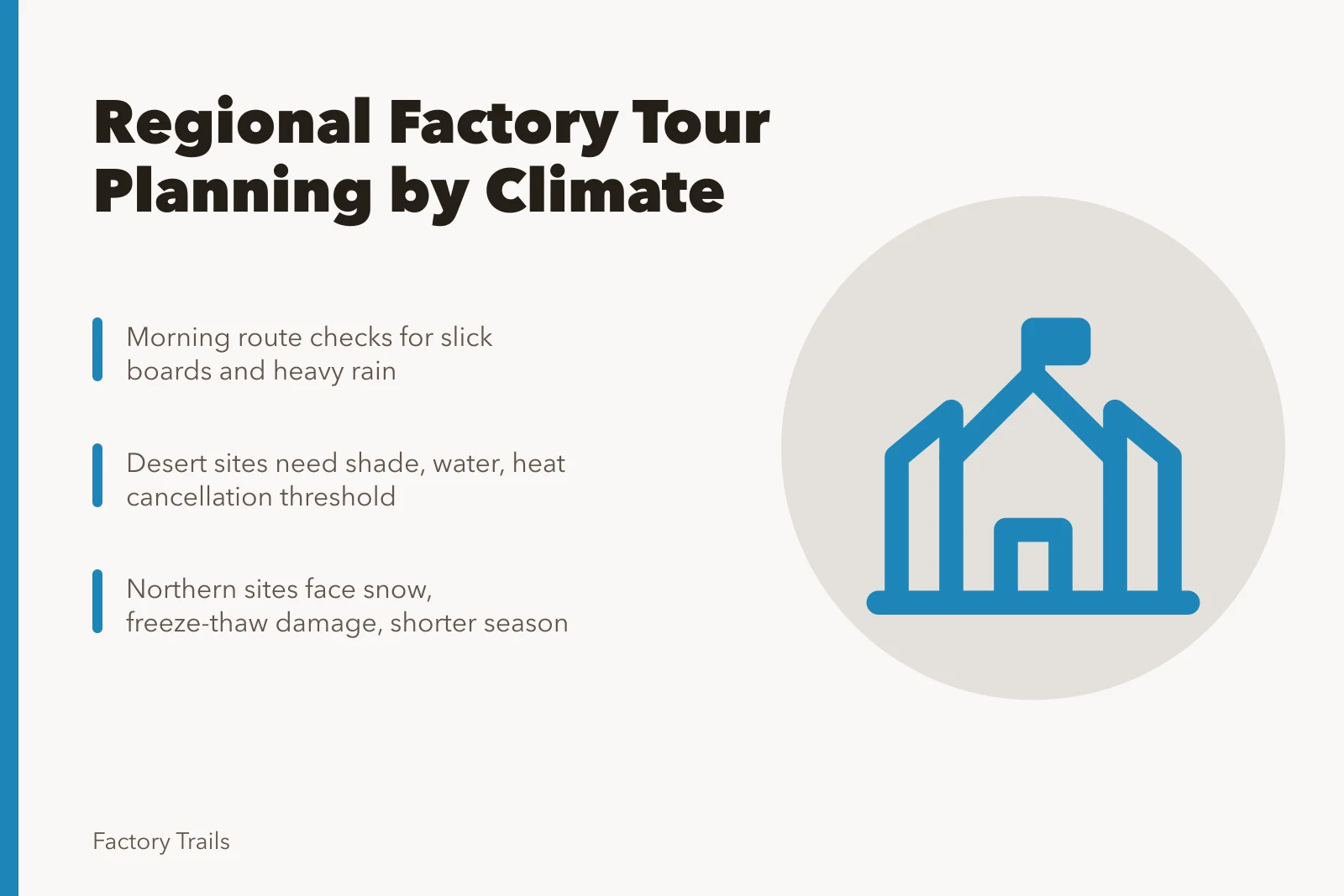
Two historic factories may share a similar building type and entirely different operating realities. A former mill in a humid river valley may need morning route checks for slick boards and heavy rain.
A desert industrial site may need shade, water, and a heat cancellation threshold. A northern site may have snow, freeze-thaw damage, and a shorter public season. A coastal site may need storm, flooding, and access-road plans.
Examples by U.S. region:
| Region | Typical industrial heritage site | Main operating pressure |
|---|---|---|
| New England and Mid-Atlantic river valleys | Textile mills, canal warehouses, ironworks | Humidity, spring floods, freeze-thaw on masonry |
| Great Lakes and Midwest | Auto plants, foundries, grain elevators | Lake-effect snow, ice, summer heat, legacy contamination |
| Southeast | Mill villages, tobacco factories, rail shops | Heat index, hurricanes, heavy rain, insects |
| Southwest and desert | Copper smelters, aerospace test sites, mining towns | Extreme heat, dust, flash floods, long travel distances |
| Mountain West | Hard-rock mines, logging camps, railroad depots | Altitude, snow, wildfire smoke, limited roads |
| Pacific Northwest | Timber mills, salmon canneries, shipyards | Rain, windstorms, landslides, short daylight |
| Gulf Coast | Ports, refineries, seafood plants | Storm surge, flooding, heat, humidity |
| Northern snow belt | Cold-storage warehouses, machine shops | Ice, freeze-thaw, seasonal closure, parking snow storage |
Regional adaptation means identifying those conditions before writing a schedule or selling a ticket. It does not mean treating every visitor as a risk. It means giving them a route and an explanation that match the place they are actually visiting.
The National Park Service explains that historic structures and cultural resources are exposed to changing combinations of weathering, sunlight, moisture, and other factors. People must help them withstand climate effects. Its cultural-resources adaptation guidance supports a practical rule for factory-tour operators: use observed local conditions to shape care and visitor operations rather than relying on a generic national schedule.
Build a regional operating profile
Create a one-page profile for each location. Keep it current and use it in training, seasonal planning, and public instructions.
| Planning area | Questions to answer | Output |
|---|---|---|
| Weather | What conditions force a delay, reroute, shelter, or cancellation? | Written thresholds and a decision owner |
| Surfaces | Where do water, ice, dust, leaves, or mud change footing? | Opening inspection points |
| Visitor preparation | What should guests wear, bring, or avoid? | Booking-page and arrival language |
| Access | Which entrances, restrooms, stops, and viewing points are usable? | A route map and alternate experience |
| Transportation | How do parking, public transit, bridges, or seasonal roads affect arrival? | Directions and late-arrival policy |
| Staffing | When are guides, maintenance teams, and emergency responders available? | Capacity and schedule limits |
The profile should name the actual route segments. "Outdoor areas may be wet" does not help a guide decide. "South ramp closes after standing water reaches the first landing" does.
Write thresholds as numbers. A sample draft might use a heat index of 90 F for a shade break and 103 F for cancellation. Sustained wind of 30 mph could trigger shelter, and 40 mph could cancel outdoor stops. Standing water of 1 inch at a route landing could close that segment. Local partners set the final values.
Sample filled profile (illustrative, not a real property):
| Field | Sample entry |
|---|---|
| Site | River valley textile mill, example only |
| Route | Upper yard, weave room, canal walk, loading dock |
| Heat | Heat index 90 F, shade stop and water; 103 F, indoor program only |
| Wind | Sustained 30 mph, move indoors; 40 mph, cancel outdoor stops |
| Water | 1 inch at canal walk landing, close that segment |
| Surfaces | Wet boards at canal walk, ice at loading dock, dust in yard |
| Access | Step-free north gate, restroom at visitor center, seating at weave room |
| Transport | Local bus stop at gate; parking fills on event mornings |
| Staffing | 2 guides, 1 maintenance contact, 1 accessibility contact |
| Cost drivers | Guide hours, drainage repair, shade equipment, insurance, printing |
| Partners | Local NWS office, city emergency management, transit authority, state historic preservation office |
| Alternate | Indoor machinery talk, canal map, oral history |
| Owner and review | Site director; review in March, June, and September |
Staffing and cost depend on route length, group size, guide-to-visitor ratio, insurance, maintenance, and local wage rates. Set a minimum staffing number in the profile and get local quotes before the season.
Offer a complete alternate experience. It might be an indoor object talk, a map-based demonstration, an oral-history segment, or a close viewing point that does not require the full route. An alternate is not a consolation prize if it is planned, staffed, and interpreted with the same care as the primary tour.
Adapt the public schedule
Schedule design is one of the strongest regional tools. Start earlier in hot climates, reserve a shorter outdoor route during peak heat, and make shade or indoor interpretation part of the program.
In northern climates, avoid assuming a route will work through the entire shoulder season. In storm-prone regions, do not place the most important part of the story at the end of an exposed walk.
| Condition | Adaptation | Visitor message |
|---|---|---|
| Heat and humidity | Earlier start, water pause, shade stop, shorter route | Bring water and expect a reduced outdoor segment when thresholds are reached |
| Rain or flooding | Protected walkway, indoor program, approved reroute | Some exterior stops may change after rainfall |
| Snow and ice | Seasonal closure, traction review, indoor route | Check conditions before traveling and wear closed-toe shoes |
| High wind or lightning | Shelter trigger, no-go outdoor zone, cancellation point | The program may pause or move indoors for safety |
| Smoke or poor air quality | Reduced exertion, indoor alternative, rescheduling rule | Check current alerts and contact the site before arrival |
Make accessibility local and specific
Do not call a tour accessible based on the building's general reputation. Describe what a visitor can expect at this location: distance, grade, stairs, surface, seating, sound, lighting, restroom access, and the best way to request assistance. A historic site may have real limitations, but vague information makes those limitations harder for visitors to plan around.
Walk the route with the public experience in mind. Can someone rest before a long slope? Is a doorway difficult to see in changing light? Can a visitor who does not use stairs still receive the essential story? Does a school group have a quiet waiting point?
These questions lead to practical improvements, even when major construction is not possible.
The physical route deserves a technical check too. The U.S. Access Board's accessible-route guide identifies walking surfaces, doors, ramps, curb ramps, elevators, and permitted lifts as route components. Use it to inform an inspection, then obtain project-specific advice for historic conditions and local requirements.
Use local partners before a busy season
Meet with the organizations that understand local conditions: emergency management, fire services, transit providers, nearby cultural sites, weather offices, accessibility advocates, and community groups. Ask what has changed since the last season. A washed-out road, summer event calendar, heat pattern, or construction project may change the route before the public hears about it.
Ask the National Weather Service forecast office for local watch and warning criteria, heat index and wind thresholds, and lightning safety guidance. Ask city or county emergency management for evacuation routes, shelter locations, and alert systems.
Ask the state historic preservation office about treatment of historic fabric when a ramp or entrance changes. Ask the transit provider about detours, stop closures, and accessible vehicle options.
Then test the scenario. If a storm begins during the third stop, who communicates with visitors? If parking fills, where does a group wait? If a ramp is closed, who directs guests to the alternate entrance? A short tabletop exercise is enough to expose gaps in a plan that looks complete on paper.
The staff response should follow the host site's own emergency procedures. OSHA's emergency action plan guidance describes reporting, evacuation procedures, and assigned duties for employees. It helps a team define staff roles during a weather or access change. It does not replace local emergency instructions.
Train guides to explain a change well
Visitors are more cooperative when staff explain a modification plainly. Avoid vague statements such as "operations have changed." Say what changed, what the group can still experience, and what staff need them to do.
For example: "The lower mill path is closed because the boards are wet. We will use the upper overlook, then continue the machinery story indoors. Please stay with your guide while we move." This gives the reason, the alternative, and the action without overloading guests with technical detail.
Give guides authority to make the approved regional change. They should not have to negotiate a weather decision at the trailhead or wait for a distant office while conditions worsen.
Turn local knowledge into an operating calendar
A regional profile is useful only when it changes the calendar. Put preparation work on the schedule before conditions arrive. A river-adjacent site can plan a spring inspection of drainage, exterior steps, and low-lying access points.
A hot-climate site can schedule staff training on heat symptoms, water supplies, shade equipment, and the communication used when a tour becomes shorter. A colder site can identify the final routine tour date, the inspection that precedes winter closure, and the conditions that permit a limited shoulder-season program.
Use four calendar layers:
- Dailyroute walk, forecast check, staffing confirmation, and visitor notice.
- Weeklyreview work orders, surface conditions, supplies, and scheduled groups.
- Seasonalchange the route, operating hours, capacity, and alternative program as conditions change.
- Annualevaluate patterns, update thresholds, fund improvements, and refresh partner contacts.
This structure prevents a common problem: a site discovers the same seasonal weakness every year but handles it as an isolated surprise.
If wet leaves make one stairway unreliable each fall, the response might be a different visitor flow, more frequent cleaning, a sturdier tread, or a decision to close that stop earlier in the season. The right solution comes from the local record, not from an assumption that all sites need the same fix.
Plan visitor communication in layers
Not every visitor reads a long booking page. Share regional information at several moments: on the event page, in a confirmation email, at arrival, and when conditions change. Keep each message consistent. A guest who sees different advice from a reservation email, a parking sign, and a guide will not know which instruction governs the visit.
| Moment | Information to provide | Best format |
|---|---|---|
| Before booking | Route demands, likely seasonal changes, and assistance contact | Event page and accessibility note |
| Before arrival | Clothing, water, parking, weather, and late-change process | Confirmation email or text |
| At check-in | Today's route, surface conditions, group expectations, and alternate options | Spoken briefing and posted notice |
| During a change | What closed, where the group goes, and what visitors should do | Direct guide instruction |
Test the language with someone unfamiliar with the site. If they cannot tell whether the tour includes stairs, an exposed walk, or a heat modification, the message is not finished. Clear detail reduces avoidable disappointment and gives visitors more agency in choosing the experience.
Distinguish an inconvenience from an operational limit
A minor inconvenience may allow the tour to proceed with a small adjustment: a shaded stop is unavailable, a parking lot is full, or a public restroom is under repair.
An operational limit changes whether the route can be safely supervised or accessed: a blocked exit, lightning in an exposed area, a flooded walkway, missing staff coverage, or a closed accessible entrance with no equivalent alternative.
Write this distinction into staff guidance. It gives frontline employees a reliable way to decide when to modify the program and when to close a section. It also helps supervisors explain why a schedule change was necessary. Regional adaptation is successful when safe changes feel practiced and understandable, not improvised.
Review the region after the season
At the end of each season, review modifications, closures, visitor questions, maintenance work, and incidents. Identify what was unusual and what is becoming normal. Record the date, condition, route effect, response, and follow-up owner.
That review turns local knowledge into a stronger next season. It can also support a budget request for drainage, shade, barriers, route repair, additional staffing, or better visitor communication.
The Interagency Visitor Use Management Framework describes a cycle of setting desired conditions, selecting strategies, monitoring results, and adjusting. A small tour operation can apply the same sequence without building a large program: set a route condition, record changes, evaluate the result, and revise the next season's plan.
Common questions
Does every factory-tour site need its own regional plan?
Yes. A shared template is useful, but each site needs local thresholds, routes, contacts, access information, and alternate-program decisions.
Should weather cancellations be posted before visitors book?
Yes. State the conditions that may change the experience and explain whether the site will offer an alternate, a reschedule, or a refund under its policy.
How often should regional conditions be reviewed?
Review them before the season, after a major event or closure, and whenever construction, climate patterns, staffing, or access conditions change.