Guides
How industrial tour operators can plan costs before setting departure prices
Industrial tour operators cost planning guide for 2027 explains fixed costs, departure costs, capacity, break-even estimates, reserves, records, and review.
What to take away
- Sort every cost into setup, fixed season, per departure, per visitor or reserve before you set a 2027 departure price.
- Base the price on a tested capacity and a paid headcount you can repeat, never on the largest room the site has.
- Worked example16 places, $52 ticket, $299 per departure, $7.50 per visitor, break-even at 15 departures.
- Set the price only after the break-even figure, the current site agreement and a reserve line sit in one model.
- Review the model at season end and after any change in site terms, transport or staffing.
A tour price is the output of a cost model. Before quoting anything for 2027, write down what the site requires, the capacity the route supports and what each departure consumes. Operators who skip this step find the gap at the first cancellation.
Our guide to factory tour cost notes for 2027 shows how to keep those numbers checkable a season later.
Break-even first: the cost map and the sum
The figures below are illustrative inputs for a small walking tour, not quoted market rates. Replace each with your own dated quote, because guide pay, insurance and site fees vary by host.
| Cost group | 2027 planning figure | Basis |
|---|---|---|
| One-time setup | $2,400 | Route test, guide training, signage, booking setup |
| Fixed season | $3,480 | Insurance $1,800 (typical $1,200 to $2,500), software $480, manager time 40 hours at $30 |
| Per departure | $299 | Guide 3 hours at $28 (typical $22 to $35), check-in staff $20, site escort fee $75 (typical $50 to $150), transport $120 |
| Per visitor | $7.50 | Site entry fee $6, materials and headsets $1.50 |
| Reserve | 5 to 8 percent of season cost | Alternate route, refunds, equipment replacement |
A guide shift is often mixed. A three-hour minimum plus an overtime rate sits in two cost groups at once.
[figure 1]
Break-even departures = (fixed season cost + one-time setup) / contribution per departure Contribution per departure = (price - per-visitor cost) x tested capacity - per-departure cost
With a tested capacity of 16 and a ticket price of $52, contribution per departure is (52 - 7.50) x 16 - 299, which equals $413. Fixed and setup costs total $5,880. Divide $5,880 by $413 and you get 14.2, so the season needs 15 departures to break even. At 20 departures it returns about $2,380 above cost.
The Small Business Administration's break-even guidance defines break-even as the point where total cost and revenue are equal. That point moves with group size and site terms, so rerun the sum when the route test or the agreement changes. Our notes on cost maps and capacity for 2027 go further.
Price from a formula, not from the room size
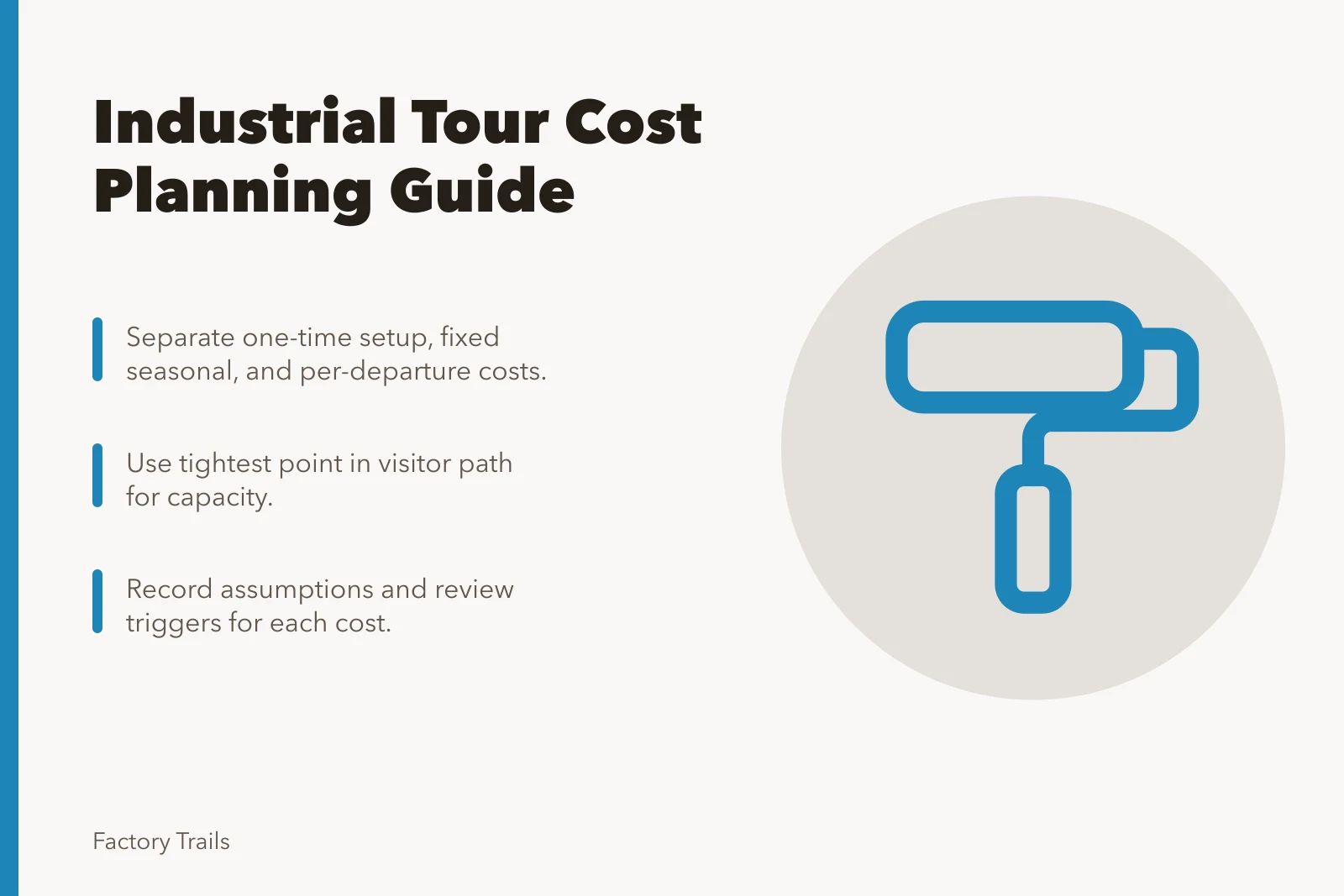
- Test capacity at the tightest point in the visitor pathcheck-in, stair, shuttle seat or exit.
- Add per-visitor cost to per-departure cost divided by capacity. That gives $7.50 plus $18.69, a variable floor of $26.19 per place.
- Divide fixed season cost, one-time setup and your profit target by the paid places you expect to sell. With $5,880 of costs, a $2,000 target and 320 places, that share is $24.63.
- Add the two figures and round. $26.19 plus $24.63 gives $50.82, so the floor price is about $52.
- Check the floor against the departures you can run. At $52, 15 departures cover the season.
If the floor price sits above what visitors will pay, change the product rather than the arithmetic. Fewer departures, a shorter route, a higher minimum booking or a written partner contribution are all testable before the season opens.
Site terms, safety and compliance costs
Read the current site agreement line by line. Application fees, per-visitor charges, escorts, security, insurance limits, staffing levels, reporting and cancellation rules all land in the model. Record who confirmed each term and the date.
Do not carry an old agreement into a new season or hand it to a new operator. Access conditions move with construction, production schedules and preservation work. Our guide to the site visit from permission to handover lists the terms worth confirming in writing.
On working plant floors, host rules usually require eye and foot protection. OSHA's general PPE requirements put the duty on the employer and cover gear the operator may buy or replace. Budget per visitor, not per season.
Reserve, scenarios and season review
Set the reserve at 5 to 8 percent of season cost for a walking tour. Give it a purpose and a review date. If the same disruption appears twice, move it into the standard budget.
- Normal operation
- tested capacity and current quotes.
- Lower attendance
- fewer paid places than planned.
- Higher cost
- extra guide time, a new site charge or fuel on transport.
- Disruption
- approved alternate route, delay or cancellation.
[figure 4]
A fixed booking slot carries site-side exposure too. Operators working with a booked underground tour such as the Britannia Mine Museum underground tour plan for a cancelled slot as well as a cancelled group.
After each departure, log group size, revenue, refunds, guide hours, site charges and route version. Do not move a price from one busy or quiet date. The IRS recordkeeping guidance supports keeping dated records behind each material number.
At season end, compare the estimate with actual totals and explain the largest differences. State the period and the costs included before calling a tour profitable.
Common questions
What is the most common cost-planning error?
Using an untested group size, or leaving out guide hours outside the public part of the tour.
Should a small operator calculate break-even?
Yes. One line of arithmetic shows how price, fixed cost and per-visitor cost relate, even for a pilot.
When should a departure price be reviewed?
Before each season, and after any material change in site terms, capacity, staffing or transport.
How much reserve is enough?
A typical range is 5 to 8 percent of season cost. Raise it if the host site can close without notice.