Costs
Factory tour budgeting: how to write 2027 cost notes that hold up
Factory tour cost budget notes for 2027 help U.S. teams document assumptions, thresholds, actuals, variance causes, contingency use, and next-step approvals.
Budget notes turn a cost model into a management document. They explain what a number includes, what assumption it depends on, and what event would require the team to revise it.
What to take away
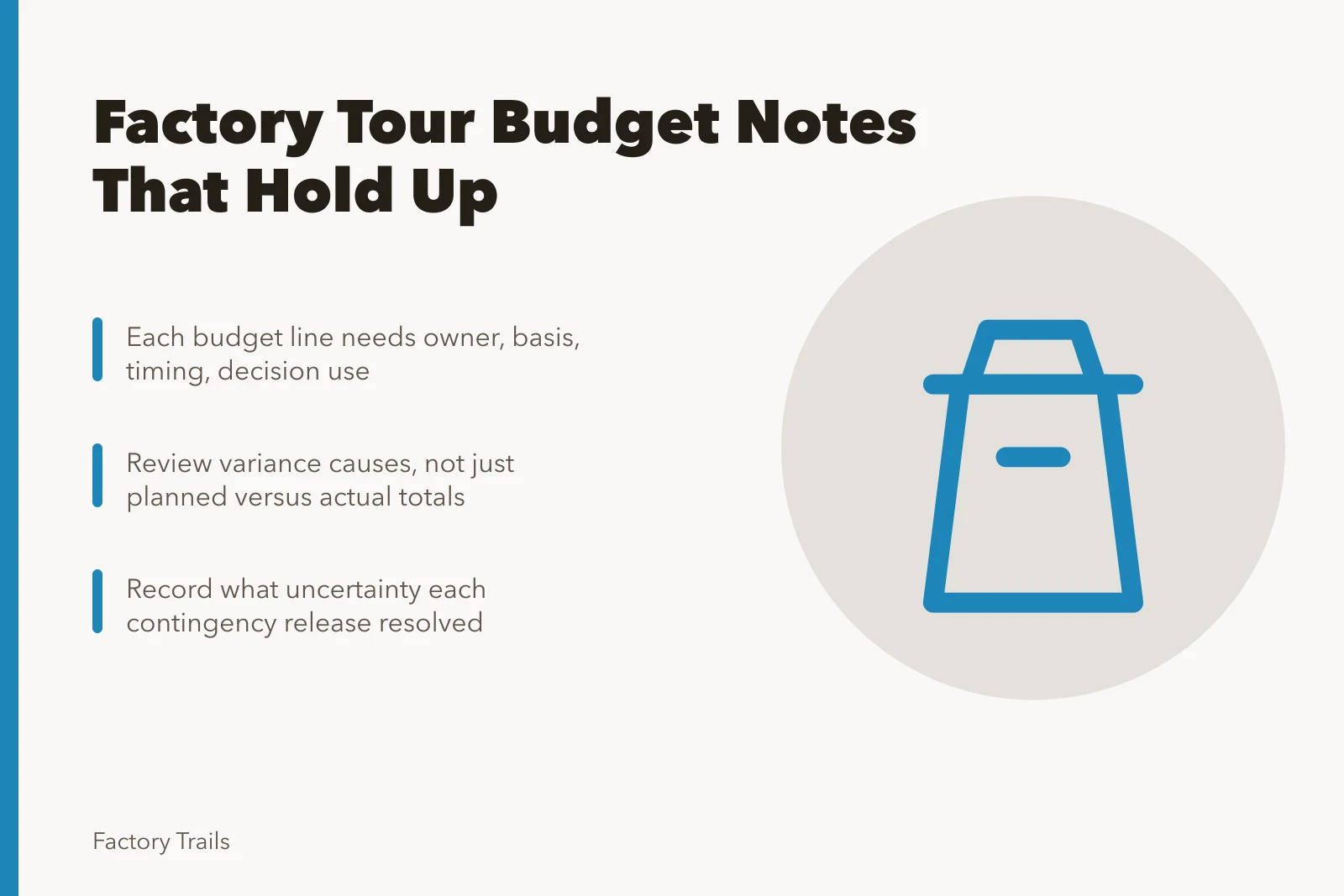
- A budget line needs an owner, basis, timing, and decision use.
- Compare variance causes, not just planned and actual totals.
- Do not release a contingency without recording what uncertainty it resolved.
What to note beside a cost
| Field | Example of a useful entry |
|---|---|
| Basis | Pilot time study, contract quote, purchase history, or explicitly stated estimate |
| Timing | One-time, per session, per visitor, monthly, or seasonal |
| Assumption | Group limit, route availability, host role, or booking volume |
| Trigger | Added session, route closure, staffing threshold, or review date |
| Owner | Person responsible for updating the number or approving a change |
| Status | Confirmed, estimated, pending review, or retired |
When an actual cost differs from the plan, record the reason. "Guide time exceeded estimate because pre-tour check-in took longer" tells the team what to improve. "Over budget" does not. A variance can signal a flawed assumption, a real operational change, or a worthwhile decision that the original model did not include.
Fields Beside Every Cost
- Basistime study, quote, history, estimate
- Timingone-time, per session, per visitor
- Assumptiongroup limit, route, host role
- Triggeradded session, route closure, review date
- Ownerperson updating or approving the number
- Statusconfirmed, estimated, pending review, retired
A worked note for 2027
The figures below are illustrative. Replace them with your own time study.
| Variance field | What to record |
|---|---|
| Line and period | Guide hours, June 2027 |
| Planned and actual | $528 planned, $704 actual |
| Cause | Route gate stayed locked, so check-in ran long |
| Size | $176 over, 33 percent |
| Action and owner | Move the gate key to the front desk; visitor operations manager |
| Status and date | Updated 3 July 2027, carried into the July review |
Line. Guide hours for pre-tour check-in, 2027 season.
Basis. Time study of 12 tours in March 2027: 18 minutes of check-in per tour with 2 hosts.
Assumption. 40 tours a month, 2 hosts, $22 an hour loaded.
Amount. 40 tours x 0.6 hours x $22 x 12 months, about $6,300. A typical range is $6,300 to $7,000 if host pay or tour count moves.
Trigger. Check-in passes 22 minutes in a month, or tour count passes 48 a month.
Owner. Visitor operations manager, with staffing costs confirmed by finance.
Status. Estimated. Review on 1 September 2027.
Variance entry. June 2027: guide hours $704 against $528 planned, $176 over. Cause: the route gate stayed locked until 9am, so check-in took 24 minutes instead of 18. Action: move the gate key to the front desk. Status updated 3 July 2027.
Keep cost and safety decisions connected
OSHA's Safety Pays tool introduction explains that its estimates are intended to raise awareness about the financial impact of workplace injuries and illnesses, not to replace a detailed analysis of a specific employer. That caution applies to tour budgeting too: a generic benchmark cannot substitute for the site's actual route, staff work, and risk controls.
If a qualified review identifies a needed safety or access action, add the work visibly to the model. Do not quietly offset it by removing an unrelated visitor-support line. The decision record should show why the model changed and what the adjustment allows the program to do safely.
A short monthly review
At each review, compare sessions delivered, attendance, staff time, variable supplies, cancellations, route changes, and contingency use against the model. Then state one action: update, test, hold, or approve. A budget note is successful when the next decision maker can understand the choice without reconstructing it from email.
The Government Accountability Office's cost-estimating guide describes estimates that document their basis, assumptions, and updates. That government guide does not prescribe a tour ledger. It does support a clear note beside every material amount: where it came from, what condition could change it, and who must revisit it.
The General Services Administration discusses updating cost estimates as project information changes. For a visitor program, date each update and distinguish a normal operating revision from a one-time pilot result. This stops a temporary launch expense from becoming an assumed recurring cost.
The National Archives' records-management fundamentals explain the role of records in documenting actions. Retain the budget note with the estimate, approval, and supporting material. That provides an evidence trail for the next owner without claiming that federal retention rules govern the program.
Use plain descriptions. A note that says "added host hour after measured check-in delay" gives a reviewer something to test. A note that says "miscellaneous adjustment" hides the decision and makes the next estimate weaker.
Review notes are also a way to keep a pilot honest. A good result may depend on a volunteer, a quiet production day, donated media work, or an unusually small group. Write that condition beside the result. The next decision maker can then distinguish a promising experiment from a cost that can be repeated every week.
If the condition cannot be repeated, change the plan before treating the pilot figure as a reliable operating cost.
Close each note with a named next action and review date. That turns an observation into program management rather than a file that no one reopens until the next budget cycle.
Common questions
What is a budget variance?
It is the difference between a planned and actual amount. Record it in the variance template above.
When can contingency be used?
Use it only for the defined uncertainty it was intended to cover, then record the decision and remaining amount.
Who approves a model change?
Use the program's stated approval process, with input from the owner of the affected route, staffing, safety, or funding decision.