Costs
Factory tours budgeting options: a 2027 comparison with budget notes
Factory tour budget notes for 2027 compare guided floor walks, viewing galleries, demonstrations, self-guided routes and virtual programs by real cost line.
Five formats cover almost every industrial site open to the public in 2027. Each one is priced differently, staffed differently, and fails differently. Budget the format you chose, not the one you wish you had chosen.
All dollar figures below are typical 2027 planning ranges, not quotes. Assume 3 to 5 percent annual inflation on labor, insurance and materials.
What to take away
- A guided active-floor walk is the most expensive format per visitor, typically $22 to $65, and the only one that depends on the plant's own production calendar. A self-guided route is cheapest, typically $1 to $5.
- A viewing gallery costs less to run but needs sightlines, interpretation and a boundary a visitor can see.
- A demonstration costs what the presenter's time costs, plus reset and inspection after every session.
- Self-guided and virtual programs are cheap per visitor and expensive to keep true.
The five options, and what each one actually is
Guided active-floor tour. A trained host walks a group past running equipment. Sloss Furnaces in Birmingham runs its grounds as a preserved site rather than a live plant, while the Big Three automakers' plant tours in Michigan and Ohio run alongside production.
The second kind is the expensive one: host hours, route checks, escort ratios and a schedule that bends around maintenance. A typical 2027 cost is $22 to $65 per visitor, driven by host hours and route checks.
Viewing gallery or mezzanine route. Visitors watch from above or behind glass. Pullman National Monument uses this pattern for its historic structures. The cost sits in sightlines, glass, lighting and interpretation panels, not in host hours. A typical 2027 cost is $6 to $20 per visitor.
Live demonstration. A working machine runs for an audience: a forge, a press, a loom, a stamping line. Britannia Mine Museum near Vancouver built its reputation on exactly this. You pay for a trained presenter, setup, materials and an inspection after each session. A typical 2027 cost is $12 to $40 per visitor.
Self-guided route. Numbered stops, signage, a map, sometimes an app. The National Park Service's self-guided historic-sites page describes app-based visits alongside visitor centers and safety information at sites the park does not always staff, which is the honest picture of what self-guided really requires. A typical 2027 cost is $1 to $5 per visitor.
Virtual program. A recorded or live-streamed walkthrough. Cheap per viewer, expensive to keep current, and dependent on someone owning the file. A typical 2027 cost is $0.75 to $4 per viewer.
Budget ranges by option
| Option | Typical cost per visitor | Typical annual budget at 3,000 visitors | Main cost driver |
|---|---|---|---|
| Guided active floor | $22 to $65 | $66,000 to $195,000 | Host hours and production coordination |
| Viewing route | $6 to $20 | $18,000 to $60,000 | Sightlines, glass, interpretation |
| Demonstration | $12 to $40 | $36,000 to $120,000 | Presenter time, reset, inspection |
| Self-guided | $1 to $5 | $3,000 to $15,000 | Content, wayfinding, repairs |
| Virtual | $0.75 to $4 | $2,250 to $12,000 | Hosting, revisions, support |
In a mixed program, guided active floor typically takes 45 to 60 percent of the annual tour budget. Viewing route takes 15 to 25 percent, demonstration 10 to 20 percent, self-guided 5 to 10 percent, and virtual 3 to 8 percent.
Where the money actually goes
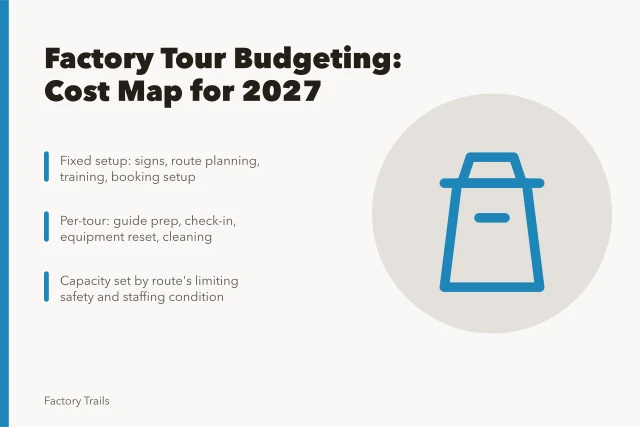
Guides are the largest single line for any hosted format. Cost it as guide hours times sessions times weeks, then add preparation and travel. A two-hour tour is rarely two paid hours.
Transport is the second line and the one most often forgotten. Coach windows, parking, drop-off timing and driver waiting time all bill. A site with one gate and a narrow access road pays for that in scheduling, not in signs.
Insurance and liability cover vary by state, by site and by whether visitors enter a production area. Confirm the requirement with your state board and your insurer before you publish a date.
Content is a real cost even when it looks free. Photographs, script, drawings, translations and accessibility versions all need an owner and a review date.
Fund the fallback in the same budget
Every format needs a second version for the days the first one cannot run. A guided walk needs a viewing-only route. A demonstration needs a recorded explanation. A virtual program needs a downloadable file for when the stream drops.
If the fallback needs content, staff or equipment, those are planned costs, not surprises. Budget them at the same time as the primary format, in the same sheet, with the same owner. Set aside 10 to 20 percent of the primary format budget for the fallback.
Keep the estimate reviewable
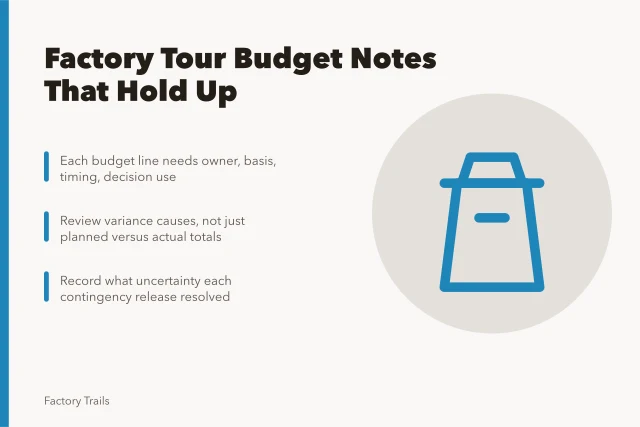
Separate assumptions from evidence. The Government Accountability Office's cost-estimating guide asks for a documented basis, stated assumptions, data and updates. It is a federal guide, not a price list for visitor programs, but the habit transfers: say what each number represents.
Keep the estimate current as the program changes. The General Services Administration describes managing cost estimates through documented information and revisions. A factory tour has different approval rules and the same need to date its assumptions and name an owner.
Store the estimate with the material that explains it. The National Archives' records-management fundamentals describe information that documents organizational activity. Keep vendor scope, approval notes, content versions and pilot observations beside the cost sheet.
Hold expansion for evidence
The first version proves the format works at one group size, one frequency and one audience. It proves nothing about a larger schedule. Record what must be true before you spend on expansion: measured capacity, stable staff cover, current content, an approved route change.
Keep the pilot total and the recurring commitment as separate decisions. A cheap pilot is not evidence that a weekly offering costs the same. When you have run the first version, compare it against the working factory visits guide before committing to a second year.
Common questions
Is a self-guided option free to operate?
No. It reduces live hosting but needs content, maintenance, honest boundaries and a way to correct outdated information. The Park Service's own self-guided examples assume app upkeep, maps and current safety information.
When is expansion spending justified?
When the first version has produced recorded evidence that the site can meet a higher capacity or broader audience. Measured capacity, stable cover and current content are the usual tests.