Guides
Part of Industrial site interpretation fundamentals: how to pick honest stories visitors trust
Industrial site interpretation checklist: what to review before launch
Industrial site interpretation checklist for 2027 gives U.S. visitor teams a practical pre-launch review for stories, sources, visitor needs, and upkeep.
Use this checklist before publishing a tour script, exhibit panel, visitor handout, or site story. It keeps the work focused on what visitors can understand and what the organization can support.
What to take away
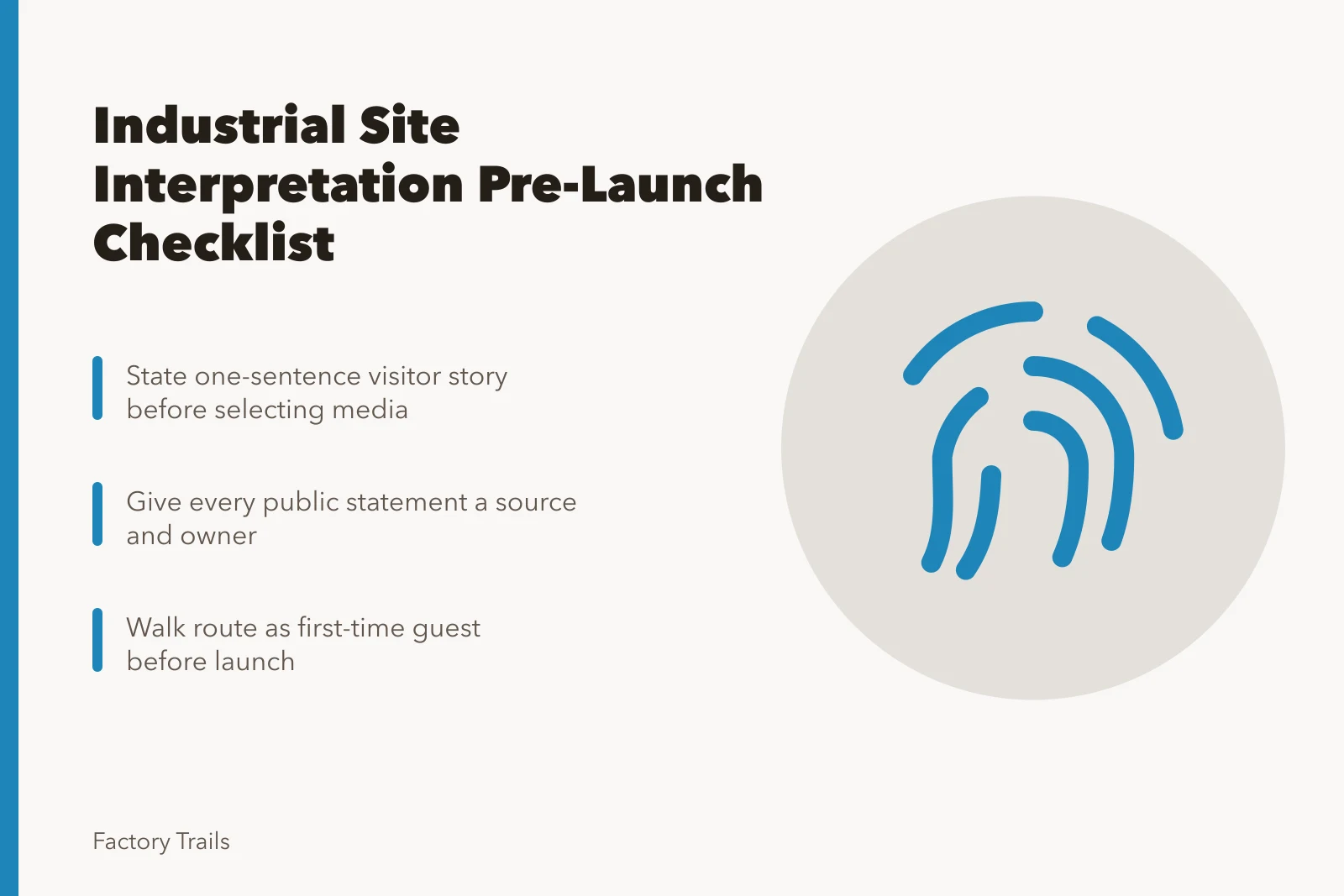
- Check the message, audience, sources, and boundaries before selecting media.
- Give each public statement a source and an owner.
- Test the visitor route and make a maintenance assignment before launch.
Complete the planning checks
- Write one sentence that states the visitor story.
- Name the audience and the time it has for the experience.
- List public sources for every factual statement.
- Mark private, restricted, or unapproved information as excluded.
- Identify the physical stop, page, or host moment where each message appears.
- Separate arrival instructions from historical or interpretive content.
- Ask a qualified reviewer to check claims in their area of knowledge.
- Assign an owner and review date to every durable item.
| Review point | Evidence to keep |
|---|---|
| Story scope | One-page purpose and boundary note |
| Historical claim | Dated source and reviewer note |
| Visitor path | Route sketch or experience sequence |
| Image | Source, rights note, alt text, and credit |
| Maintenance | Owner, review date, and change trigger |
The National Park Service's long-range interpretive planning guidance treats visitor experience goals, media, facilities, and personal services as parts of one plan. Use that same check here. A sign, a host talk, and a web page should not tell incompatible versions of the site story.
Pre-Launch Planning Checks
- Write one-sentence visitor story
- Name audience and time
- List public sources
- Mark private info excluded
- Identify physical stop or page
- Separate arrival from history
- Assign owner and review date
Run a final visitor test
Walk the route as a first-time guest. Can you find the entry, understand the first message, recognize what you are looking at, and know where to ask a question? Read the materials aloud. Replace long sentences, unexplained acronyms, and claims that depend on knowledge a visitor does not have.
Review the material when the physical setting, approved story, route, or visitor instructions change. Remove anything that the organization can no longer verify. A smaller current program is more useful than a larger one that has become unreliable.
Keep the source work usable
Start a source worksheet before the copy is polished. The National Archives worksheet collection shows a useful habit: separate what a record visibly says from the conclusion a reader draws from it. For an industrial visitor project, note the item, date, creator, relevant detail, and the exact sentence it can support. That makes later review faster and keeps one striking image from carrying more meaning than it can prove.
Check signs and route cues in place
Review a route marker at the location where visitors will encounter it. The U.S. Access Board's sign guidance explains requirements for signs that identify permanent rooms and spaces, including tactile characters and placement. Not every interpretive panel falls into that category, but the guidance is a helpful prompt to test contrast, reach, placement, and whether the first instruction can be found without guesswork.
Set a practical review trigger
Write down the event that forces a check: a route closure, revised historic research, a new safety boundary, or a damaged panel. The National Park Service's wayside planning guidance frames interpretive work around purpose, audience, resources, and site conditions. A simple trigger list keeps those decisions connected after launch, when a quick repair can otherwise turn into unreviewed new copy.
Keep the test small enough to repeat. Ask one person who has not seen the draft to find the start point, explain the main idea, and identify one unanswered question. Note where the item failed, not simply whether the tester liked it. Then record the correction and the date. This produces a useful review history without turning a straightforward launch check into a research study.
Before release, make one final comparison between the approved draft and the installed or uploaded version. Check titles, dates, image credits, route names, and contact details. A last comparison catches small production changes that can alter meaning, especially when text has been resized, translated, or moved into a template.
Common questions
Does every stop need a separate theme?
No. A few clear themes can connect several stops. Each stop should add evidence or a different perspective.
What belongs in the source file?
Keep the source, date, rights or permission note, reviewer, and the exact sentence or image it supports.
Can this checklist be used for a self-guided visit?
Yes. Give extra attention to orientation, route clarity, readable media, and a clear contact point for questions.