Guides
How manufacturing museums can keep safety records factual and narrow
Manufacturing museum safety records for 2027 help U.S. sites document observations, public effects, approved actions, communications, and review dates.
What to take away
- Six fields carry every entryobservation, public boundary, responsible role, communication, review date, closeout.
- Publish the confirmed visitor effect only, never a guessed cause or an unapproved reopening date.
- No federal rule fixes these fields for private museums. OSHA covers workers, not visitors.
- A typical retention for routine entries, offered as a range and not a rule, is three to seven years.
- File the record beside the draft, so a later query can be checked against a dated source.
Six fields, one row per event
Open one dated row per event. Log it where your factory tour safety records already live, so the museum and any partner plant keep the same habit.
| Field | What it captures |
|---|---|
| Observation | A factual note about a route, room, object, exhibit, or program. |
| Immediate public boundary | The confirmed restriction, detour, or visitor instruction. |
| Responsible role | The function authorized to assess and approve next steps. |
| Communication | The page, sign, staff note, or listing that changed. |
| Review date | When the boundary and message are checked again. |
| Closeout | The verified outcome and any continuing follow-up. |
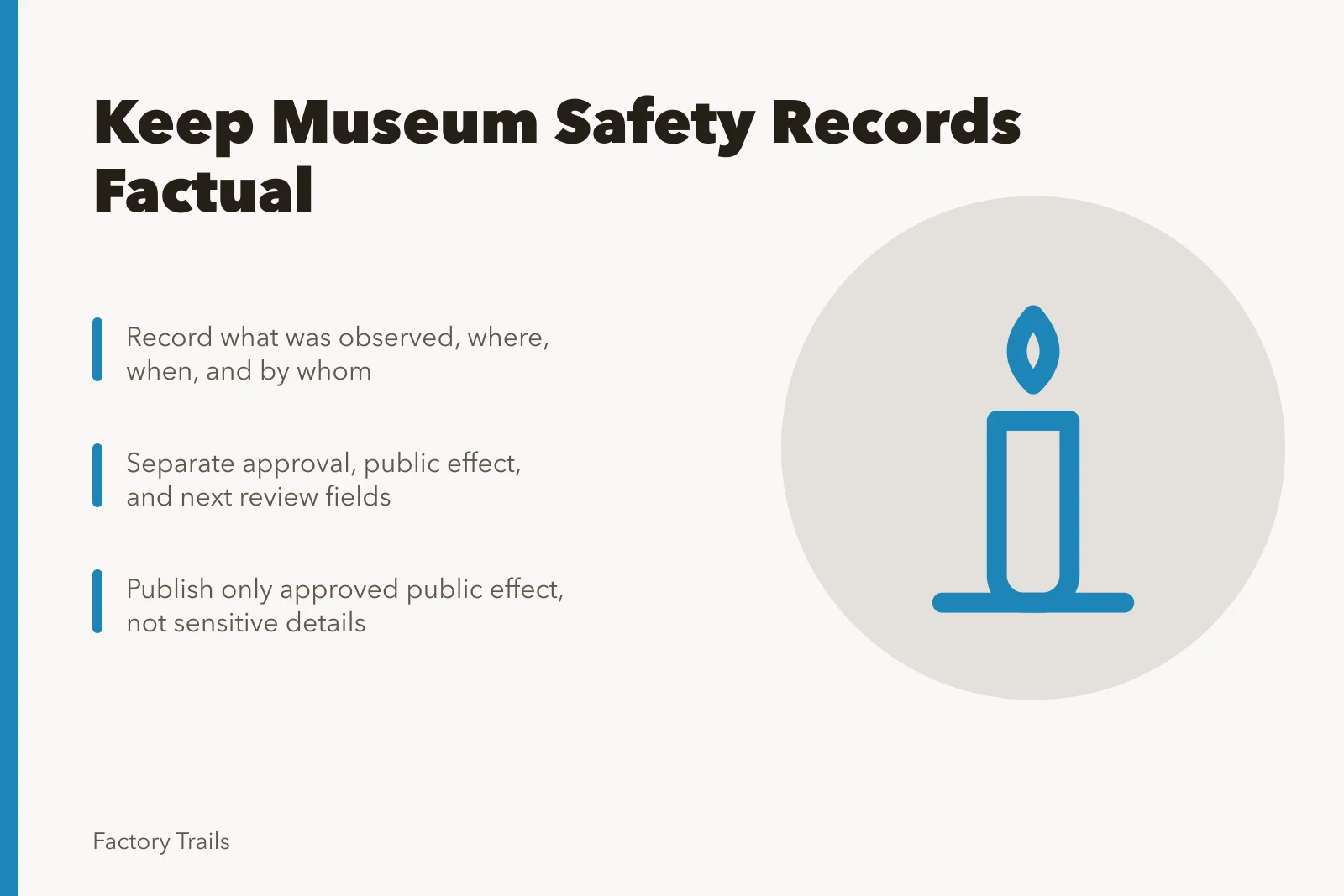
Safety Record Fields
- Observationfactual note about location or exhibit
- Immediate public boundaryconfirmed restriction or detour
- Responsible rolefunction authorized to approve next steps
- Communicationpublic page, sign, staff note, or listing
- Review datewhen boundary and message are checked again
- Closeoutverified outcome and any continuing follow-up
An observation is not a cause. Write that the south stair handrail is loose, not that poor maintenance created a hazard. The second version commits the museum to a finding nobody has approved.
Worker safety rules feed the same rows. OSHA 29 CFR 1910.132 requires employers to assess workplace hazards and supply protective equipment. That gives any PPE instruction on a tour a documented basis instead of a habit.
Museum practice points the same way. The NPS Museum Handbook treats dated written records as core professional work, and its logic transfers from collections to visitor routes.
The February 1, 2027 posting window
If your museum keeps an OSHA injury and illness log, the annual summary, Form 300A, is posted from February 1 to April 30. In 2027 that window opens on February 1.
Use it as the review alarm. In that week, reopen every dated entry and confirm or revise the public wording. Sites still assembling their own paperwork can start with the manufacturing museum fundamentals checklist before the first sweep.
Nothing in 2027 adds fields to a visitor safety record. The year matters because the review cycle lands inside it, not because a rule changes.
Example record and public notice
One filled row shows the shape.
| Field | Entry |
|---|---|
| Observation | South stair from the weave room to the mezzanine roped off. Rope installed 14 April 2027, 09:20, by site staff. Handrail fixing loose at the third landing. |
| Immediate public boundary | Visitors use the north stair, which is step-free at ground level. |
| Responsible role | Facilities supervisor. |
| Communication | Tour route page updated 14 April 2027. Briefing note issued to guides. |
| Review date | 28 April 2027. |
| Closeout | 27 April 2027. Handrail refixed and inspected. South stair reopened 28 April 2027 and the route page updated the same day. |
The public version is shorter.
Route change: the south stair between the weave room and the mezzanine is closed. Please use the north stair, which is step-free at ground level. This is in place from 14 April 2027 and is reviewed on 28 April 2027. Check the tour route page before you travel.
That notice gives the effect, the start date, and the next check, with no cause attached. Sites with underground routes, such as the Britannia Mine Museum underground tour, publish notices of about this length. Keep any sponsor or booking line separate from the visitor fact.
Retention and where the record lives
Keep the closed record with the draft it changed. NARA's records-management fundamentals describe records as information kept to document actions, which is exactly what a dated entry is. Those schedules bind federal agencies, not private museums, but the structure is the clearest public explanation of retention.
Store the record in the same content system as the page, under a short ID such as MS-2027-014. Keep an internal copy after a public notice comes down.
Write a retention line into policy. Many museums keep routine entries for three to seven years, a typical range and not a rule. Keep anything tied to a specific object or structure longer.
Most trouble comes from drift: the notice goes, the page stays. The common factory visit mistakes list covers that failure from the visitor side.