Guides
How to vet an industrial tour provider before you sign a contract
Vetting an industrial tour provider starts with the assignment, the real route, safety insurance, and who holds authority when a visit changes.
What to take away
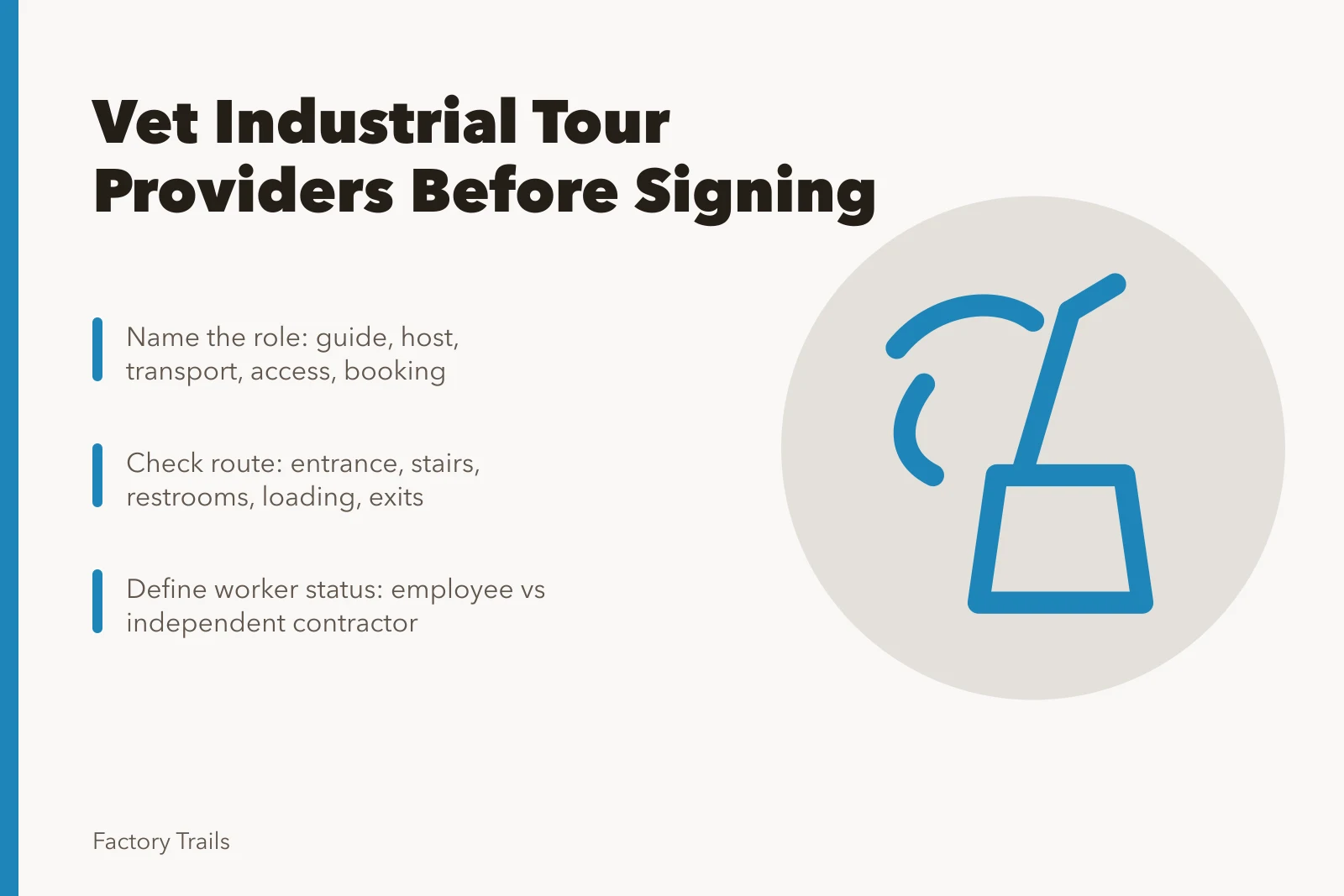
- Name the role before you price itguide, site host, transport partner, access consultant and booking coordinator are five different jobs with five different scopes.
- Walk the actual visitor route with the candidate, including the drop-off point, the stair, the surface change and the late-arrival door.
- Write down who supplies training, tools, insurance information, route materials and supervision before anyone signs.
- Test the arrangement with one realistic disruption, not with a promise.
- Give every candidate the same core facts, or their prices are not comparable.
Start with the assignment, not the title
"Need help with tours" tells a candidate nothing it can price. Name the work first. Which site, which group type, which route segments? Which date window, which language, which arrival plan?
Assignment areas to pin down
Assignment area
- Route
- Walked public path?
- Visitors
- Fits size, age, language?
- Scope
- Included before, during, after?
- Authority
- Who can change timing?
- Access
- Alternate experience exists?
- Records
- Reported after change or cancel?
Question to ask
- Route
- Route notes, unknowns
- Visitors
- Group profile
- Scope
- Written deliverables
- Authority
- Contact list
- Access
- Visitor-facing copy
- Records
- Handoff form
What to keep on file
- Route
- Visitors
- Scope
- Authority
- Access
- Records
Write one page before you ask for proposals. State the site. State the expected group profile. State the route the visitors will actually walk. State the operating hours. State the site restrictions. State the one person who can approve a change mid-visit.
Then ask each candidate to say what it delivers and what stays with the host. The gap between those two answers is where tours fail.
| Assignment area | Question to ask | What to keep on file |
|---|---|---|
| Route | Has the candidate walked the public path? | Route notes and open unknowns |
| Visitors | Does the plan fit group size, age, language and stamina? | Group profile |
| Scope | What is included before, during and after? | Written deliverables |
| Authority | Who can change timing, route or group limits? | Contact list |
| Access | What alternate experience exists? | Visitor-facing copy |
| Records | What is reported after a changed or canceled tour? | Handoff form |
This is not a vendor scorecard. It is a way to surface the conditions that decide one specific visit.
Walk the route before you trust the résumé
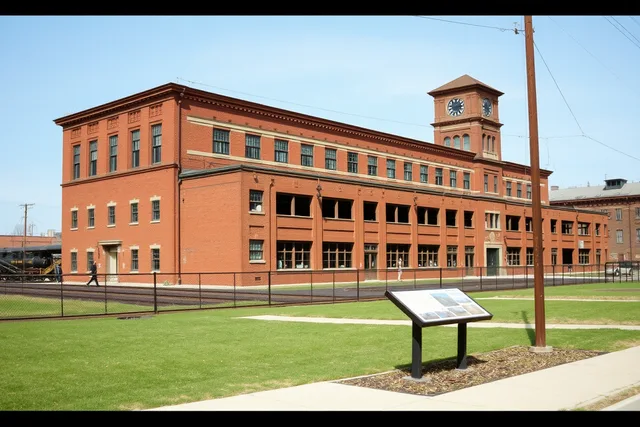
A candidate can have years of museum, factory, transport or hospitality work and still not know your meeting point. Ask what they know about the visitor entrance, the route sequence, the stairs and the surface changes. Ask what they know about the restrooms, the restricted areas, the vehicle loading bay and the late-arrival process.
The U.S. Access Board guide to accessible routes lists the components a route review covers: walking surfaces, doors, ramps, curb ramps, elevators and permitted lifts. Use it to structure the walk. It does not declare a historic plant accessible, and it does not replace a local assessment.
Put the route review on the list even if the provider never leads visitors. A transport partner needs the exact drop-off point and the waiting plan. A coordinator needs the site contact who can open a gate. A researcher needs to know which parts of the story visitors can actually see from the path.
Sort out the worker arrangement early
A job title is not a relationship. The work may be done by an employee, an independent contractor, a company, or a mix of people across one visit.
What to pin down with providers
What the candidate says
- Manage group
- Which group, where, whose rules?
- Adjust access
- What details, who approves?
- Transport included
- Pick-up, vehicle, waiting, late arrival
- Handle communication
- Which messages, audience, approval path?
What to pin down
- Manage group
- Adjust access
- Transport included
- Handle communication
The Internal Revenue Service independent-contractor guidance sets out the test: behavioral control, financial control, and how the two parties see the relationship.
Document the arrangement rather than assuming a label settles it.
For selection, list who supplies these items:
- training
- tools
- insurance information
- route materials
- vehicle coordination
- visitor messages
- supervision If the host directs a change, record whether the provider tells visitors or whether site staff do.
| What the candidate says | What to pin down |
|---|---|
| "We will manage the group." | Which group, where, under whose site rules? |
| "We can adjust for access needs." | What details do you need, and who approves the alternate? |
| "Transportation is included." | Pick-up point, vehicle size, waiting time, late-arrival process |
| "We handle communication." | Which messages, which audience, which approval path? |
Test how the provider handles a bad day
Ask when the provider receives the final route, the guest count, the weather plan, the contact list and the site restrictions. Then ask what happens when the route changes, a coach runs late, a gate closes, or the group arrives with different needs than booked.
Bad-day decision flow
- Route changes or coach runs late
- Who watches conditions?
- Who makes the call?
- Who tells the visitors?
- Keep the part that mattered
The National Weather Service heat-safety resource covers how heat affects people and what precautions reduce risk. The provider does not have to write a weather policy alone, but the plan should name who watches conditions, who makes the call, and what visitors hear when the plan moves.
Run a tabletop exercise before your busy season. Hand the team a closed entrance, a delayed bus, or an outdoor stop that has to move inside. Watch whether they find the decision owner, tell the visitors, and keep the part of the experience that mattered.
Fit the proposal into your own operating plan
The Small Business Administration treats a business plan as the place where goals, operations and financial planning sit together. Its business-plan guidance applies here: a provider proposal should attach to your plan, not float beside it.
Keep scope, assumptions, cost structure, timeline and responsibilities with the route plan. Before you commit, work through the factory tours checklist: how to scope, budget and pick a provider so the proposal lines up with the assignment you actually wrote.
Before you choose, confirm every candidate received the same core facts. If one got a group size, an access requirement or a route restriction the others did not, their prices and promises cannot be compared.
Run the handoff test
Use this before the first public date:
- Route, arrival point and visitor itinerary confirmed.
- Provider role and host role written down and agreed.
- Contacts and change authority reachable during the visit.
- Visitor instructions match the route as it stands today.
- A record is made after any change or cancellation.
If an item is open, name the owner and the deadline. The provider may still be the right choice, but do not let an unanswered question ride along to the gate.
Common questions
Does every provider need to visit the site before being hired?
Not always. Anyone responsible for live route, visitor movement, arrival or site communication needs accurate route information, and a site walk is the cheapest way to get it. A booking coordinator working from a current site pack may not.
Is the cheapest proposal a warning sign?
Price by itself is not. It becomes a problem when scope, preparation, staffing assumptions or change responsibilities are missing from the quote. Compare those four lines before you compare the number.
What has to be written before the first tour?
The assignment, the route assumptions, and who is responsible for what:
- who can change the plan
- how visitors are told
- what record follows a material change The industrial site interpretation checklist: what to review before launch covers the visitor-facing side of that same preparation.
How do I check a provider's claims about a working plant?
Ask the site authority, not the provider. Whether a line is running or shut for July or December maintenance, which areas are off limits, and what photography is allowed are the plant's calls, and they change with the maintenance calendar.