Guides
Factory tours checklist: how to scope, budget and pick a provider
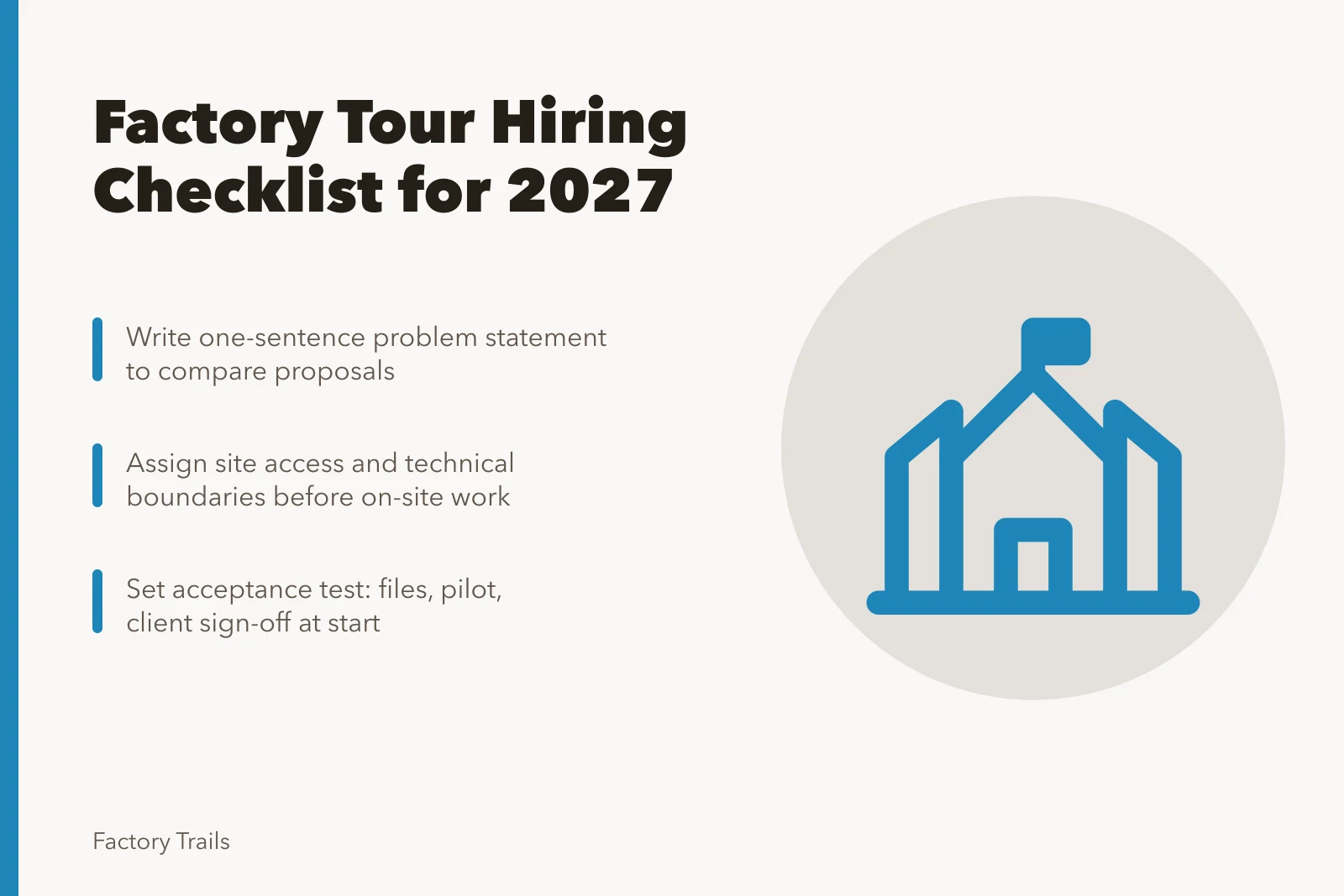
A factory tour hiring checklist for 2027 that fixes scope, site access, acceptance tests and the close-out file before any provider starts work.
Use this checklist before hiring a provider to help plan, write, design, test, or support a factory tour.
What to take away
- The close-out checklist is written at the same time as the brief, not at the end.
- One named program owner reviews the post-engagement note before it is filed.
- File handoff names the recipient, the storage location, the format and the checker.
- A provider who cannot open the plant's own access rules cannot test a tour route.
- Unfinished items stay open with an owner and a date, so acceptance is honest.
Write the close-out checklist first
Most engagements fail at the end, not the start. The brief says what to build; the close-out list says what "built" means.
Close-out checklist items
- Deliverables receivednamed files, agreed format
- Files usableclient opens and edits each
- Factual reviewreviewer named, corrections logged
- Rights and licencesusage terms stored
- Site-specific claimsfacility contact signed off
- Open itemsowner and date each
Draft both on the same day. A close-out line that cannot be written is a scope line that was never agreed.
| Close-out item | Evidence required |
|---|---|
| Deliverables received | Named files, in the agreed format |
| Files usable | Client opens and edits each one |
| Factual review | Reviewer named, corrections logged |
| Rights and licences | Usage terms stored beside the asset |
| Site-specific claims | Facility contact has signed off |
| Open items | Owner and date for each |
The GAO cost-estimating guide treats purpose, scope, assumptions, documentation and updates as the features of a credible estimate. Apply the same discipline to the close-out list: it is a document that gets updated, not a form filled in once.
Assign site access before anyone quotes
A plant is not a studio. Access depends on whether the line is running or shut for July or December maintenance, and on the escort ratio the facility sets.
The provider needs a named facility contact who controls site access, induction and photography permissions. Where tripods are banned, that has to reach the photographer before the visit, not on the gate.
Do not write safety, PPE or induction instructions into the brief. Point the provider at the plant's own safety officer and its published visitor rules, and let the facility deliver them.
OSHA's contractor-guide worksheet covers defining expectations and communicating relevant information to an outside party working on site. Use that discipline for the commercial relationship; use the facility's rules for everything physical.
Agree the acceptance test in writing
An acceptance test is a sentence the client owner can check without asking the provider's opinion.
"We will walk the route with two visitors who use wheelchairs and log every point where the published accessibility statement and the route disagree" is a test. "The tour will be accessible" is not.
The GSA guidance on managing project costs stresses documented cost information and updates as work develops. The same habit applies to acceptance: record what was checked, on what date, by whom.
Where the deliverable is a script, the test is a read-through against the plant's own record. Sloss Furnaces, Pullman National Monument and the Britannia Mine Museum all publish interpretation that separates a working plant from its preserved twin. A script that blurs the two fails the test.
Confirm the file handoff
Before work starts, name four things: who receives the files, where they are stored, what format is required, and who checks the files open.
Skip this and a project looks finished while the client holds a locked design file, an uneditable map, or an image with no rights note.
The National Archives records-management fundamentals describe records as evidence supporting business needs and accountability. Keep the brief, the proposals, the selection basis, the change notes and the final handoff in one place.
That file is what makes the next realistic plan for factory tours in 2027 cheaper to write than this one.
Worked example: the shutdown that was booked wrong
A heritage site booked a filming crew for the second week of July. The line was shut for maintenance, so the "working plant" footage the brief asked for did not exist.
The provider delivered what it could. The client rejected it, because the acceptance test said "working line, in operation".
The fix cost one calendar check at scoping. Add a line to the brief: which weeks is the line running, and who confirms it.
Review the note with the program owner
After first use, write one page on the selection process. It records a missing client input, a review stage that earned its place, or a dependency the next brief should carry.
Keep it to the process. Do not rate the provider with generalities you cannot evidence.
The program owner reads it before it is filed. Date the review and retain it with the handoff file.
Common questions
Who signs off on the final deliverable?
Name the client owner before work begins. The facility contact reviews site-specific accuracy, while the program owner approves anything visitor-facing.
What if the provider finds a technical problem?
The provider reports it through the assigned site contact. A visitor-program provider should not be making technical decisions outside the engagement.
Can a project start without a final budget?
Only when both sides understand the approved initial scope, the fee approach, and who can authorise changes. Anything else is a dispute waiting to happen.