Guides
Industrial tour cost warning signs: what to check before you sign
Industrial tour cost warning signs for 2027 help U.S. operators catch false capacity, outdated fees, hidden staff time, weak reserves, and unsupported claims.
What to take away
- A low ticket price proves nothing until you know which costs sit outside it.
- Four warning signs carry most of the riskroom capacity used as route capacity, guide pay tied to tour minutes, undated fee figures, and a reserve spent most weeks.
- Confirmation means written terms, a dated quote, and a named contact at the property.
- Delay the launch when capacity, site fees, staffing, or alternate-route costs have no source.
- Close a cost gap with schedule, minimum booking, or price, never with a thinner visit.
Four warning signs and what clears them
Every cost model fails in the same few places. Check these four before you sign anything, and write down what would settle each one. Variance is normal on a new route, so the cost map and capacity notes matter more than a rounded ticket figure.
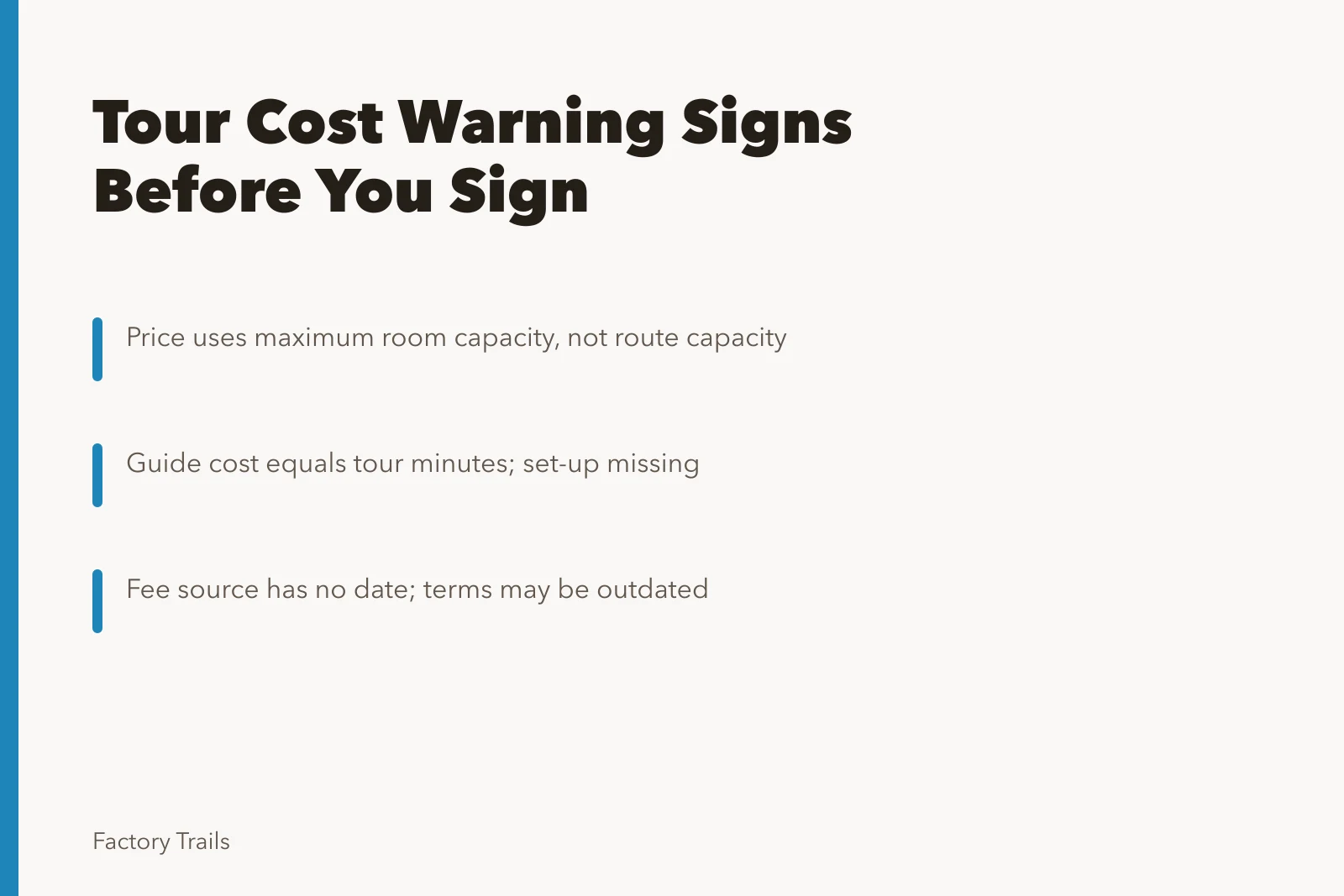
Tour cost warning signs
- Price uses maximum room capacity
- Guide cost equals tour minutes
- Fee source has no date
- Reserve is always used
| Warning sign | What it usually hides | Evidence that clears it |
|---|---|---|
| Price built on maximum room capacity | The tested route holds fewer people | Dated route test at the advertised group size |
| Guide cost set to tour minutes | Set-up, briefing, and follow-up go unpaid | A time log covering one full departure |
| Site fee with no date or source | An outdated or misread agreement | Current written terms and a named contact |
| Reserve spent most weeks | An ordinary operating cost in disguise | Twelve months of spend against the reserve |
Treat each property as its own case. The Royal Canadian Mint tours page separates a Winnipeg production facility tour from the Ottawa boutique mint, so capacity and terms do not carry from one site to another.
Review the warnings in this order
Work through them in the order that protects a booked visitor.
- Test the full visitor path at the advertised group size and record the number you get.
- Time one complete departure, including set-up and briefing, before you accept a guide rate.
- Request current written terms and a dated fee quote, then name the contact who supplied them.
- Compare twelve months of reserve spending against the reserve line.
- Adjust the price, the schedule, or the minimum booking only after the first four steps.
That order keeps you from polishing a ticket number for a format the property cannot yet support. Record each outcome, and note the evidence when a warning closes. Factory tour budgeting shows how those notes feed a 2027 cost file.
Example: the guide-hour line that hides money
The figures here are typical ranges, not quotes. A 90 minute tour gets priced at 1.5 guide hours at $25 to $40 an hour. The real departure needs about 3.0 hours, split as 0.5 for set-up, 1.5 on the floor, and 1.0 for follow-up and reporting.
The gap is 1.5 hours a departure. Eight departures a week across 40 weeks turns that into 480 hours. At $25 an hour the season is short about $12,000. At $40 an hour it is short about $19,200.
The repair is a higher price, an extra departure slot, or less duplicated set-up. Dropping the briefing or stretching the group past the tested size does not repair it.
What counts as confirmation before you price
Written terms count when the property signs or issues them. A dated quote counts. So does a named contact who can restate the fee on request.
The IRS recordkeeping guidance asks businesses to keep records that support income and expenses. A fee assumption with no date fails that test long before it reaches a price.
Use the factory tour budget checklist to mark which lines still lack that evidence before a launch is approved.
Do not close a cost gap by cutting the experience
A model that works only by skipping the safety briefing, using an untrained guide, or exceeding the tested group size is not a model. The cost lands somewhere else, usually on staff time or on the visitor.
Protective gear is a real line. The OSHA general PPE rule requires employers to provide protective equipment where hazards require it. Ask whether visitor gear sits inside the site fee or is billed to you, and put the answer in writing.
Put a written rule on every shifting cost
Late transport, an extra escort, an alternate room, or a cancellation moves money between parties fast. If no rule says who pays, the guide absorbs it or the ticket hides it.
Write the rule into the agreement and name the person on your side who can approve the change. Factory tour format costs help you see which format carries which exposure before you sign.