Guides
How to keep industrial tour cost records that stand up
Industrial tour cost records guide for 2027 helps U.S. operators retain receipts, invoices, time logs, agreements, refunds, reports, assumptions, and reviews.
What to take away
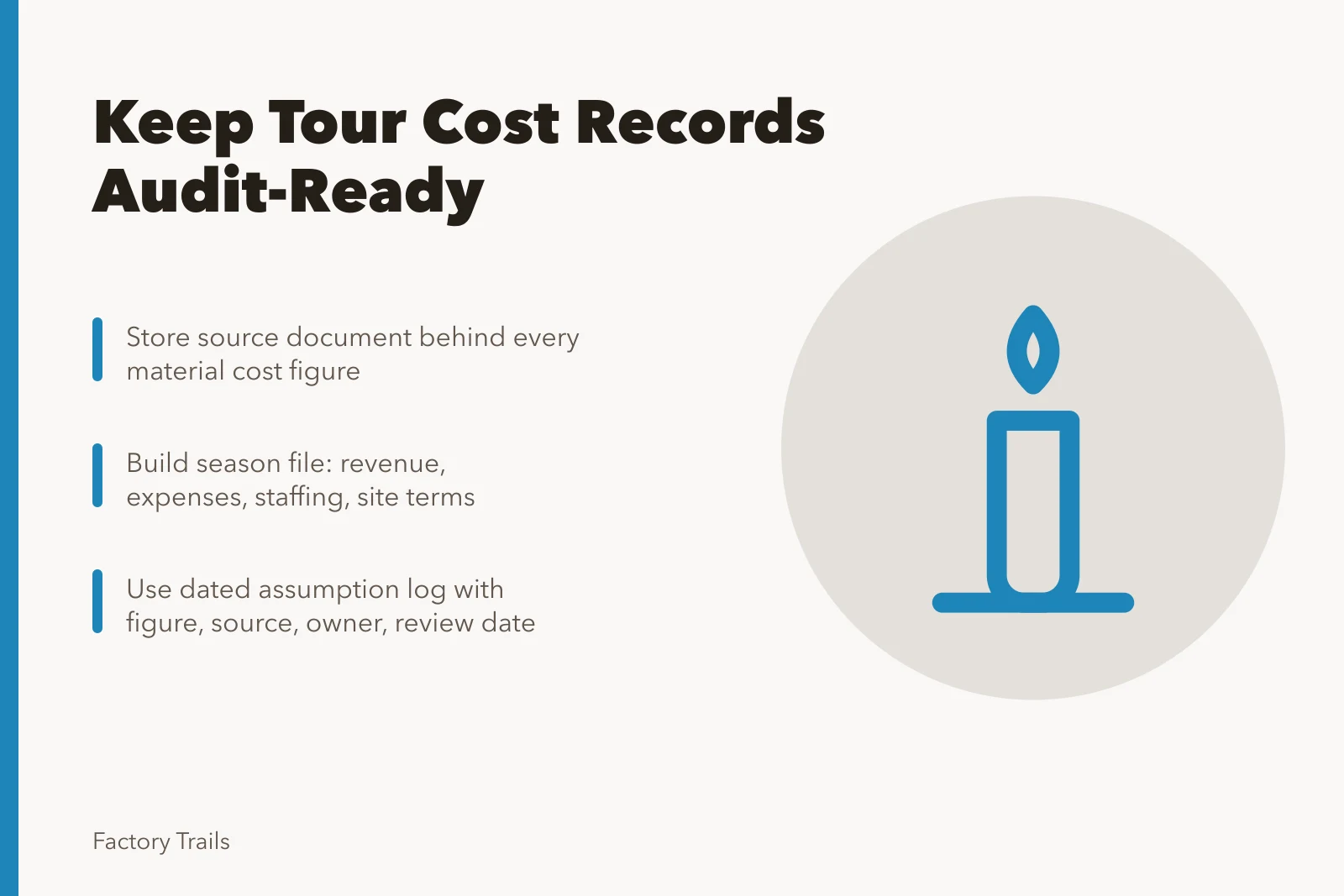
- Store the source document behind every material cost figure.
- Keep revenue, expense, agreement, and operating records together by season.
- Separate tax documentation from the internal notes used to improve the tour.
Cost records let an operator explain how a price was built and what actually happened during a season. They are useful for internal review, partner conversations, and professional tax or accounting support. This guide covers U.S. recordkeeping expectations for a tour operation. It is not tax advice.
Build a season file
| Record group | Keep | Why it matters |
|---|---|---|
| Revenue | Booking exports, payment reports, refunds, commissions | Shows what the operator received |
| Expenses | Invoices, receipts, statements, proof of payment | Supports the cost model |
| Staffing | Time logs, guide rates, contractor agreements | Captures work outside the public tour |
| Site terms | Access agreement, fee schedule, reports, amendments | Explains charges and obligations |
| Analysis | Assumption log, departure review, season summary | Shows why the model changed |
The IRS guide on starting a business and keeping records explains that records support entries in business books and should be kept in an orderly, safe way. The appropriate records and retention needs depend on the business and professional advice.
For a tour operator, the operational benefit is immediate: a later reviewer can trace a price or cost claim to its original document.
Season File Record Groups
- Revenuebooking exports, payment reports, refunds, commissions
- Expensesinvoices, receipts, statements, proof of payment
- Staffingtime logs, guide rates, contractor agreements
- Site termsaccess agreement, fee schedule, reports, amendments
- Analysisassumption log, departure review, season summary
The National Archives records-management FAQ index provides general information about records that can be found and understood later. It is not a retention schedule for a tour operation. It supports giving files a plain name, date, owner, and version so that the current fee schedule is not confused with an earlier one.
How long to keep records
| Record group | Typical retention |
|---|---|
| Invoices, receipts, proof of payment | At least three years after the return is filed, longer for costs tied to an asset or a claim |
| Booking, payment, and refund reports | The same period as the revenue they report |
| Time logs, guide rates, contractor agreements | At least three years, plus any period in which a contract is still open |
| Site terms: access agreement, fee schedule, amendments | For the life of the agreement, plus the period for the costs it covers |
| Assumption log and season summary | While the tour format is in use, plus three years |
Treat these as typical periods, not a rule for every operator. Keep records longer when a contract, a dispute, or a tax question is open, and confirm the period for your entity with a tax professional. A plain spreadsheet and a dated folder tree cover most operations.
Match the record to the estimate
If the model contains a guide-hour assumption, keep the time log that later tests it. If it contains a site fee, retain the agreement or published fee source. If a refund changes revenue, keep the booking report and reason. The source record does not need to be public, but it should be findable.
Make one register for the whole season. Columns: cost category, record type, date, period covered, file location, owner, and next review point. The register can point to a restricted invoice folder without copying payment information into the operations file. Flag each row where a figure is an estimate rather than a confirmed amount.
Refunds and commissions need their own lines: the booking reference, the amount, the reason, and the payment report that shows the money moved. The register doubles as the template for a new season.
One season register row looks like this.
| Cost category | Record type | Date | Period covered | File location | Owner | Next review |
|---|---|---|---|---|---|---|
| Site access fee | Signed access agreement and fee schedule | 14 March | 1 May to 31 October | season-2027/agreements/site-a.pdf | Operations lead | Before the 2028 renewal |
Copy the columns, not the entries, so your own paths, owners, and review dates fill each row.
Use an assumption log
Create a dated list of estimates that are not yet confirmed. For each entry, state the figure, source, owner, and review date. When a quote arrives or a pilot produces actual data, close the assumption and retain both the old and new value. This makes cost changes understandable rather than mysterious.
Protect access and privacy
Limit access to payment details, personal data, and vendor account information. Guides may need a current route and the applicable fee or refund rule, but they do not need every financial document. Use the smallest access level that lets each role do its work.
The U.S. Small Business Administration information-quality page describes records in terms of creation, maintenance, use, and disposition. That lifecycle is a helpful prompt to remove outdated contacts and duplicate reports from a working file while preserving the documents that support a current decision.
Keep tax files apart from working notes
Tax documentation and internal notes answer different questions. A receipt should stay as issued. A comment about a late guide, a rerouted departure, or a vendor dispute belongs in the assumption log or the season summary, not on the invoice.
If a supplier invoice arrives with a note about a delayed delivery, file the invoice in the tax folder and record the delay as a separate operations note with a date and an owner.
Close every cost record cycle
At the end of a departure, attach the actual attendance, staff time, route version, invoices, refunds, and change notes to the estimate that preceded it. At season end, retain a short variance review explaining meaningful differences.
The Internal Revenue Service recordkeeping guidance says businesses should keep records supporting income and expenses. It does not define a tour review, but it supports preserving the evidence behind the figures used in one.
Review the file access list at the same time as the documents, and confirm who owns the current season file.
Common questions
Should one spreadsheet replace the source documents?
No. A spreadsheet is a summary. Keep the invoice, agreement, report, or log that supports the number.
How often should the assumption log be reviewed?
Review before launch, after early departures, and before each new season.
Can records show a tour needs a different format?
Yes. A repeated mismatch between capacity, staffing, cost, and visitor needs can support a route or schedule change.