Guides
Part of How to pick an industrial heritage travel provider for 2027
How to keep industrial heritage travel provider selection records for 2027
Industrial heritage hiring records for 2027 help U.S. publishers document scope, sources, access checks, corrections, and transparent provider decisions.
What to take away
- Keep one record per provider, with every field filled before a claim reaches the page.
- Label each source by what it can provecurrent access, historical context, or neither.
- The 2027 in the title is the season the records serve. Open the set during selection and review it twice a year.
- Keep the decision trail for about three years, a typical editorial span, then hold only the correction log.
The eight fields, and the order to fill them
Fill the fields in order and the record answers most later questions without a call. Scope and live source carry the most weight, because both change between seasons. A scope is a list of line items, and the 2027 scope checklist shows which lines need a source before they enter a provider agreement.
Field / What it captures
- Provider and service
- The exact role, named at facility level
- Scope
- Deliverables, exclusions, timing, group size
- Live source
- The current page for access, hours or terms
- Historical source
- Context for interpretation only
- Review date
- The day the live detail was checked
- Fallback
- The public alternative and its trigger
- Commercial disclosure
- Placement, referral or other relationship
- Correction log
- The source supplied and the edit made
Record fields to capture
- Provider and servicerole under consideration
- Scopedeliverables, exclusions, timing, group needs
- Live sourcecurrent access or commercial page
- Historical sourceinterpretation evidence only
- Review datewhen live detail was checked
- Fallbackpublic alternative and trigger
- Commercial disclosure and correction log
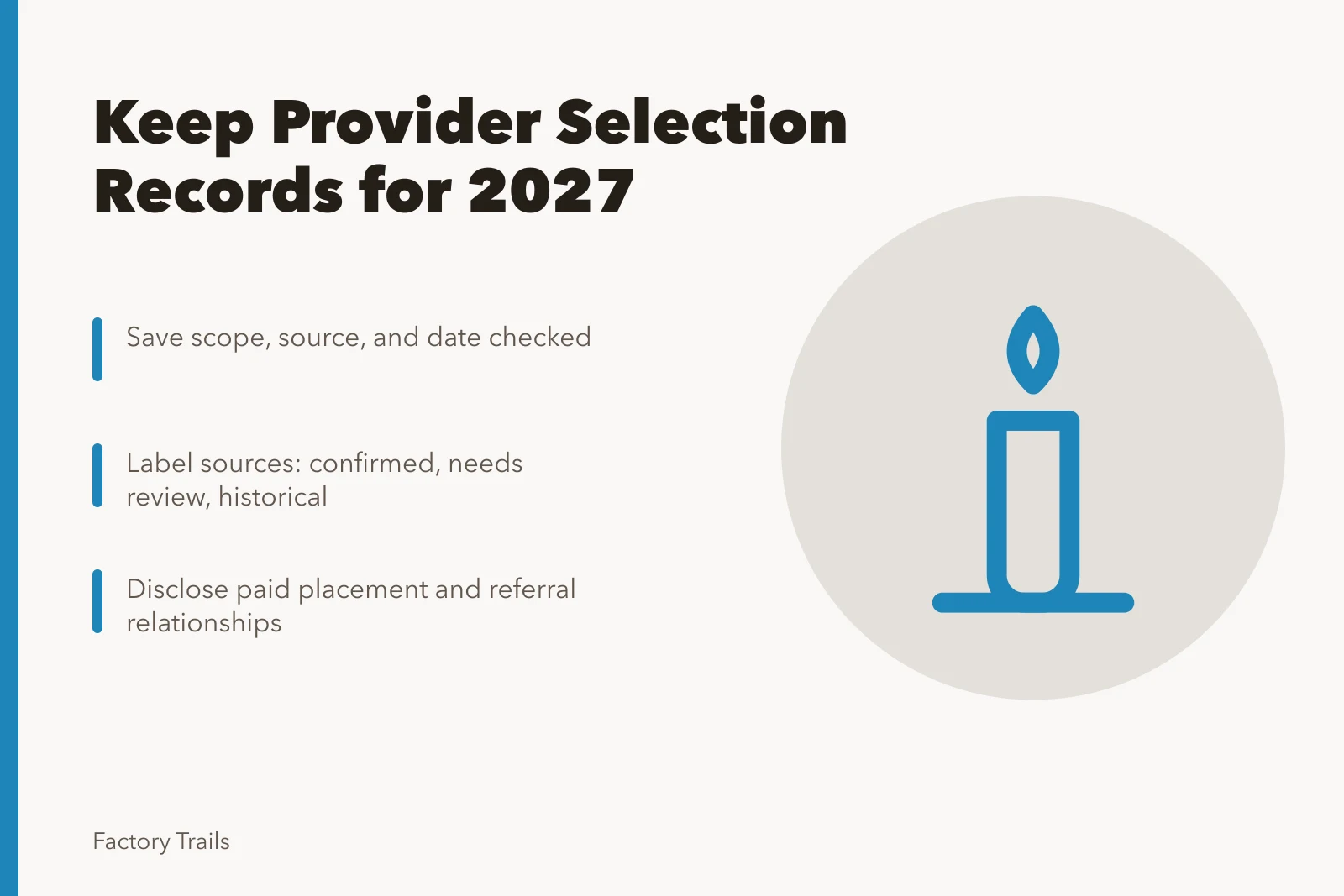
A live source is the provider's own page or the site's own page, checked today. A historical source is a book, a photograph or an encyclopedia entry, and it carries context only. Separate cells show a later reader which source supports which sentence.
Name the facility, not the brand
A record that reads "brewery tour" or "mint tour" cannot be checked. The Royal Canadian Mint sells tours at two locations, and its own tour page separates the Winnipeg production tour from the Ottawa boutique.
Canada is the second market for these records. The Britannia Mine Museum underground tour guide shows why a booking record must name the tour, not just the museum.
What 2027 means for the record set
The year in the title is a season, not a label. Group slots, permits and museum programs for 2027 are agreed during late 2026 and early 2027, so the set opens while selection is still running.
Treat the season as the unit of record. One dated set, with review dates written in before any sentence is drafted.
Example: one filled-in record for a real site
Lowell National Historical Park runs working textile mill exhibits and guided walks, which makes it a useful model. The values below are illustrative, not verified details about that park.
Provider and service: Lowell National Historical Park, guided mill floor tour. Scope: 90-minute walking tour of working machinery, groups of 12. Live source: park visit page, checked 12 January 2027. Historical source: mill era context only.
Review date: 12 January 2027. Fallback: self-guided canal walkway if guided slots fill. Commercial disclosure: none. Correction log: 4 March 2027, provider supplied a page showing a changed meeting point, sentence revised.
The park publishes its current tours on the Lowell National Historical Park page, which makes that page the live source. A regional list does a different job, and the Alabama industrial heritage sites guide is the place to look for a second site in the same state, beyond Sloss Furnaces.
Steps to open the 2027 record set
- List every provider and service you expect to cover, named at facility level.
- Create one row per provider with the eight fields, leaving the correction log empty.
- Paste the live source address and the date you opened it, not the date the page was published.
- Put the editorial decision in its own column, so a recommendation cannot pass as a site rule.
- Set both review dates before you draft any sentence.
Evidence types and correction requests
A provider biography cannot prove that public access exists today. A historic photograph cannot prove that a service still runs. Old articles should not set a current price.
Four status labels do the work. Confirmed means a current responsible source supports the claim. Needs review means it cannot be repeated without another check. Historical means the source explains earlier context only. Removed means the sentence is gone.
Operational terms move. The National Park Service visitor conditions guidance is a model for flagging terms that change without notice, such as closures or seasonal hours.
When a provider requests a correction, ask for the source that supports the exact change. Compare it with the sentence, revise where warranted, and log the date. Payment never replaces verification.
Working plant visits fail in their own ways, and the mistake prevention fixes for 2027 show which failures begin in the selection file.
Retention and review cadence
Records that never expire become clutter and a liability. A workable pattern is a three-year decision trail, a typical editorial span rather than a rule, plus a correction log kept while the page is live.
Review the set before the season opens and again at mid-season. Anything labelled Needs review is rechecked or cut. A fallback that no longer exists gets the same treatment.
A record set is only as good as its dates. Archive rather than delete, so a later reviewer can see what changed and when.