Guides
How to pick an industrial heritage travel provider for 2027
Choosing industrial heritage travel help in 2027 gives U.S. visitors a practical way to evaluate scope, current authorization, evidence, and communication.
What to take away
- Write the brief firstarea, date, group size, mobility needs, target locations, language, and outcome.
- Ask which permit or authorization covers work inside a managed public site, and ask for the page that states it.
- Score the same scope questions for every candidate instead of reading star ratings.
- Treat $600 to $1,200 for a research day and $1,500 to $3,000 for a driver-guide motorcoach day as rough U.S. planning ranges, not quotes.
- Book early. Spring and fall weekends and underground mine tours often close six to nine months ahead.
Write the brief, then match the provider type
A request for help with a heritage trip hides four jobs. A guide interprets on public ground. A driver moves a group. A researcher works in archives. An organizer handles dates, vendors, and paperwork.
A good mill historian may hold no commercial driving licence. A coach operator may know nothing about a 1910 spinning room.
Cover seven details in the brief: area, date, group size, mobility needs, target locations, language, and outcome.
Trip brief essentials
- Geographic area
- Trip date
- Group size
- Mobility needs
- Public locations to visit
- Language needs
- Desired outcome
Canada is a second market for this site, so a British Columbia mine tour can sit beside a Pennsylvania furnace site in one shortlist. Booking steps for that mine are in how to book a Britannia Mine Museum underground tour in BC.
Sort out authorization for managed sites
Authorization belongs to one service in one place, not a general badge.
When a provider will lead, transport, photograph, or sell inside a managed park, ask which authorization applies and who issues it. The National Park Service Commercial Use Authorization page for Fort McHenry defines a CUA as a business permit for set commercial activities in a park area.
If a provider only does off-site research, ask how they will check public access details. A specific answer beats a confident one.
Compare scope with five fixed questions
Put the same five questions to every candidate. The gaps between answers are the comparison.
| Question | Useful answer | Warning sign |
|---|---|---|
| What is included? | A written route, research task, transport role, or tour length | Everything is covered |
| Which places are confirmed? | Named public locations, each checked against a current source | A place list with no access detail |
| What if conditions change? | A named public fallback and a contact plan | Sort it out on the day |
| How are boundaries handled? | Set entries, public routes, site rules | Suggestions to find unofficial access |
| How is an error corrected? | A direct contact and a source-based correction | No route to challenge a claim |
Ask what the service is not. A researcher may supply context but no transport. A driver may supply transport but no entry to restricted property.
Groups entering a working plant as well as a museum should raise induction and footwear points early, as the working factory visits safety checklist sets out.
Example: two candidates scored on one card
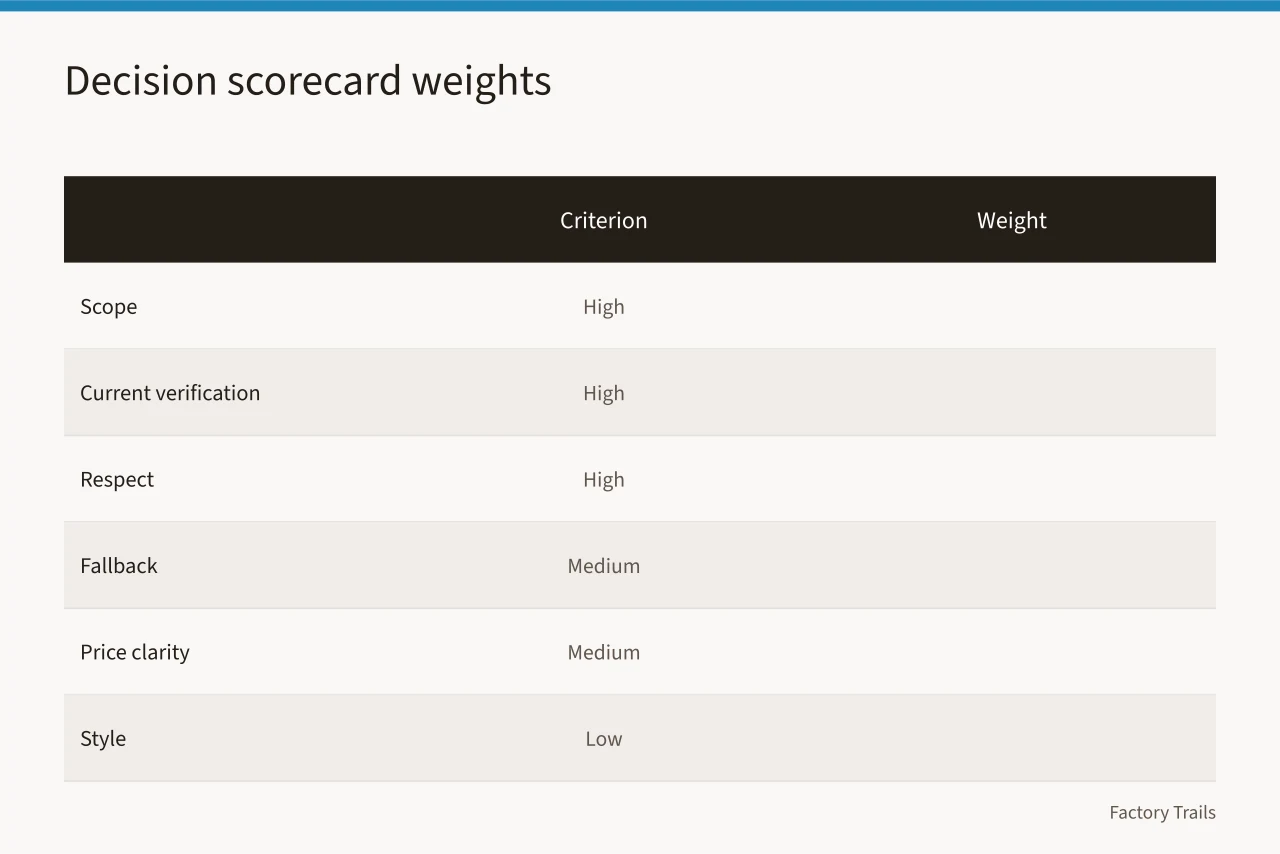
Score each candidate from 1 to 5, multiply by the weight, then compare totals.
Weight
- Scope
- High (3)
- Current verification
- High (3)
- Respect for site and community
- High (3)
- Fallback
- Medium (2)
- Price clarity
- Medium (2)
- Style
- Low (1)
- Total
Candidate A
- Scope
- 5 = 15
- Current verification
- 5 = 15
- Respect for site and community
- 4 = 12
- Fallback
- 4 = 8
- Price clarity
- 3 = 6
- Style
- 5 = 5
- Total
- 61
Candidate B
- Scope
- 3 = 9
- Current verification
- 2 = 6
- Respect for site and community
- 4 = 12
- Fallback
- 2 = 4
- Price clarity
- 5 = 10
- Style
- 3 = 3
- Total
- 44
Candidate B was cheaper and more polished. Candidate A named its access source and fallback, so it wins on the criteria that carry weight.
What the work costs in 2027
Rates move with city, group size, and season. Use these as planning ranges, then get a written quote.
- $300Local historian or walking guide
- $600Archive or records-office research day
- $1,500Motorcoach day with a driver-guide in a U.S. city
- 10Multi-day coordinator or tour manager
A low quote may exclude entry logistics, research time, and contingency hours. The factory tour budget checklist shows how to line up inclusions and exclusions.
Verify claims and keep one decision record
Match the evidence to the claim. Live access and permits need a current page from the responsible organization. Historical process questions need an archival source.
The National Park Service visitor conditions guidance exists because operating information changes often and separately from a site's history. A provider should not promise access it cannot document today.
Do not request a folder of general links. Ask for the one page that supports the specific recommendation, and note the date you checked it.
Before booking, save the scope, source pages, dates checked, access limits, the fallback, and the reason for the choice.
The National Archives explains basic records management concepts, including why an identifiable source, date, claim, and later correction belong in one file.
If a provider asks for a correction, request the direct source and edit the affected sentence. A historic photograph or an old business name is context, never proof of present-day access.
Keep that file as the industrial heritage care checklist describes, with dated evidence for every access claim.
Common questions
Does every provider need authorization?
No. It depends on the service and the place. Ask when the work sits inside a managed public site, and check the current rule with the responsible organization.
Can a guide promise entry to a historic building?
Only where current responsible information supports it. A historic photograph or an exterior view is not enough.
What belongs in a written scope?
The exact service, covered locations or research questions, timing, price inclusions and exclusions, access assumptions, and the fallback.