Guides
Part of How to pick an industrial heritage travel provider for 2027
Industrial heritage travel provider selection scope checklist: what to settle before 2027
Industrial heritage hiring checklist for 2027 helps U.S. visitors define scope, check current access requirements, and select responsible travel help.
Use this checklist to choose heritage-trip help without turning a vague plan into an unsupported promise. This is a process checklist, not a provider ranking.
What to take away
- Define the service before comparing providers.
- Verify place-specific rules when service happens at a managed site.
- Ask for written scope, access limits, and a fallback.
- Keep referrals and paid placements separate from factual claims.
Define the job
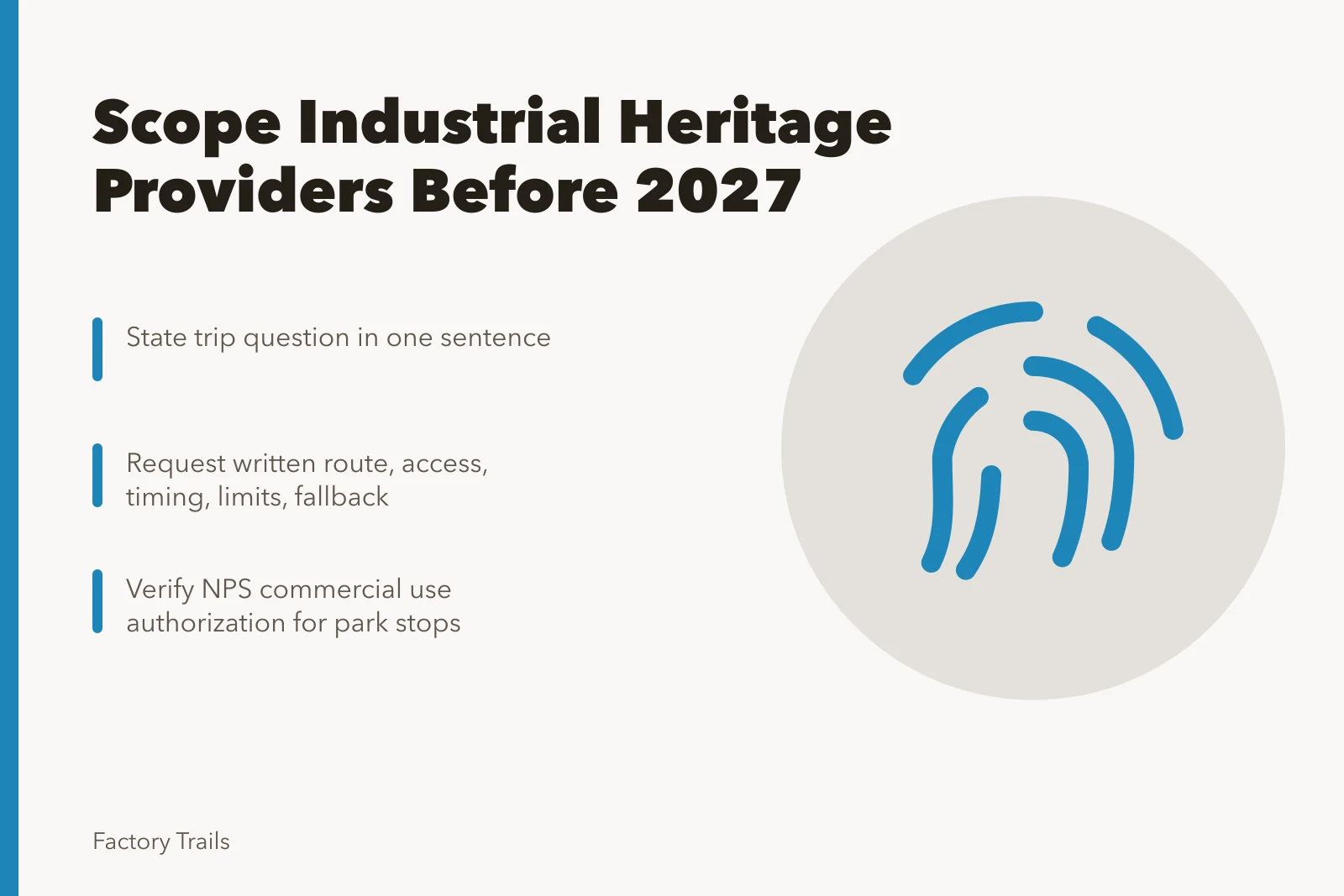
- State the trip question in one sentence.
- Name the public locations, dates, and group needs.
- Identify whether you need research, interpretation, transport, or coordination.
- List what the provider must not promise, including unconfirmed access.
The National Park Service Independence commercial authorization page explains that commercial tour services on park property may require a Commercial Use Authorization and that its online system handles opportunities, applications, reports, and fees. Use the managing organization's live terms to check a provider's planned activity. A general claim of experience does not establish authority for a particular place.
Define the Job
- State trip question in one sentence
- Name public locations, dates, group needs
- Identify research, interpretation, transport, coordination
- List what provider must not promise
- Check current responsible site terms
Steamtown National Historic Site charges no general admission, but its heritage train excursions require a ticket and often advance reservation.
Application fees for a Commercial Use Authorization are typically $250 to $500 per park, and some parks add a percentage of gross receipts. Ask the provider for the park's current fee schedule and the application steps: create a CUA account, select the park opportunity, submit the application, pay the fee, and file the required report.
What the 2027 date means
No single national rule changes on one date in 2027 for industrial heritage travel. The deadline is the season you are buying. Settle four items before that season: the park's current authorization terms, the provider's insurance and report filings, the site's reservation window, and your own review date.
For a June 2027 trip, settle the written scope by September 2026 and recheck park terms 60 days before departure. Authorizations, insurance certificates, and reservation windows expire on separate cycles.
Compare the written scope
Check / Evidence to request
- Service
- A defined route, research deliverable, or transport role
- Access
- The managing organization's live rules for every stop
- Timing
- Meeting point, duration, and change notice
- Limits
- What is excluded and what cannot be promised
- Fallback
- A public alternative that preserves the trip question
Public access details should come from the managing organization, not from a general experience claim. The National Park Service visitor conditions guidance shows why operating terms must be reviewed separately from historical context. A provider should state what it can arrange and what the visitor must confirm directly.
Keep the written scope, source, date, and correction note together. The National Archives outlines basic records-management concepts. That record lets an editor distinguish a provider promise from a supported public fact.
The National Park Service Museum Handbook supports careful use of collection information. An artifact or image record does not establish a current provider service, entry right, or public program.
Red flags to remove
- No direct answer about public entry or current rules
- A promise to enter or photograph a place without evidence
- A route based on private, residential, or working land
- A quoted total without written inclusions and exclusions
- A ranking request that lacks transparent editorial criteria
Save a decision note
Record the candidate, scope, sources checked, review date, decision, and reason. This protects both the traveler and a future editor. It also lets you correct a stale recommendation without reconstructing the original conversation.
Field / Fill in
- Candidate
- Service promised
- Access source and date
- Exclusions and fallback
- Review date
- Decision and reason
Turn the scope into a decision tool
Example: a 12-person group wants to trace a historic textile mill in Lowell, Massachusetts on June 12, 2027. The written scope names a two-hour walking route on public streets, a one-page source note, and a meeting point. It excludes entry into locked mill buildings, archive access, and any promise of photography permission.
The fallback is the Boott Cotton Mills Museum, which requires a ticket and current operating hours. The decision note records the route, the park's live terms, the review date, and the reason. If the provider cannot show the park's terms, the fallback becomes the decision.
For the same Lowell brief, Candidate A offers a walking route and source note but no transport. Candidate B offers a van and general history but no park terms. Candidate A wins because the written work matches the trip question.
Common questions
What is the most important item in the scope?
The precise service and the limits around it. This prevents a provider's historical knowledge from being mistaken for a promise of access.
Should a publication list providers by default?
No. Use clear criteria and current evidence before publishing any provider-specific recommendation.
Why include a fallback?
It gives the group a responsible option when a live condition changes.