Guides
How to keep working factory visit cost planning records clear for 2027
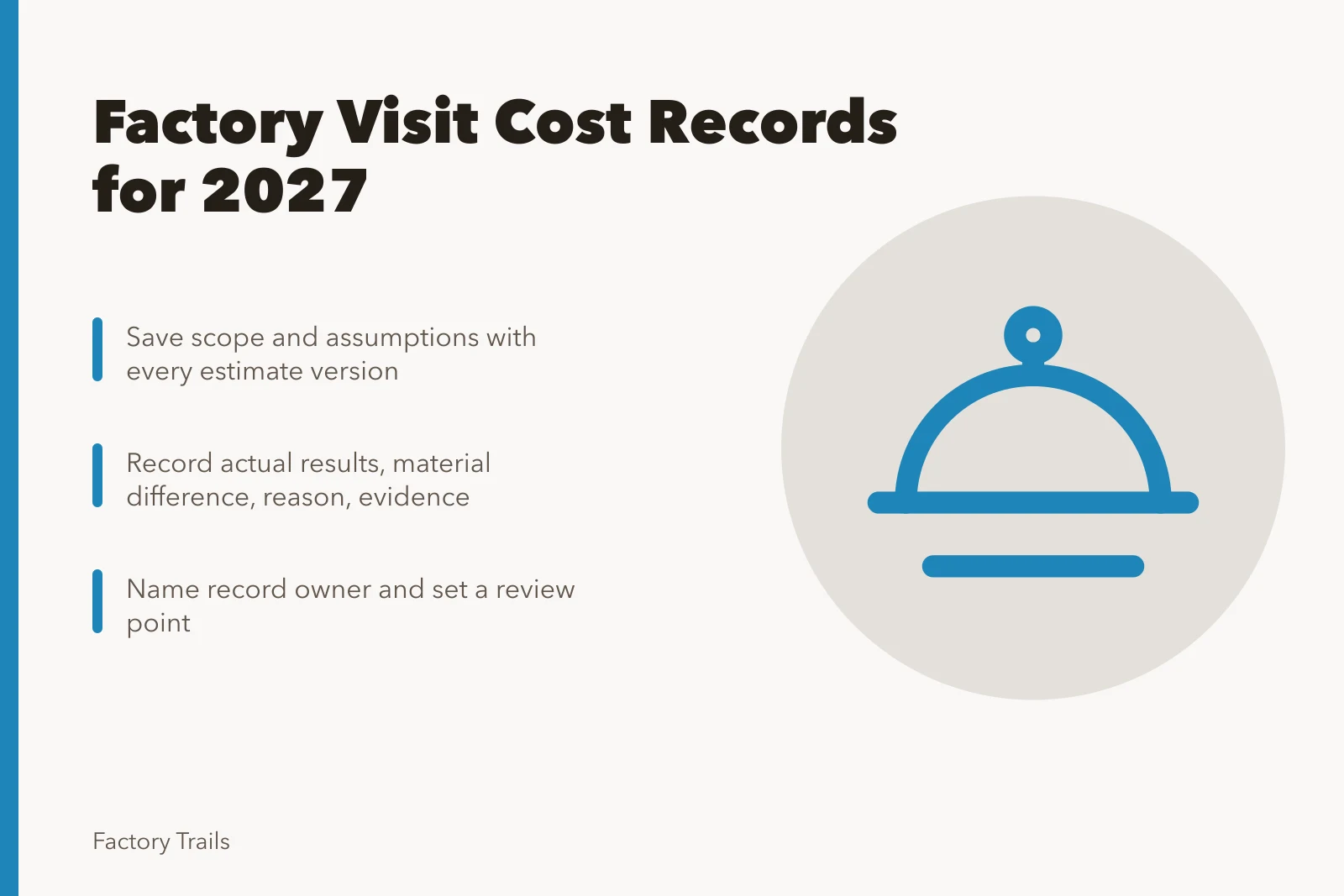
Factory visit cost records for 2027 help U.S. teams preserve estimate scope, assumptions, actual session results, updates, and decision approvals for later review.
Cost records let a team explain a visitor-program estimate long after the planner who built it has moved on. Set the file up once, in a fixed order, and 2027 stays readable all year.
What to take away
- Build the 2027 file around five recordsestimate brief, assumption list, cost worksheet, actuals note and decision log.
- Name one program owner and one review point before the first booking of the year.
- Write each change as a dated entry and keep the prior version instead of overwriting it.
- Follow the operator's retention schedule. A common working rule is the current version plus one prior version.
- Keep controlled facility, safety and security records out of the visitor-program file.
The five records a 2027 cost file needs
Each record answers one question a reviewer will ask. The set is deliberately small.
Record / What it shows
- Estimate brief
- Purpose, program format, time period, named owner
- Assumption list
- Group cap, session count, route status, staffing basis
- Cost worksheet
- Categories, source data, exclusions, calculation date
- Actuals note
- Material difference, reason, evidence available
- Decision log
- Approval, changed assumption, follow-up owner, date
Give every version the same running order: scope, assumptions, cost lines, source notes, approvals, actuals and changes. A reviewer then spots a missing item without comparing pages line by line. If the cost lines still need shaping, the 2027 scope checklist shows what belongs in version one.
Core cost record set
- Estimate briefpurpose, format, period, owner
- Assumption listgroup cap, sessions, route, staffing
- Cost worksheetcategories, sources, exclusions, date
- Actuals notematerial difference, reason, evidence
- Decision logapproval, changed assumption, owner, date
A 2027 planning and review calendar
A workable sequence for a U.S. visit program looks like this.
- Januaryconfirm the program owner, the format and the group caps for the year, then open version 1 of the estimate brief.
- Before each booking windowre-check route status and the staffing basis, then re-date the assumption list.
- Within a week of every session, write the actuals note while the numbers are still traceable.
- End of each season, or after any material changereview the file with the approving roles and log the decision.
- Fourth quarterclose the year's versions and carry the opening assumptions into 2028.
A file opened for the first time in December is a reconstruction, not a record. Teams that fix their own review dates in January avoid that.
Example: a brief header and a change entry
A filled entry is easier to copy than a description. These two lines come from the same pilot program.
Estimate brief, version 3, dated 12 March 2027. Format: 90-minute guided walking route, three sessions per day. Group cap: 12. Owner: visitor-program coordinator. Assumption: two hosts per session, drawn from existing staff.
Change entry, 4 April 2027: group cap lowered from 15 to 12 after host review. Session staffing estimate unchanged. Recorded by program owner, confirmed by operations lead. Affects version 3.
The change entry replaces the email thread that produced it. A later reader gets the cause and the confirming role without the back-and-forth. Timing errors tend to surface in the actuals note first, so the list of recurring visit mistakes is worth a look before any reschedule.
Who owns the record and who reviews it
The National Archives records-management profile describes assigning responsibilities for records and information. Apply that by naming the person who maintains the estimate record and the roles that confirm the conditions beneath it.
The program owner keeps the working file. That role takes no authority over a route, staffing, safety or security decision.
GAO's cost-estimate practices summary describes documenting an estimate so a person unfamiliar with it can update or recreate it. That is the test for the version history. If a new owner cannot rebuild the current number from the file, something is missing.
Retention: how long prior versions stay
The National Archives scheduling guidance explains that records schedules give disposition instructions rather than one universal period. Follow your operator's schedule.
Where no schedule applies, many operators keep the current version plus one prior version, and hold the decision log for the life of the program. Treat that as a working example, not a rule. The version that explains the active budget decision should stay retrievable.
What stays out of the file
Controlled facility drawings, employee records, safety incident reports and security procedures belong to other systems. If a figure from one of them shaped a cost line, cite the source and the date instead of copying the document.
When a change is really a capacity shift, the capacity and cost map notes show how session counts move through the worksheet.