Guides
Part of Factory tours in 2027: what to confirm before you plan a visit
Factory tour records: what owners must keep before a 2027 visit
Factory tour records guide for 2027 helps U.S. publishers track current access, source limits, photo credit, observation dates, and corrections.
What to take away
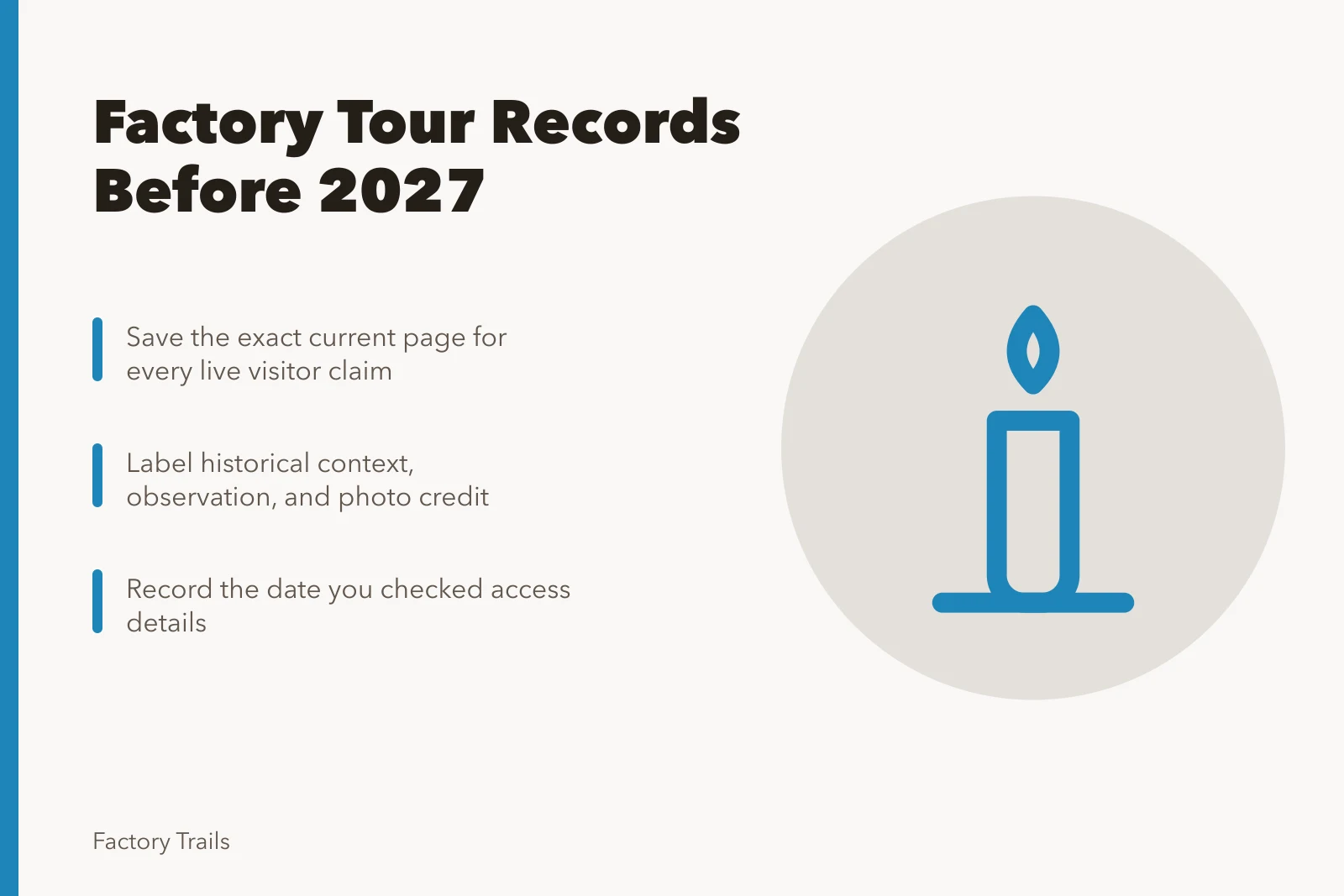
- Keep one record for every claim a reader can act onthe page that supports it, the quoted line, the source role, the review date, and the limit.
- Store the record beside the article file. Email threads and personal notes lose the trail.
- Prepare it before the 2027 season opens. Operators publish tour calendars and booking windows months ahead.
- Ask a business that wants a correction for the responsible page, then log the change.
Why 2027 sets the deadline
Operators publish next-season tour calendars, prices and booking rules before the season starts. A 2027 visit gets planned and written about during 2026.
An empty record forces you to rebuild every claim from memory while reservations open. That is slower work, and the errors are harder to spot.
Budget the rebuild with the factory tour budget checklist for 2027, which sets out what belongs in the scope before the season opens.
The seven fields every record needs
These seven fields are the minimum an owner should keep for each tour claim.
Tour record fields
- Public claimtour time, entry, reservation, safety
- Sourcespecific responsible page that supports it
- Scopecurrent access, historical interpretation, media credit
- Review datewhen live information was checked
- Observationwhat was seen on a specific date
- Limitwhat the source does not prove
- Correctionsource supplied and resulting revision
| Field | What it holds | Where it comes from |
|---|---|---|
| Claim | The exact sentence a reader acts on | Your draft |
| Source | The specific page, not the whole site | Operator or agency page |
| Role | Live access, historical context, safety rule, or media credit | Your own note |
| Quoted line | The sentence that supports the claim | The source page |
| Review date | The day you opened the page | Your calendar |
| Limit | What the source does not prove | The gap you accept |
| Status | Confirmed, needs review, corrected, or removed | Your update log |
The limit field carries the most weight. A page that describes a tour in general terms does not confirm today's times, fees or booking rules. Write that gap down while the details are fresh.
Example: a record for a booked underground tour
Start with a site where booking controls the visit. The Britannia Mine Museum entry describes a guided underground tour and points to booking details.
That entry is background, not a live booking page. The record keeps the two apart.
Claim: guided underground tours run at the museum. Source: https://en.wikipedia.org/wiki/Britannia_Mine_Museum Role: background and tour description. Checked: the date you open the page. Limit: no current times, prices or booking rules. Status: needs review. Next step: confirm on the museum's own booking page before republishing.
Replace the checked line with a real date every time you look. Booking steps for this site sit in how to book a Britannia Mine Museum underground tour in BC, which is worth reading before you promise a reader a place on a tour.
Match each claim to the right source type
A live schedule, price or booking rule needs an operator page. The Royal Canadian Mint tours page treats the Winnipeg production facility tour and the Ottawa boutique as separate offers. A claim about a production line belongs there, not on a brand history.
A history page explains why a mill mattered. It cannot confirm that the mill runs tours today. The Lowell history pages cover a textile past, while the park's own visit page is what proves current hours.
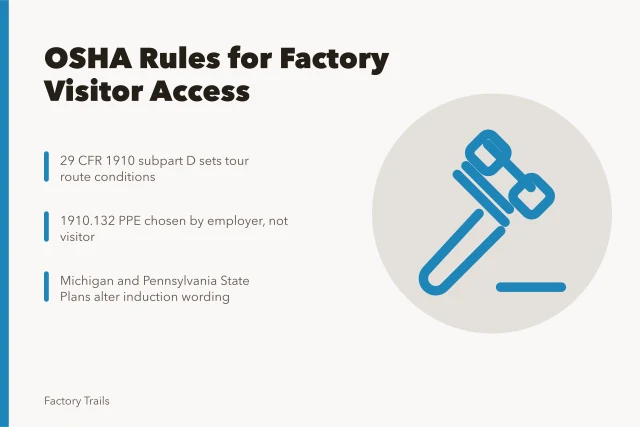
Safety statements need the standard itself. A line about eye protection should point to OSHA 1910.133; general protective equipment duties sit in OSHA 1910.132.
Regional claim sets grow fast. The guide to Alabama industrial heritage sites beyond Sloss Furnaces shows how much context one record folder has to hold.
Update the record before you republish
- Open the record beside the draft.
- Open each source page and compare it with the quoted line.
- Rewrite the sentence only to match what the page now says.
- Replace a dead link with a page supporting the same claim, or cut the sentence.
- Set the status and the new review date.
A correction request follows the same path. Ask the business for the page that carries the disputed fact. If that page supports the change, edit the sentence and note the date. Paid placement gets a separate label.
Do not keep a well-written sentence that no source backs. Continuity is not worth an unsupported claim about access, hours or safety.
The working factory visit mistakes list for 2027 covers the mistakes that follow a missing record, which is the pattern to avoid on any site you plan to visit.